
GODDESS BLOG

Finding Mary Magdalene
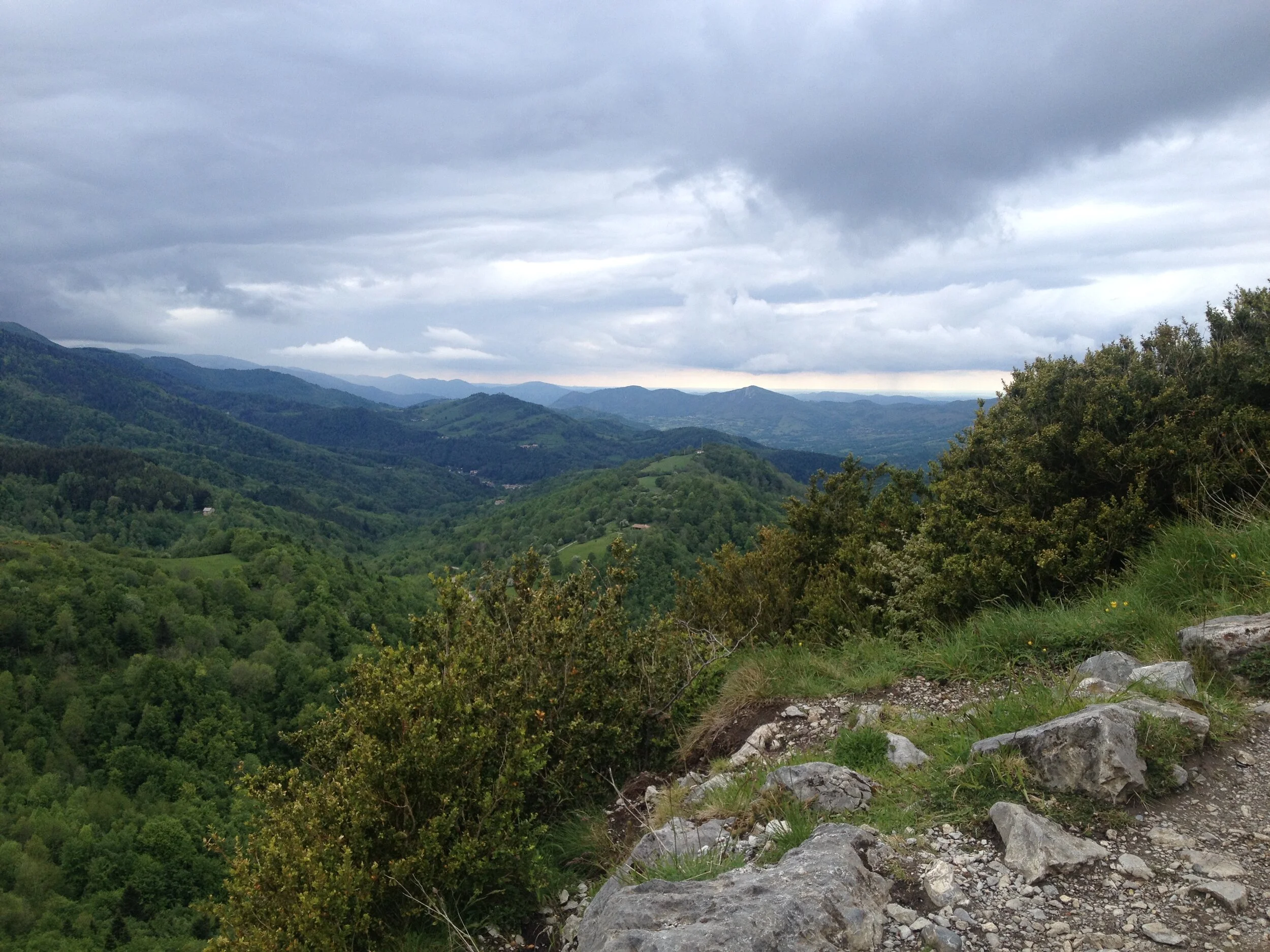
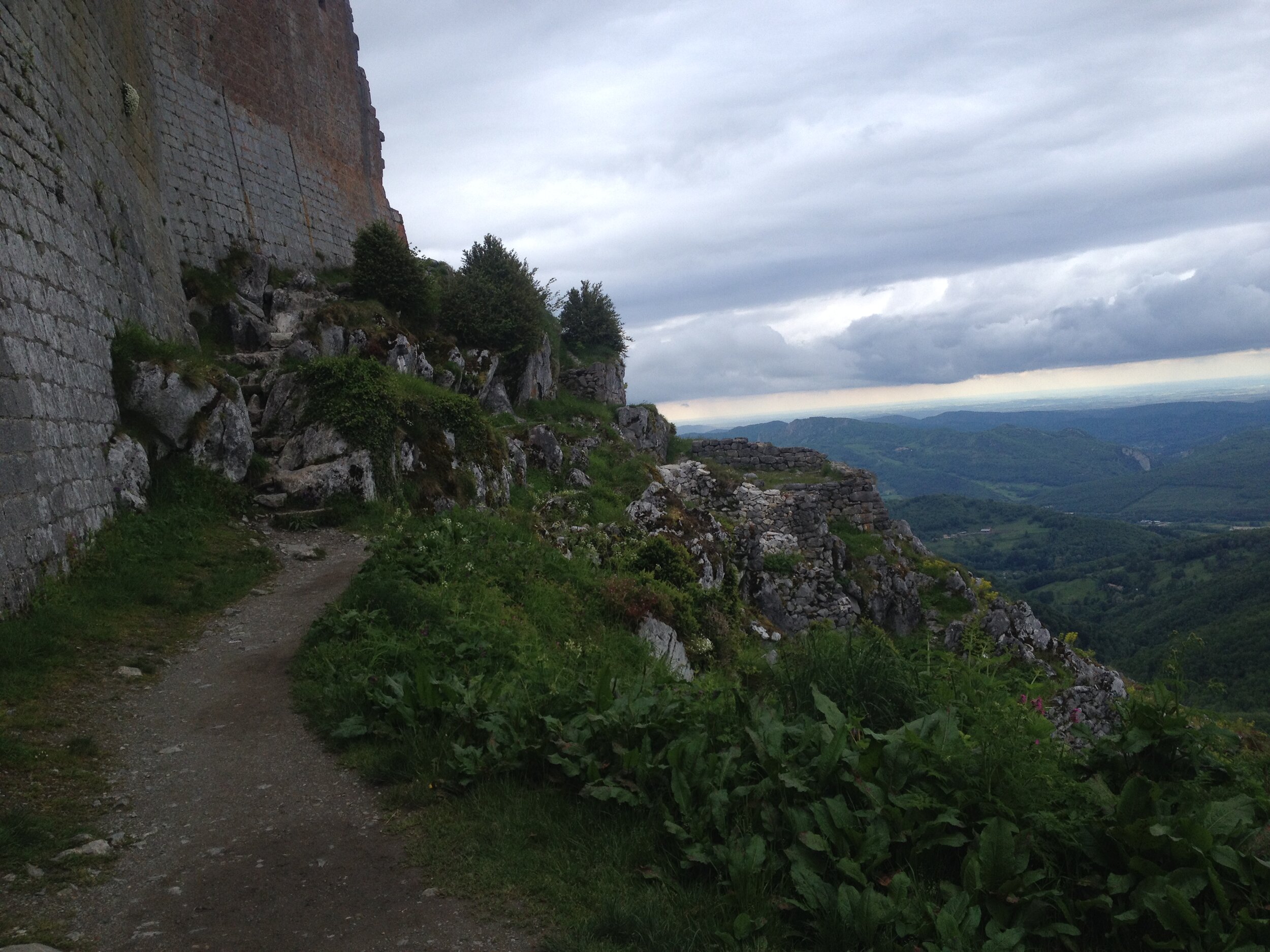
Seeing the fortress high above me, I parked my car and prepared myself for the ascent. The path was rocky and steep, but I felt encouraged by fellow pilgrims. Along the route I could hear the melodic ringing of cow bells, dangling from the necks of cows, far off in the distance. As I approached the summit I turned to look out among the sea of mountain peaks, and was rendered nearly speechless. “This must be what Heaven looks like,” I whispered. For as far as the eye could see, were voluptuous green mountain peaks, extending outward past Spain, and reaching what I imagined to be, the Atlantic Ocean . . .
FINDING MARY MAGDALENE BLOG SERIES.
“Languedoc Part 3: Finding Mary Magdalene”
Originally Published: June 19th, 2014
Coming off my “angelic high” from the previous day’s journey to Alet-les-Bains, I awoke and prepared for another driving adventure in France. You may remember that I had previously mentioned the terror I experienced at the mere thought of driving in France. When the time finally came, the only “challenge” I had was finding a gas station among the bountiful vineyards. My second driving experience, however, was not as charming.
I took a shuttle bus to the Carcassonne airport only to discover the car rental place was not actually located at the airport; and to make matters worse, it required me take a taxi to the rental office. Crisis averted, I got the car, set my GPS in English mode, and took off for the nearest gas station. There was, however, a minor problem. The station had no gas attendant on duty to take my cash, and because my American credit cards lack a “chip,” the French card machine would not take them.
So, off I went in search of a mega gas station. Again, I encountered the same problem. I kindly asked another driver what was going on and he informed me that because it was a national holiday in France, the gas attendant would not be on duty.
Well! That would surely pose a problem with just a quarter tank of gas and several sites to visit.
I drove back to the agency and explained my dilemma, of which he could offer me no solution, but ensured me there would be a station along the way in Limoux.
Off I went. By the seventh try, I was desperate. I sat at the pump wondering what to do. Then, as if by divine intervention, an attractive man with shoulder length curly hair, pulled up in a vehicle I would certainly label a “hippie van.” He must have sensed I have a thing for the gypsy type! I realized this was my chance. As he was pumping gas, I casually got out of my car, and approached him. Turning on the charm, I smiled and asked if he spoke English. “No,” he said, fainning apology. “Okay, no problem,” I mumbled to myself, “I’ll try in French.” So off I went about my “grand problème,” and he got it! Not only did he get it, but he offered to put the gas on his credit card in exchange for my cash!
Emergency averted, I took off for the destination du jour, Rennes-le-Chateau. To my amazement, and slight embarrasment, the very next gas station I passed had an attendant on duty. Obviously, there was an important lesson I needed to learn regarding flirting and French men.
International fame hit Rennes-le-Chateau with Dan Brown’s Da Vinci Code. However, decades before, the tiny town had become notorious for the scandalous parish priest, François Bérenger Saunière. Supposedly, he had discovered a hidden treasure on its grounds. Some say it was actual golden treasure, while others believed it was the remains of Mary Magdalene. Further more, Saunière was said to hold secret information about Jesus and Mary Magdalene.
After several winding turns, I arrived at the little mountaintop village of Rennes-le-Chateau. I walked through the quiet streets toward the abbey, stopping at a gift shop along the route. Decked with books and jewelry and music - pretty much all things spiritual - I had the sneaking feeling that something quite unspiritual was brewing.
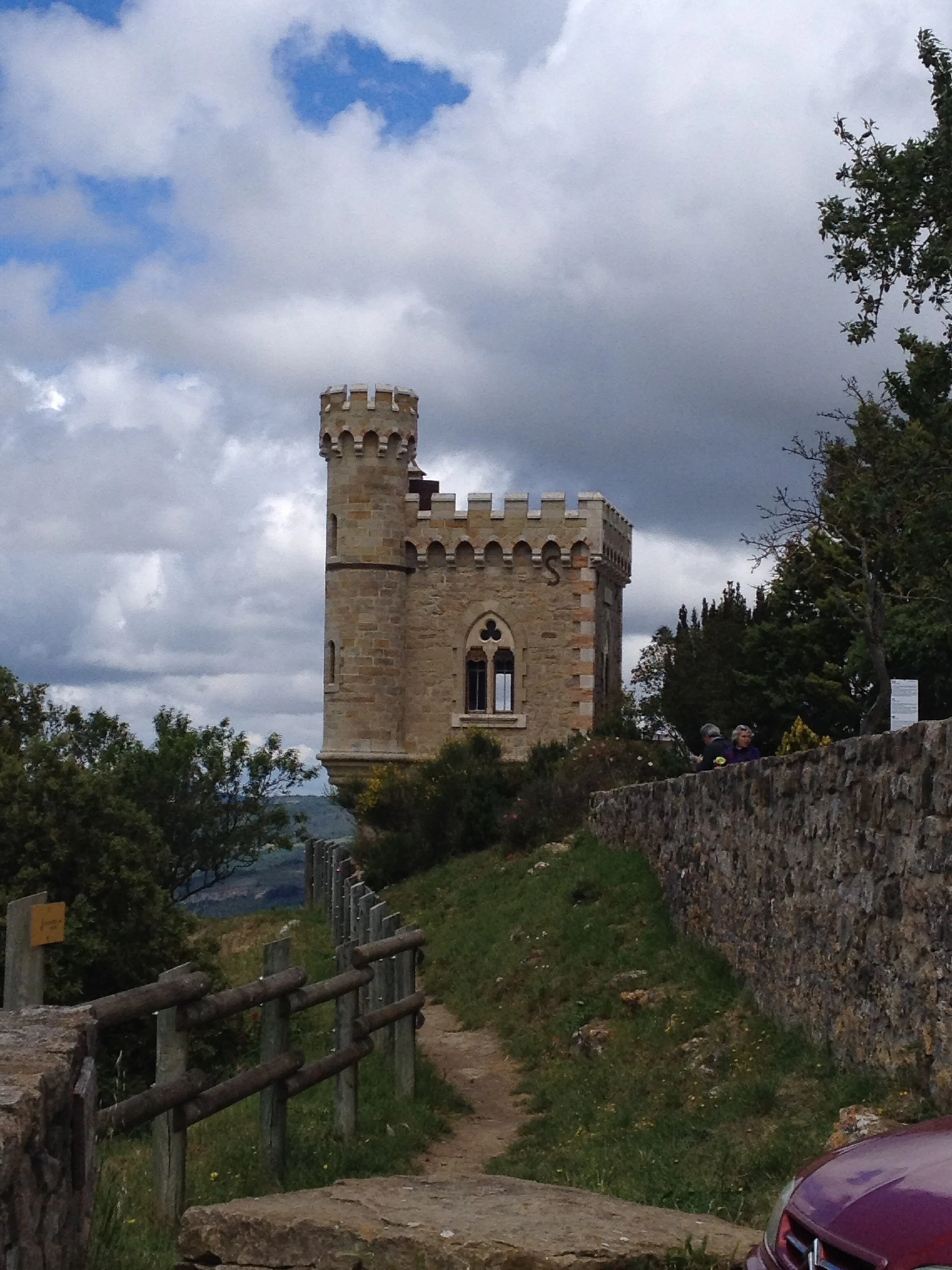
Somehow, I ended up buying a ticket for the museum, which was a conspiracy theorist’s dream. The museum gift shop even sold Rennes-le-Chateau wine, bearing Saunière’s face. Despite the lack of depth, I did find delight in the Magdal Tower, built on church grounds by Saunière.
According to Margaret Starbird, Magdal (from Magdala) means “The Tower” in Hebrew. She contends that the town of Magdala did not exist during the lifetime of Jesus and Mary, so it is more plausible that Magdala (Magdalene) was not Mary Magdalene’s given name. For Starbird, this suggests that Magdala was a name given to Mary Magdalene to denote her strength and wisdom within the community of Jesus and his followers, eventually earning her the title of “Apostle to the Apostles.”
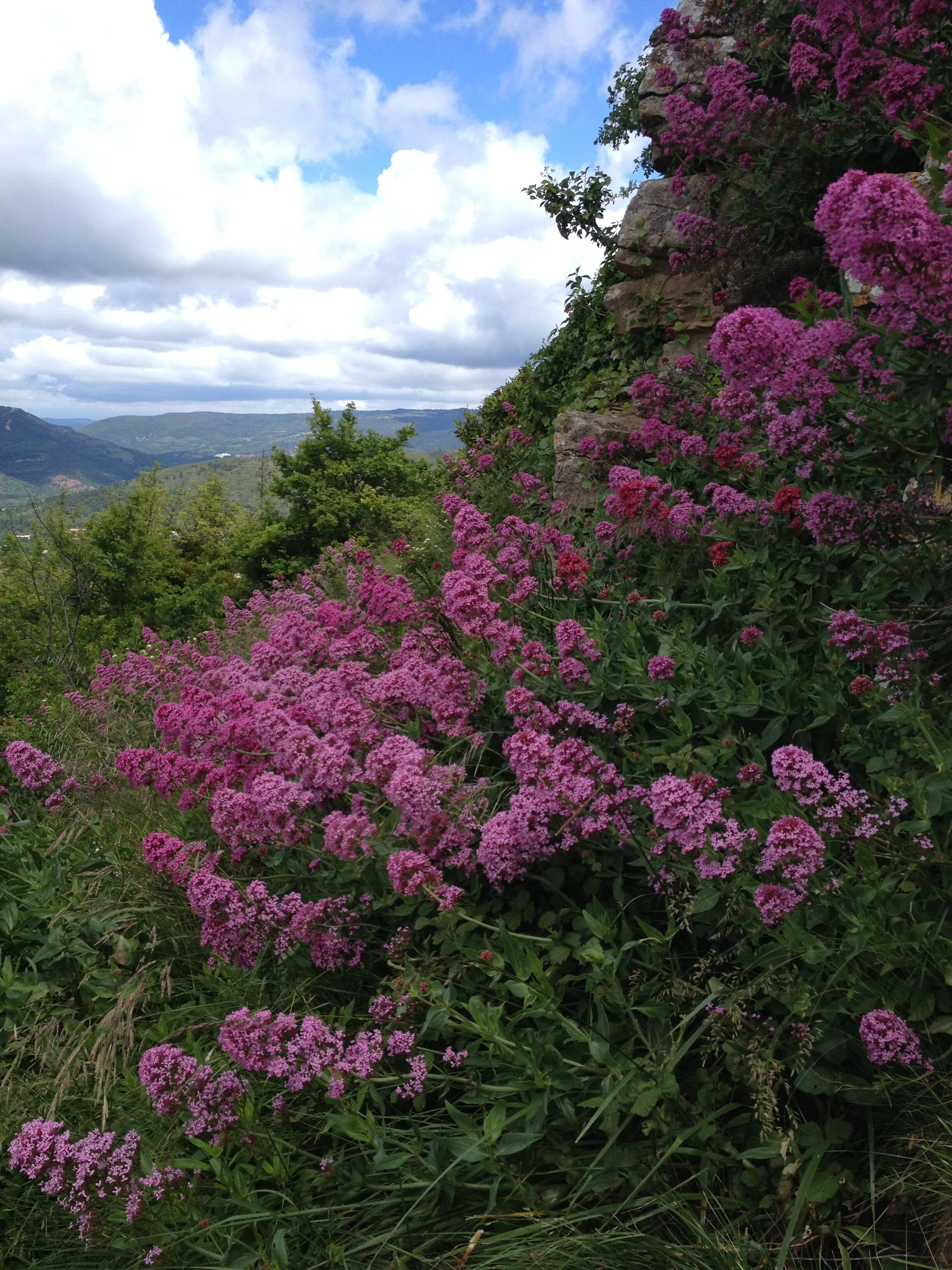
The church of Rennes-le-Chateau was tiny and darkly lit. I knew in my heart that the spirit of Mary was not there; the energy had become more about the drama and intrigue of the Saunière story and less about her story. Mid-meditation, a camera crew entered the small church, filming a very important person, and his entourage. Images of Mary Magdalene were numerous, yet I found myself annoyed by the “scene” of Rennes-le-Chateau, and quickly left for solitude just outside the town walls. The surrounding grounds were beautiful and lush, and despite my overall misgivings, I feel there may lay a secret of Mary hidden within the hills of Rennes-le-Chateau.
I eagerly left Rennes-le-Chateau, but first, made time to enjoy a fabulous lavender creme brûlée.
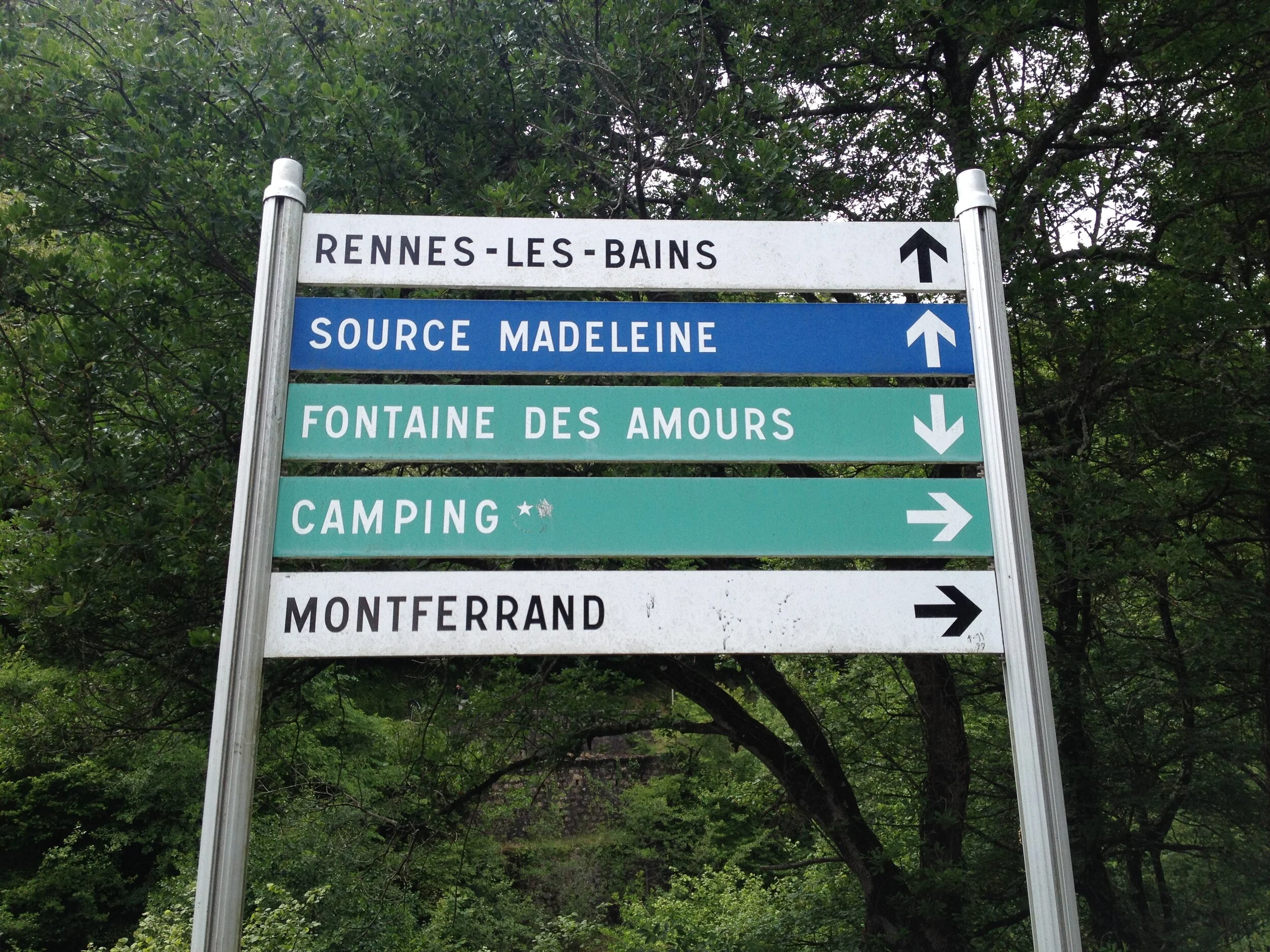
Next I drove to nearby spa town, Rennes-les-Bains. I was mesmerized by its beauty and vibrant energy. Hippies littered the streets. Inside I jumped for joy. Along the ancient pathways and the river of Rennes-les-Bains, one can find such glorious sites as the Seat of Isis, The Source Madeleine, and the Fountain of Lovers; where, legend has it, if you and your lover bathe naked in its waters, you’ll be lovers for all time.
Sadly, I was out of time. I left Rennes-les-Bains—promising to return soon—for Mt. Bugarach, a supposed former Essene community tucked away in the Pyrenees. I took a stroll through its empty ancient streets, admiring Mt. Bugarach, as it loomed over the city; a stoic protector of an ancient lineage forever in hiding from the ancient Roman Empire.
Severely behind schedule and over my allotted mileage, I decided to head to Montségur. To miss such a sight was not an option for me. Despite overwhelming car-sickness, I drove like the wind through the endlessly winding roads of the Pyrenees. After much anxiety and doubt that I would ever reach Montségur, my GPS informed me I was 5 kilometers from my destination. A heavy mist hung in the air, as I drove further into the heart of the Pyrenees and Cathar country.
I looked up and was overcome by the view of a fortress nestled high upon a mountain peak. “How stunning!” I exclaimed to myself. “How beautiful and majestic. But that CAN’T be Montségur. I only have 5 kilometers left…I’ll have to visit that site next time I’m in the region.” Ten minutes later, as I approached the town of Montségur, I realized that that fortress was indeed, Montségur.
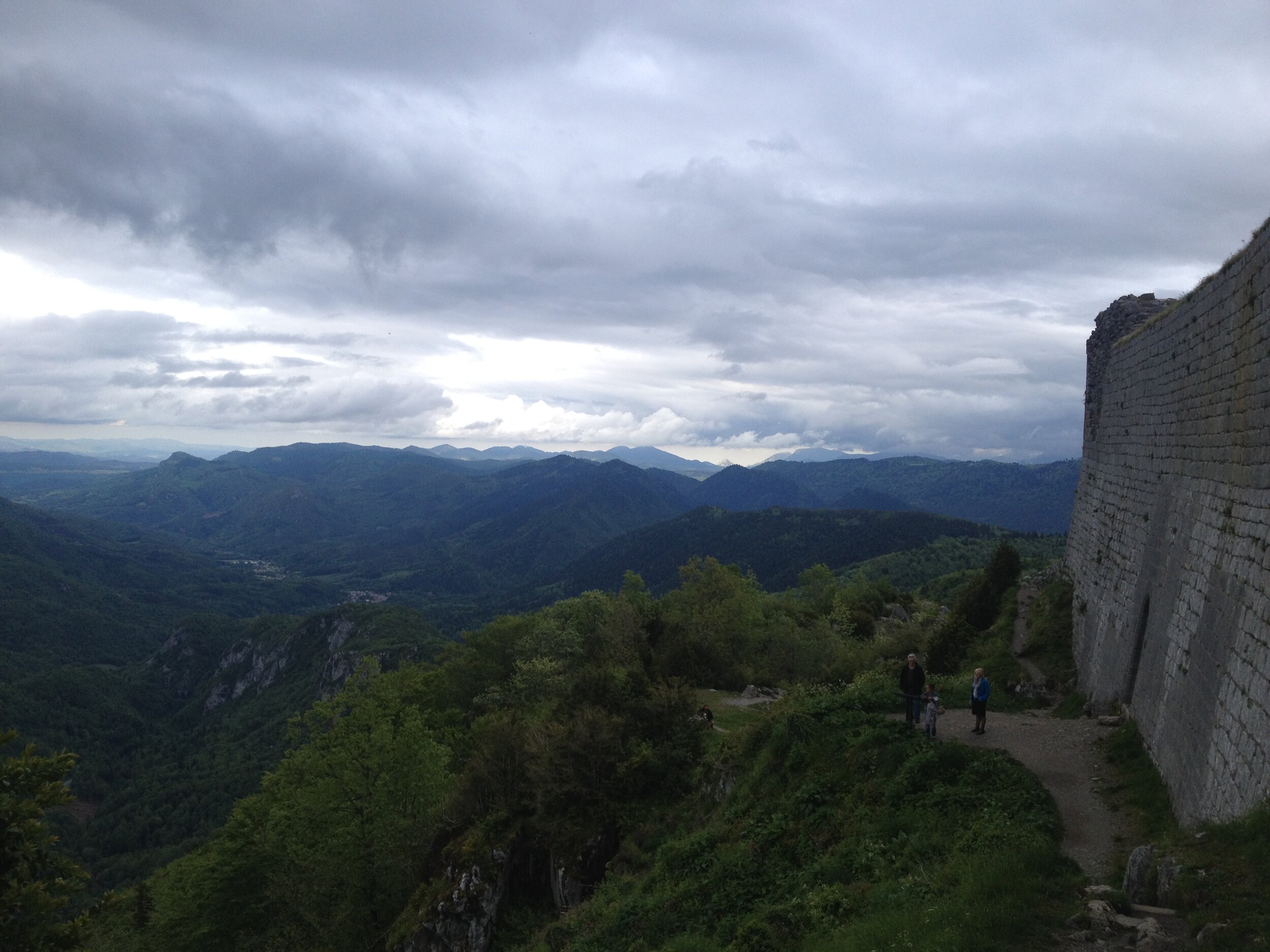
Seeing the fortress high above me, I parked my car and prepared myself for the ascent. The path was rocky and steep, but I felt encouraged by fellow pilgrims. Along the route I could hear the melodic ringing of bells, dangling from the necks of cows, far off in the distance. As I approached the summit I turned to look out among the sea of mountain peaks, and was rendered nearly speechless. “This must be what Heaven looks like,” I whispered. For as far as the eye could see, were voluptuous green mountain peaks, extending outward past Spain, and reaching what I imagined to be, the Atlantic Ocean.
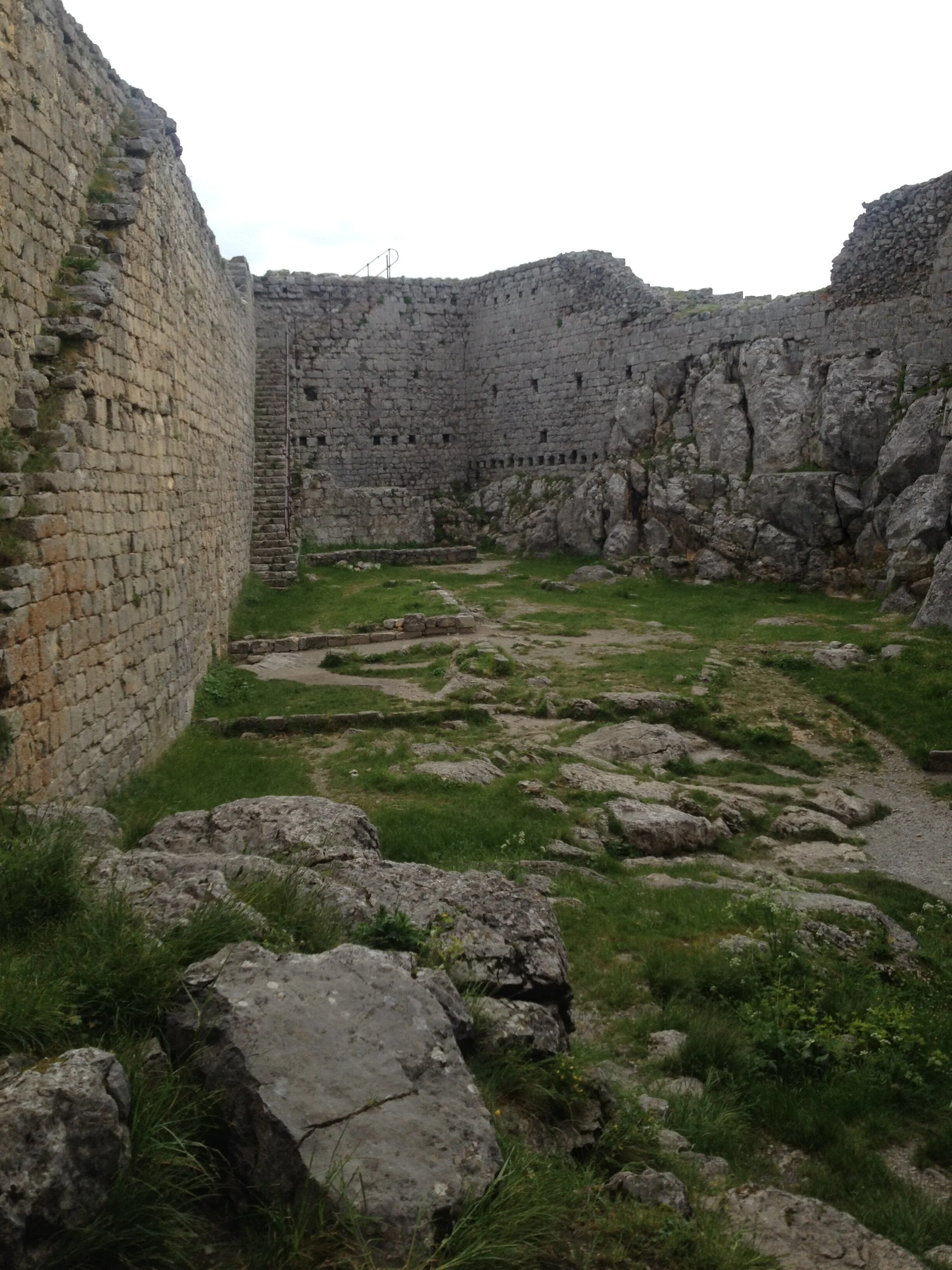
Face-to-face with the now abandoned majestic fortress of Montségur, I imagined life streaming in and out of it’s stone walls. I entered the fortress and a sudden stillness came over me, as if I were walking into someone’s intimate space. The inner walls of the fortress held the laughter of children. I could almost see them playing hide and seek. I realized there was a presence still lingering from the trauma of long ago.
Montségur gained notoriety for being the last stronghold of the Cathars in the face of the Crusades. History has mixed understanding of the Cathars, with the most commonly held belief that the Cathars were a serious acetic religion that believed the material world to be sinful, and therefore devoted all their attention and energy to the spiritual realm. In esoteric circles it is believed that the Cathars were actually the keepers of an original Gnostic Christianity. Their primary teacher, Mary Magdalene. And, depending on who you talk to, Jesus as well. The Cathar faith and belief held the knowledge of the Holy Grail, which was protected by the Knight Templar, and had connections to the activist medieval love poets, the Troubadours. To read Joseph Campbell’s exciting commentary on the Troubadours, click here:
https://journey-to-the-goddess.tumblr.com/post/86396881610/marriage-in-the-middle-agesas-in-most-of
The Church launched a full-out crusade against the Cathars and region of Languedoc. They slaughtered and burned them, until only those of Montségur were left. After a year siege, the water supply within the high fortress of Montségur failed, leaving the Cathars with no choice but to surrender. The Church, feeling “generous,” gave the Cathars the option to convert to Catholicism and be saved, or be burned at the stake. After a 15 days truce, it was over. All 200 Cathars - men, women, and children - calmly walked down the mountain and into the burning pyres. And that was, essentially, the end of the Cathars. Some believe a few escaped and kept the knowledge alive. Still others say those who escaped kept the royal bloodline of Mary and Jesus alive.
Upon my descent, I looked out at the endless horizon and wondered what it was like for the Cathars, in the face of certain death, to see this view for the last time. So I chose to honor the Cathars the only way I knew how: by infusing each step I took down the mountain with honor and dignity, for a people willing to die for their beliefs.
My drive home was full of emotion. The mystique of the Pyrenees faded into perfectly manicured rolling vineyards, and country houses made of stone.
I returned my car without problem and made my way back to Carcassonne. Suddenly, I realized my pilgrimage was officially over. I smiled as I reflected on the months of planning and hard work it took to prepare for this pilgrimage, that resulted in a life changing two week adventure. The icing on the cake? On the following day I would be turning 31 in my new favorite French city, Arles.
~~~~~~~~~~~~~~~~~~~~~~~~~~~~~~~~~~~~~~~~~~~~~~~~~~~~~~~
My heart bursting with love, I traveled from Arles to Nice and from Nice down into Italy. An open invitation awaited me in Ischia. Tears fell from my face as I crossed over the French border into Italy. For this self-proclaimed Italophile, something new was blooming inside, something unexpected: a yearning to return to the southern region of France, where Mary Magdalene is honored and revered as a woman of courage, devotion, and passionate love. Her name and reputation have been dirtied for nearly 2,000 years, as a way to manipulate and control people. One result, women have been placed secondary to men. This, as history is our witness, is a great disservice to women and men alike.
Although back in the states, my quest for Mary Magdalene has only just begun. Many others have come before me, and surely there will be plenty to follow. To France and back, my search for Mary Magdalene has led me back to me. My journey is her journey, and from this place of wisdom, I am truly finding myself.
The Angel Sanctuary of Alet-les-Bains
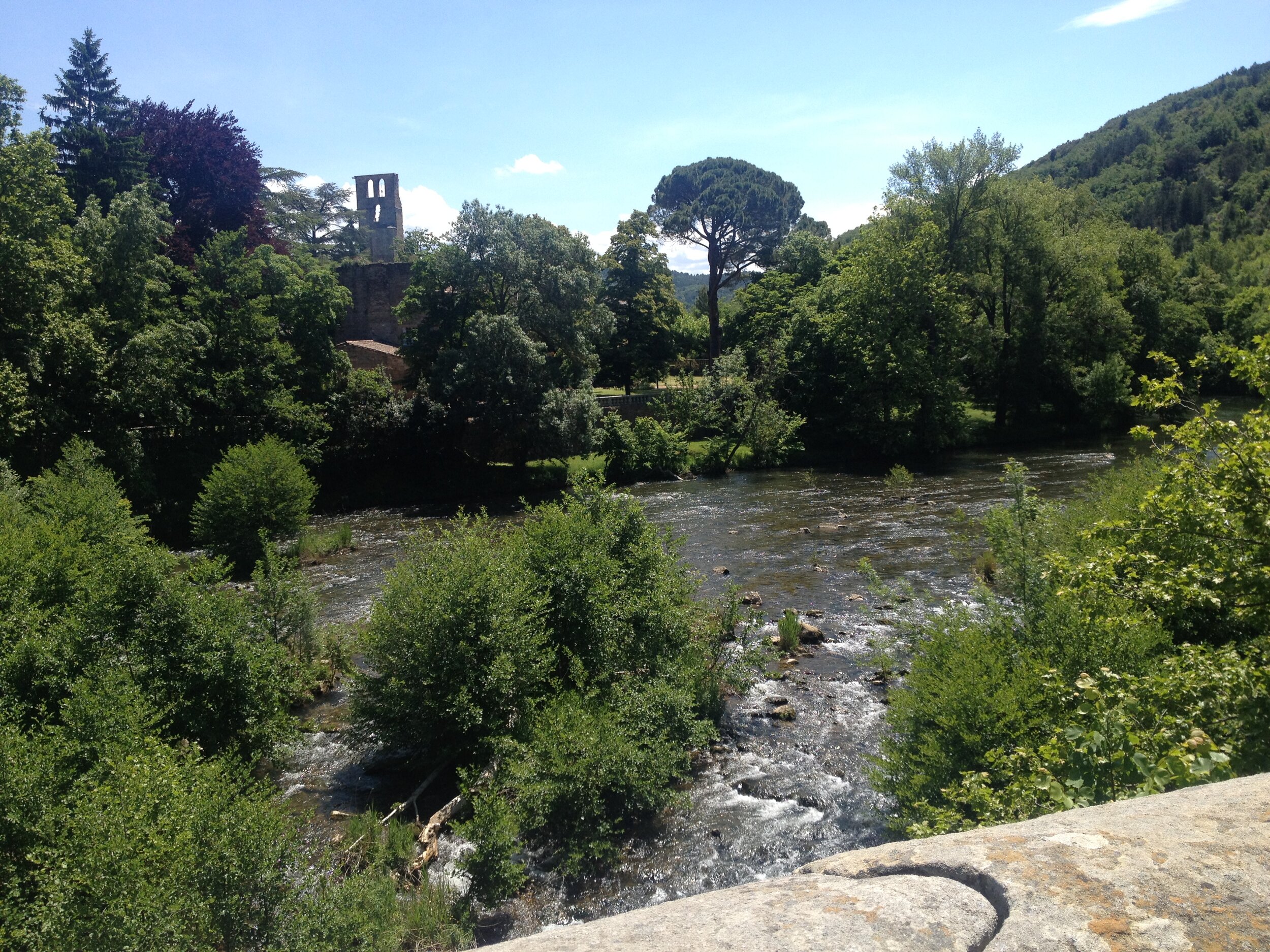
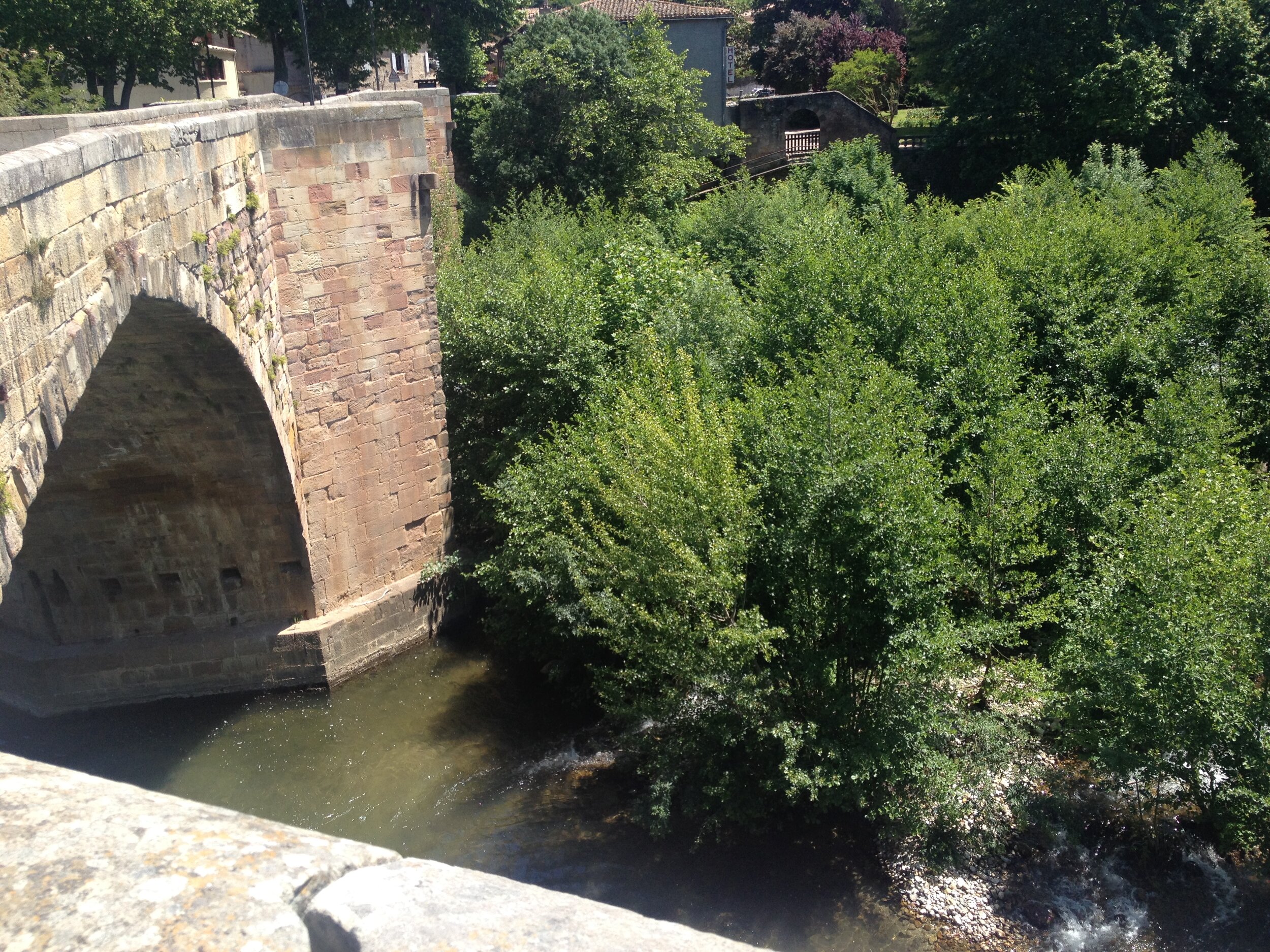
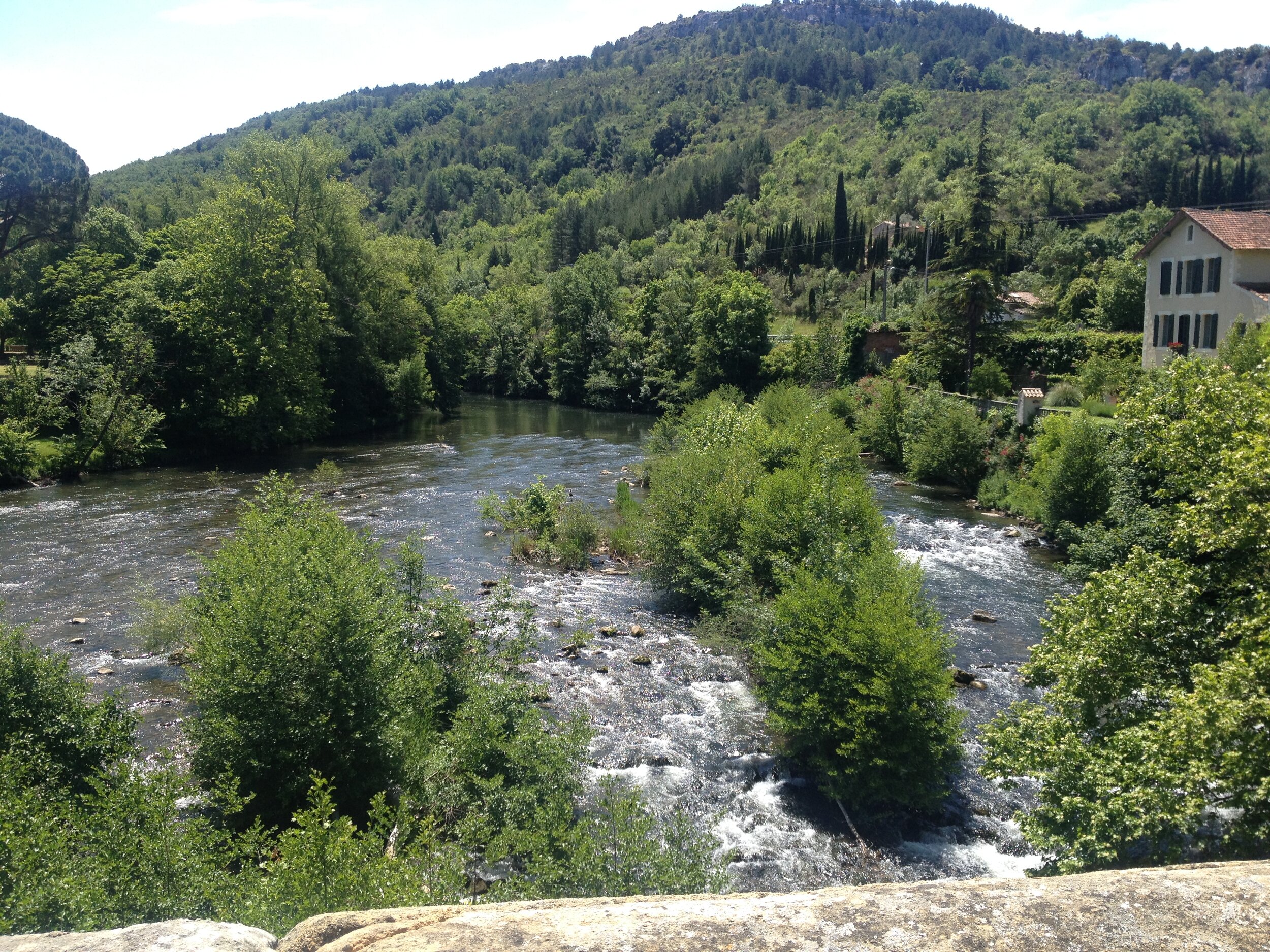
Enchanted by its picturesque perfection, I crossed over the ancient stone bridge that stood high above the swift-moving waters below. I made my way to an “island” between the town and the main road where I ate my picnic lunch. Meandering down to the river, I ran my hand along its waters, ceremoniously dipping my feet in its fresh stream . . .
On day two, I awoke with anticipation for the day’s events. My plan: to rent a car and drive to the famous Mary Magdalene pilgrim site, Rennes-le-Chateau.
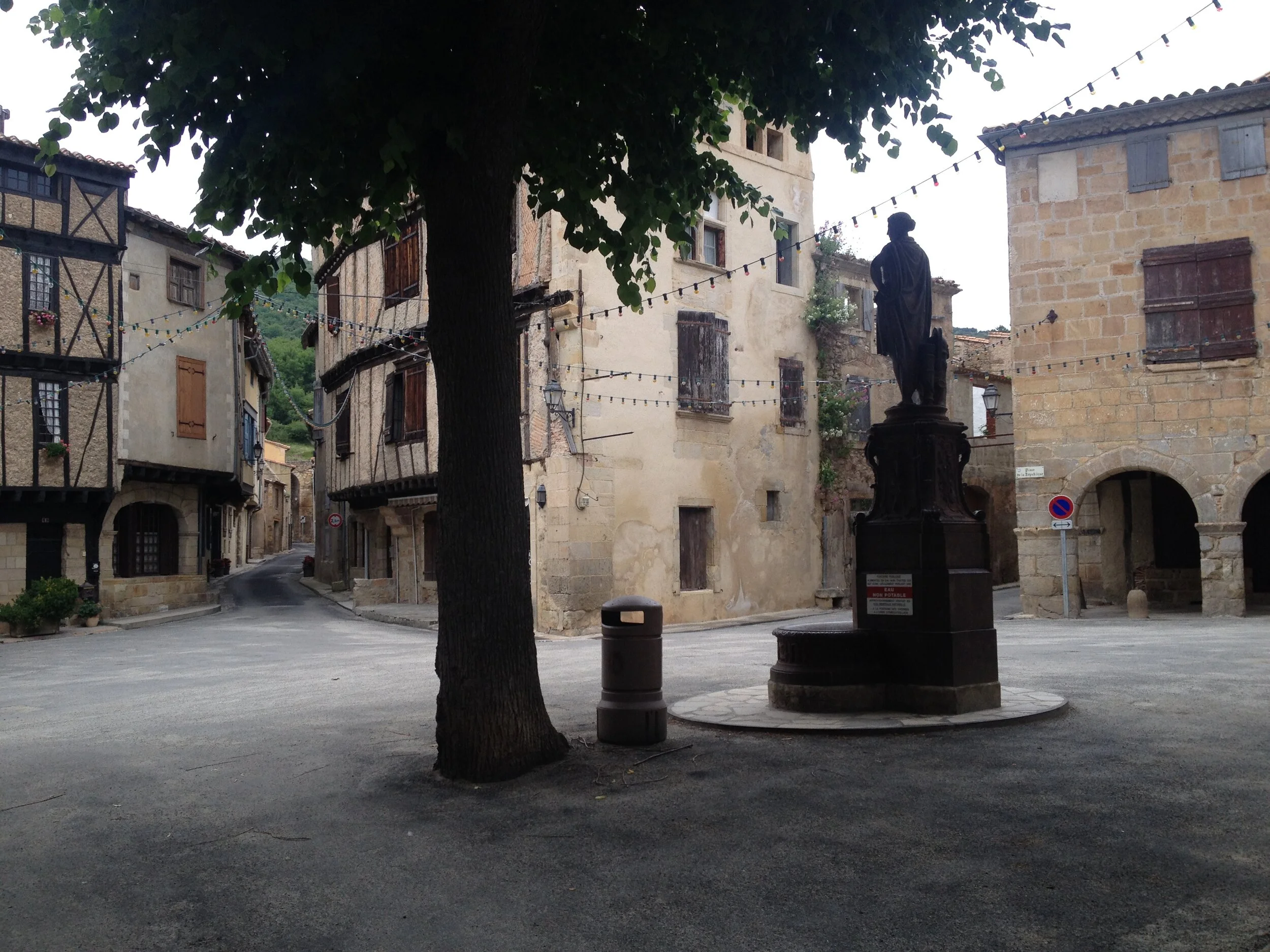
Well, that didn’t happen. I couldn’t get a car, so decided to postpone the trip for the following day. Annoyed, but not defeated, I decided to take a day trip by bus to nearby town, Alet-les-Bains. After much difficulty trying to figure out how to get there, how to buy the bus ticket, and where to catch the bus, I finally arrived in the peaceful hamlet of Alet-les-Bains. Reminiscent of a village straight out of Grimms’ fairytales, Alet-les-Bains lay at the foot of the Pyrenees. For centuries, it has been a destination for its natural springs and healing waters, perfect for the skin and digestion. Excellent! Who couldn’t use some special healing water after seven years living in NYC.
Enchanted by its picturesque perfection, I crossed over the ancient stone bridge that stood high above the swift-moving waters below. I made my way to an “island” between the town and the main road where I ate my picnic lunch. Meandering down to the river, I ran my hand along its waters, ceremoniously dipping my feet in its fresh stream.
Happiness filled my heart. I crossed the little pedestrian path back into town and came face-to-face with The Angel Sanctuary. Curious to see the sign written in English, I wondered what could be beyond the gates. Cautiously, I walked through the garden of The Angel Sanctuary and up the steps. As I looked around for where to go next, I noticed a few people sitting in chairs while sipping tea and coffee.
I walked through a non-descript door into The Angel Sanctuary, and was welcomed by a variety of colorful paintings and an Irishman named Eugene. Suddenly, I felt as if I had come home, fully at ease and welcomed in this serene space. Eugene and I spoke for some time about The Angel Sanctuary: How it came to be and why he and his companion, Lorrie, were there. The Angel Sanctuary was at one time a natural spring and spa. Cultivated by the Romans centuries ago, the spring had been used to remedy many physical conditions.
Lorrie and Eugene had come on vacation to Alet-les-Bains seven years ago and never left. They took over the spring grounds, which had stopped functioning as a spa a few years prior, and transformed it into The Angel Sanctuary, home to Lorrie’s visionary paintings.
Overcome with emotion, I began to cry as I told Eugene why I was in France, and what a miracle it was that I had serendipitously showed up on their doorstep. As some as you know, I don’t believe in coincidence, especially in a case, such as this.
Eugene encouraged me to step next door so I could experience the heart and soul of The Angel Sanctuary. Once next door, Eugene pointed to a tiny enclosed space at the center of the room. It was in fact, an alter, and at the center was a spout that dispensed the special healing waters. He warned me, “You’ll see. The water runs off and on at its own discretion.”
I slowly peaked around the corner and respectfully entered the alter space, as not to disrupt the divine flow. I stood before the water spout, in awe of its simple yet extraordinary abilities to bring about renewed life. Suddenly, the spout gurgled, and sacred water sprang forth from its mouth. In my fragile state, tears fell from my already moist eyes, and I gladly took part in its healing waters.
Taking my leave from the alter, the first painting that caught my eye was, Angels of Love:
“When one calls deep from one’s
own heart,
and deep from one’s soul,
to meet one’s eternal Love,
The Heavens Sing.
For not only has a true Love been
born,
but a great Love,
to grace the earth.
At that moment the heavenly Angels
are sent forth
to unite the eternal ties of Love,
where two truly become one.
And the link from heaven and earth
are bound together
To give birth to the true essence of
Love.”
Entranced by the serentiy of the space, I hypnotically sat before each painting, reading its inscription, and receiving the grace imparted by the angels of the sanctuary. There, among the paintings, immense love, like I have never known before, filled my heart. Deep-rooted pain dislodged itself from the darkest corners of my psyche, and I felt completely free and taken care of. “This must be what Heaven feels like,” I thought to myself.
After some time, I withdrew from the inner sanctuary and returned to the gift shop next door. It was difficult knowing I would have to leave soon. “I never want to leave this place. Never,” I thought. I went over and over in my mind, trying to figure out how I could stay, how I could remain there in the little sleepy town of Alet-les-Bains, close to the sanctuary, immersed in that deep love for the rest of my life.
I thanked Eugene and promised to stay in touch. For me, a bond had been forged. He told me that year after year, many return to The Angel Sanctuary. Some of whom, like myself, are on the Magdalene quest.
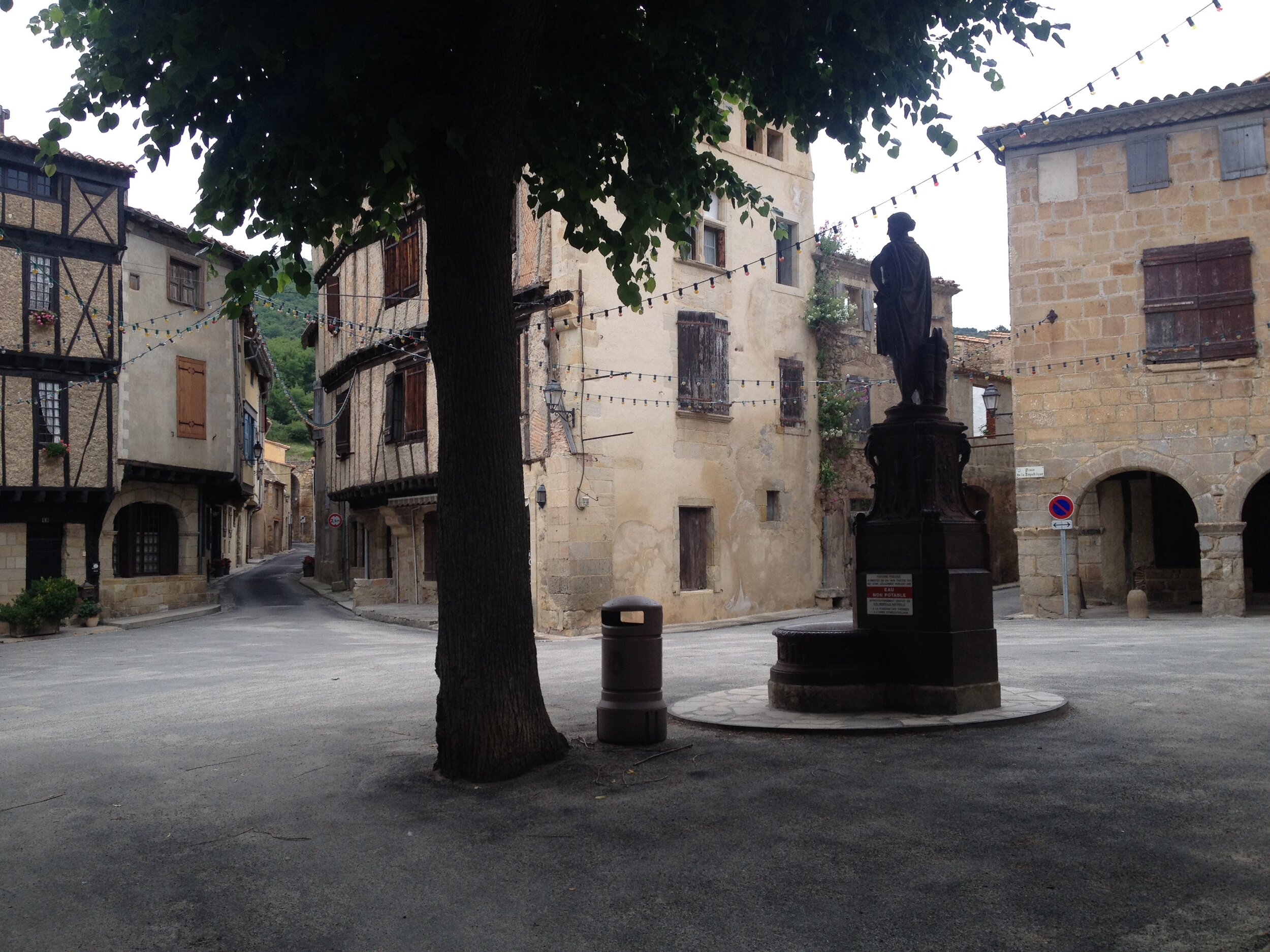
He then directed me to the community fountain, another healing water outlet, direct from the Pyrenees. Once upon a time, people would bathe and wash their clothes in the fountain. Now, it is used exclusively for drinking purposes. To my delight, I discovered people came to collect the water with empty bottles and jugs by the arm-full. “How pure and simple,” I thought to myself. “This is how it is meant to be, direct from nature herself, withouthuman intervention.”
Later, I realized it was the sancturay, the sacred space facilitated by Lorrie and Eugene, that I craved. Not necessarily Alet-les-Bains. The truth is that I can not live the rest of my days only in the house of angels. So the question became, (and still lingers), how do I bring that same feeling, that sense of ease, love and wholeness with me into the world, wherever I am and whomever I am with.
This is my challenge. For I am not meant to meditate it a cave high above the world. Not this time. Now it is time to bring the message of love and grace and light outward, into the world.
With a sadness in my heart, I left Alet-les-Bains. I could not forsake the remainder of my journey, and that which I had come so far to see. In the morning, I would head for the infamous Rennes-le-Chateau, to uncover the secrets of Mary Magdalene.
~~~~~~~~~~~~~~~~~~~~~~~~~~~~~~~~~~~~~~~~~~~~~~~~~~~~~~~~~~~
Post Script: During a recent conversation with sage and dear friend, Hippie Lou, I began to realize that all of the books I’ve read, the lectures I’ve listened to, and the never-ending philosophical conversations I’ve been a part of, hold little weight until I transform that wisdom into action.
I finally understand the true meaning of a yogi, as described by my dear Indian teacher. A yogi is a person who puts her words in to action, who lives just as she speaks. Words are not mere concepts to a yogi, but an actual moment-to-moment daily practice. And this is when life becomes a meditation.
And my mode of action is the play itself. It IS the Pilgrimage. The transformation comes in how I choose to actualize this wisdom I’ve gathered.
READ NEXT BLOG: Languedoc Part 3: Finding Mary Magdalene
The Fortified Medieval Castle of Carcassonne
Continuing on, I toured the contours of the castle. I explored the Basilique of Sainte Nazaire, discovering a magnificent life-size marble engraving of a Knight Templar, supposed protectors of the Cathars. At the right of this knight, stood a statue of Saint Anna, my patron saint, sitting with her young daughter, the Virgin Mary. Stained glass windows seemed to contain the symbols, and messages, of a suppressed wisdom . . .




Finding Mary Magdalene Blog Series.
“Languedoc, Part 1: The Fortified Medieval Castle of Carcassonne”
Originally Published: June 12, 2014
Because of my hotel mishap in Les Maries, I had an extra day at my disposal. I decided to use that as an opportunity to spend a night in Arles.
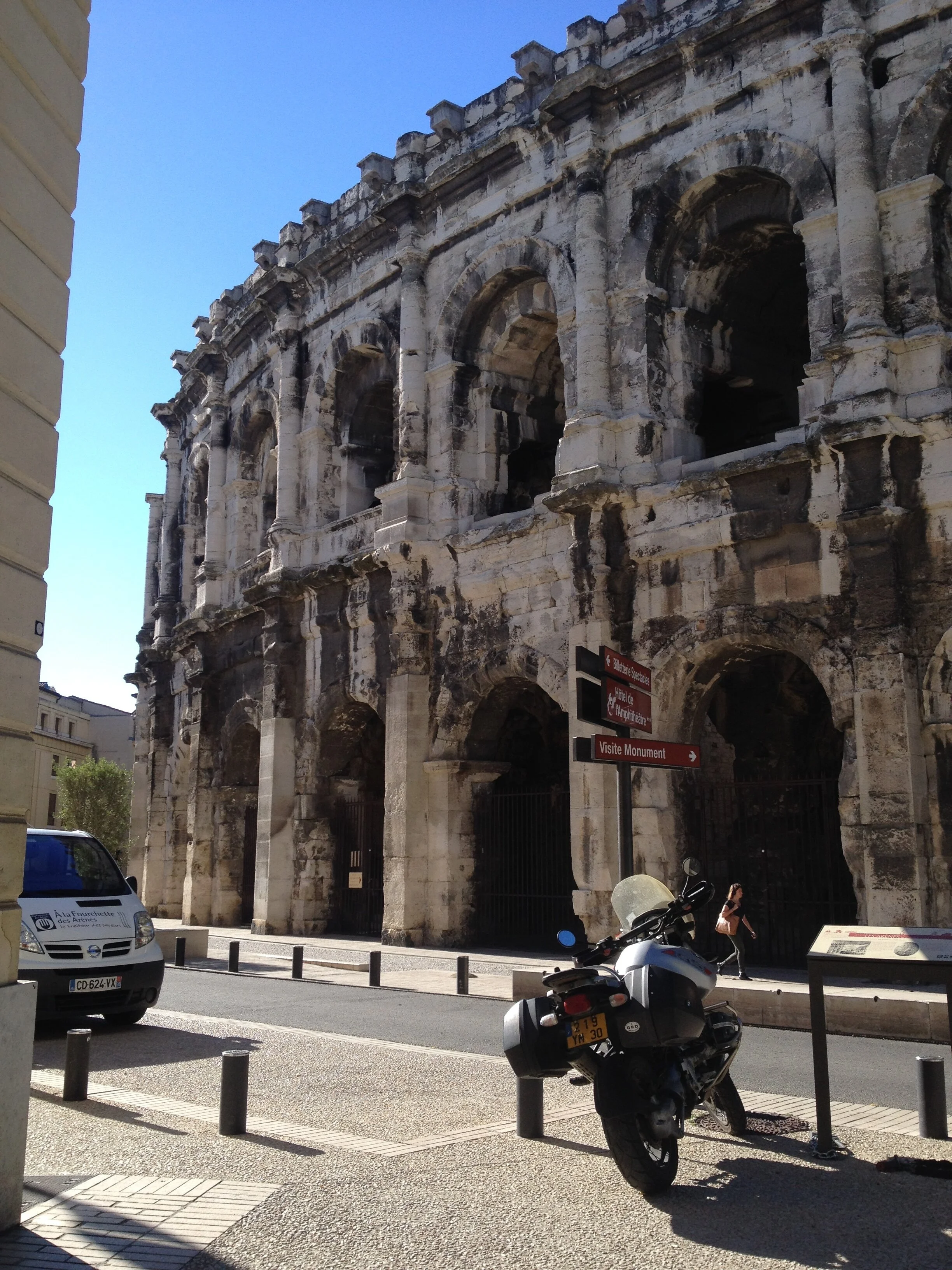
Arles has a reputation for being one of the most charming cities in southern France; and boy, does it live up to its reputation! Teeming with life and verve, Arles was the final home and inspiration for some of van Gogh’s most famous paintings. It sits along the Rhone and has been colonized by many peoples, most notably, the Romans. It at once feels very Italian–complete with a fully intact Roman amphitheater–yet oozes French charm.
Hôtel - Musée, my hotel for the night, provided me with the perfect backdrop to complete my French Country Dream. Chic, warm and cozy, my room smelled of lavender. Aged green shutters opened up to a glorious view of the quaint patio below that was adorned with jasmine, roses and climbing vines; terracotta tiles and cast iron patio furniture.
I spent the evening walking in a dream world. I found a neighborhood cafe and quickly made myself at home. A glass of wine and fondue, and viola, my life was complete.
I awoke the next morning with a sadness in my heart, and made my way to Nîmes.
Nîmes is also a former Roman colony, but has the underlying feeling of brute force, lacking the quaint charm of Arles. I stayed an uneventful night there, before heading to my final pilgrim site, Carcassonne.
Carcassonne cite is a fortified medieval city that embodies, among other historically important events and peoples, the wisdom of the Cathars and Templars.
After plopping my stuff in the hotel, I decided to spend the rest of the afternoon exploring the medieval castle at the heart of the city. I made my way over the ancient bridge that connected the ville basse with the cite. I explored the park on either side of the river, quietly listening for the hushed voices of the city’s guardians. Following their lead, I sat near the river, digging my hands into the moist earth, absorbing the centuries of history that had traversed this land.
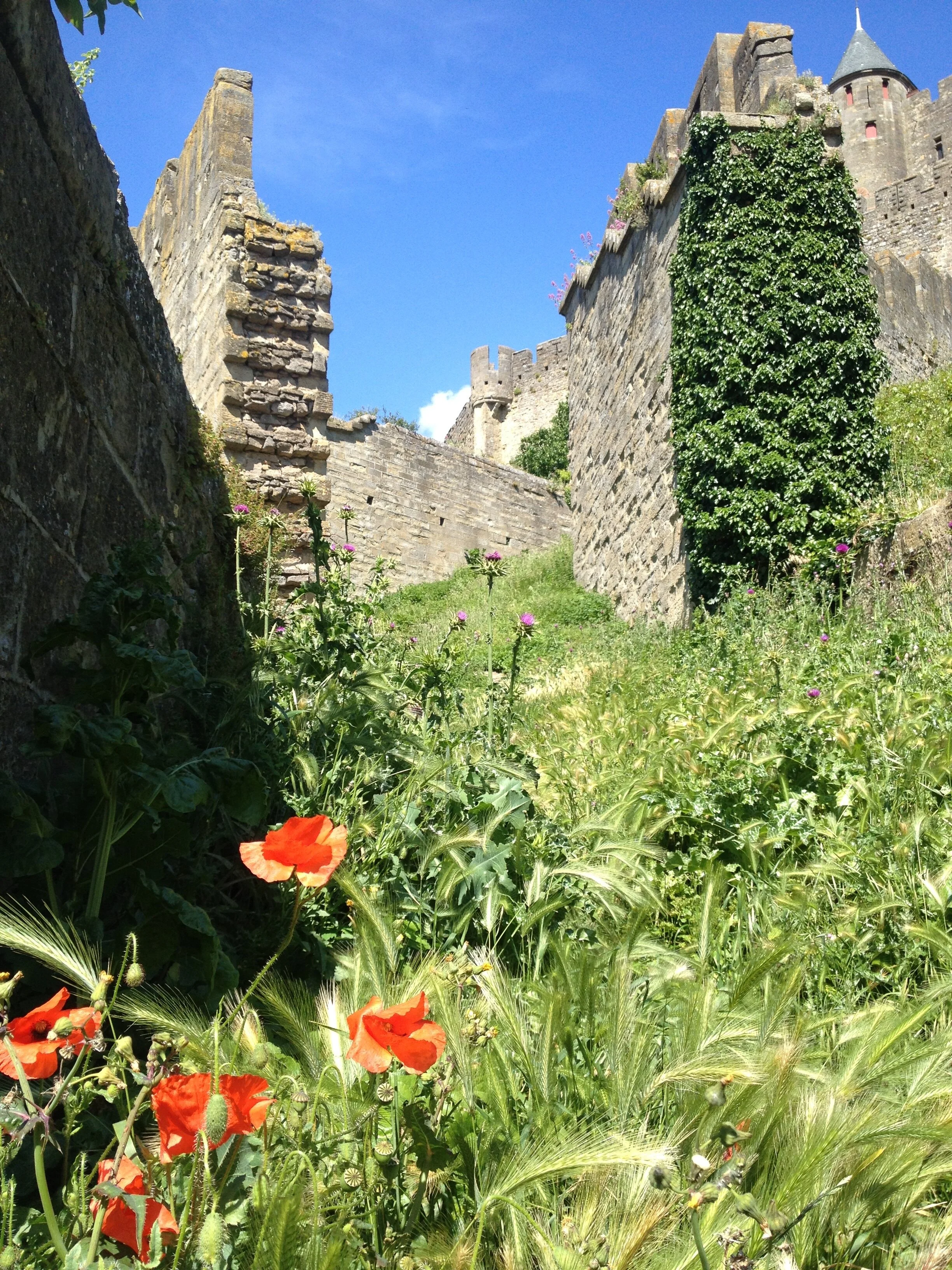
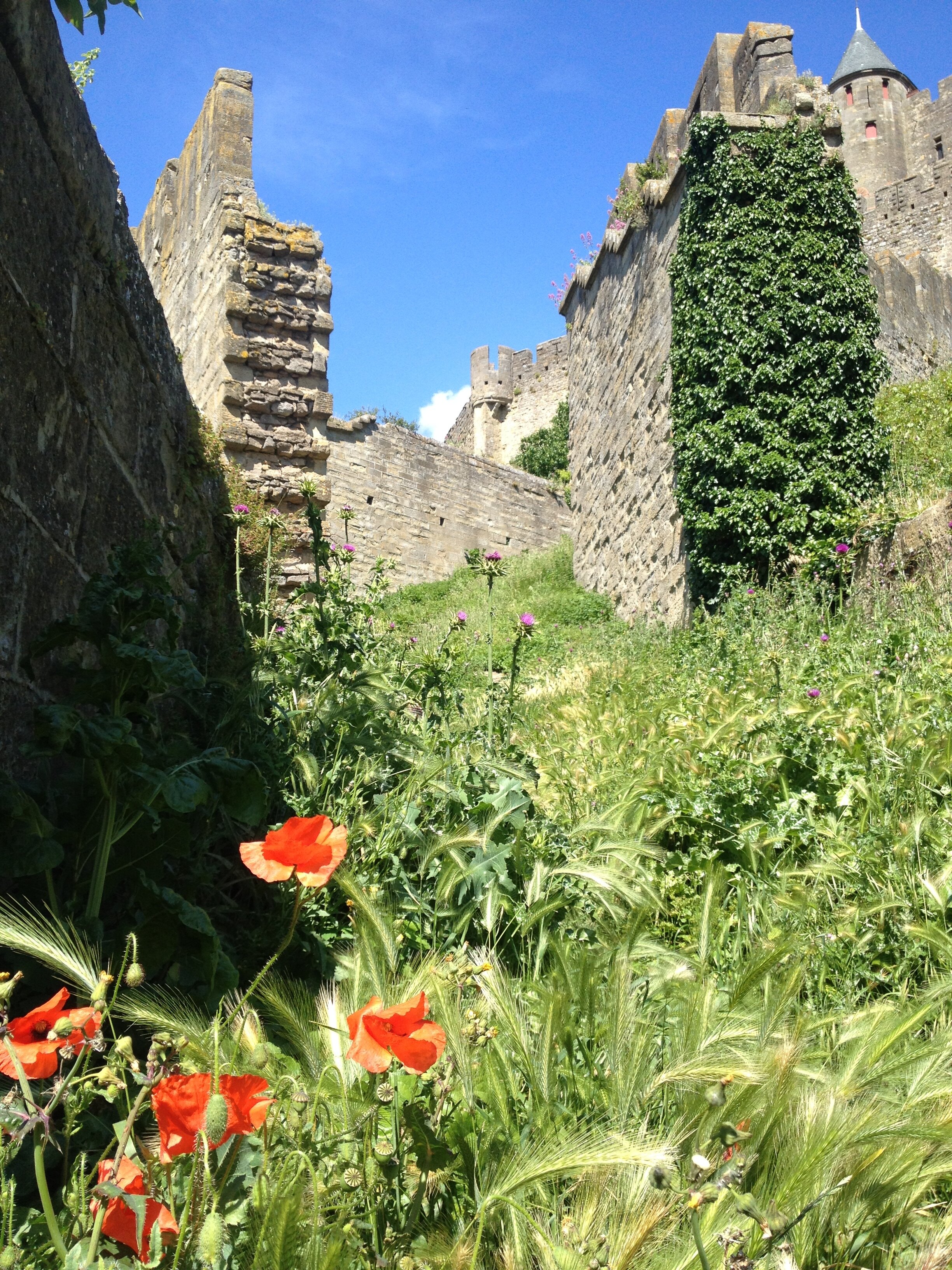
Feeling the “call of the castle,” I made my way to an ancient pathway, that I imagined once welcomed returning heroes along its route. Overgrown with weeds and wildflowers, remnants of the ancient stone way remain. I looked up and felt the brute strength it took to build these walls. I felt the sweat of the hundreds of men who spent their lives building this fortress, in service of the kingdom. And then I sensed him; a knight who had returned from battle, longing to be in the embrace of his secret lover. His presence so strong, I wondered: was that me in a past life?
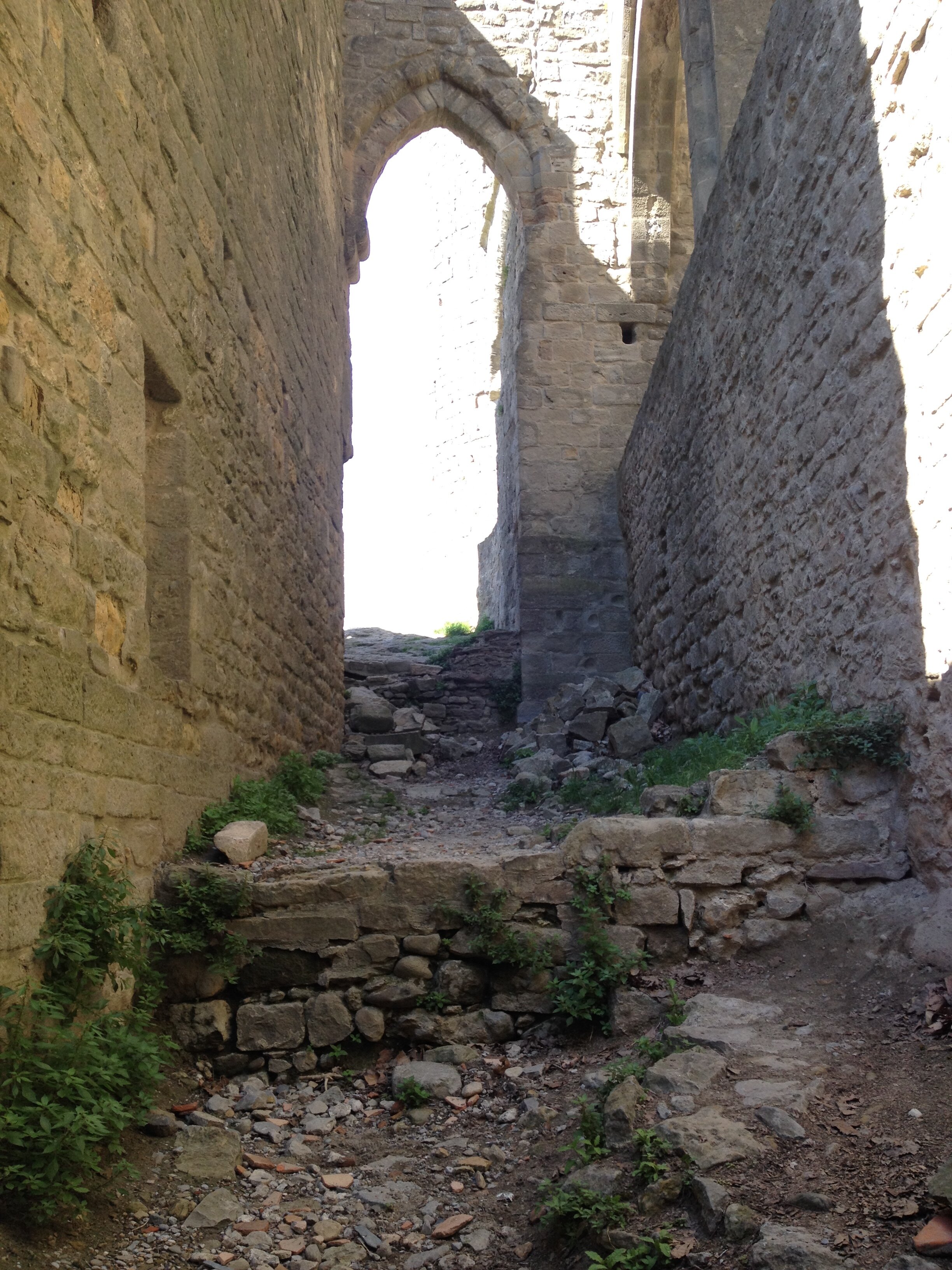
A force compelled me further along the path. No longer in everyday use, I wondered if I had discovered a secret portal to another realm. I climbed, and to my surprise, found myself at an entry point beyond the first layer of castle walls.
I was called to a large, non-descript wooden door. Reaching out to touch the door, I remembered. I remembered what it was like to be her, the princess or nobelwoman awaiting her knight, in secret. Their love affair, forbidden. In a flash, the entirety of their romance and tragic end came into my consciousness, as I felt her anticipation, and her pain. Every corner I turned, contained more memories of their romance: their hopes and dreams, and their love.
In my heart, I could hear her say, “I am sorry my love. Please forgive me. I am so sorry.” Tears flooded my eyes, and I felt immense pain for the hurt she had caused this man.
And so, with the encouragement of Mary, I prepared myself to do a ceremony in remembrance, and to release this past trauma. I didn’t know where or how, but I knew the answer would come to me in time.
Continuing on, I toured the contours of the castle. I explored the Basilique of Sainte Nazaire, discovering a magnificent life-size marble engraving of a Knight Templar, supposed protectors of the Cathars. At the right of this knight, stood a statue of Saint Anna, my patron saint, sitting with her young daughter, the Virgin Mary. Stained glass windows seemed to contain the symbols, and messages, of a suppressed wisdom.
For dinner, I splurged on a fabulous pork cassoulet, famous cuisine from the region.
As the sun began to set, I decided to head home. However, my path took me just along the outside of the castle walls. Heeding her call, Mary had found a place for me to perform a small ceremony, softly illuminated by the last remaining orange and pink rays of sun.
Not-so-elegantly, I waded through the tall grass, reaching out toward the castle wall for support. I pulled out my stones–some of which I had found earlier by the river–and looked out over the town below. Crying, I felt a burden lift from my spirit.
Upon my descent, I took the same route down, as I had up. Acknowledging that this was the last time I would ever need to walk these steps, I left a poppy in the wall–a gift she would have given him long ago–as a remembrance of the love shared between the star-crossed lovers.
As I approached the parking lot, the sun had nearly set, and I turned to have one more glance at the castle. In my mind’s eye, I could see the couple waiving me goodbye. Happy and liberated, they were free to live in their bliss for eternity, and I free to find my own.
That night, I slept well. With two more days left, and many sites still to visit, I felt at peace, and wondered what the next days would bring.
READ NEXT BLOG: The Angel Sanctuary of Alet-les-Bains
Saint Sara’s Final Procession to the Sea
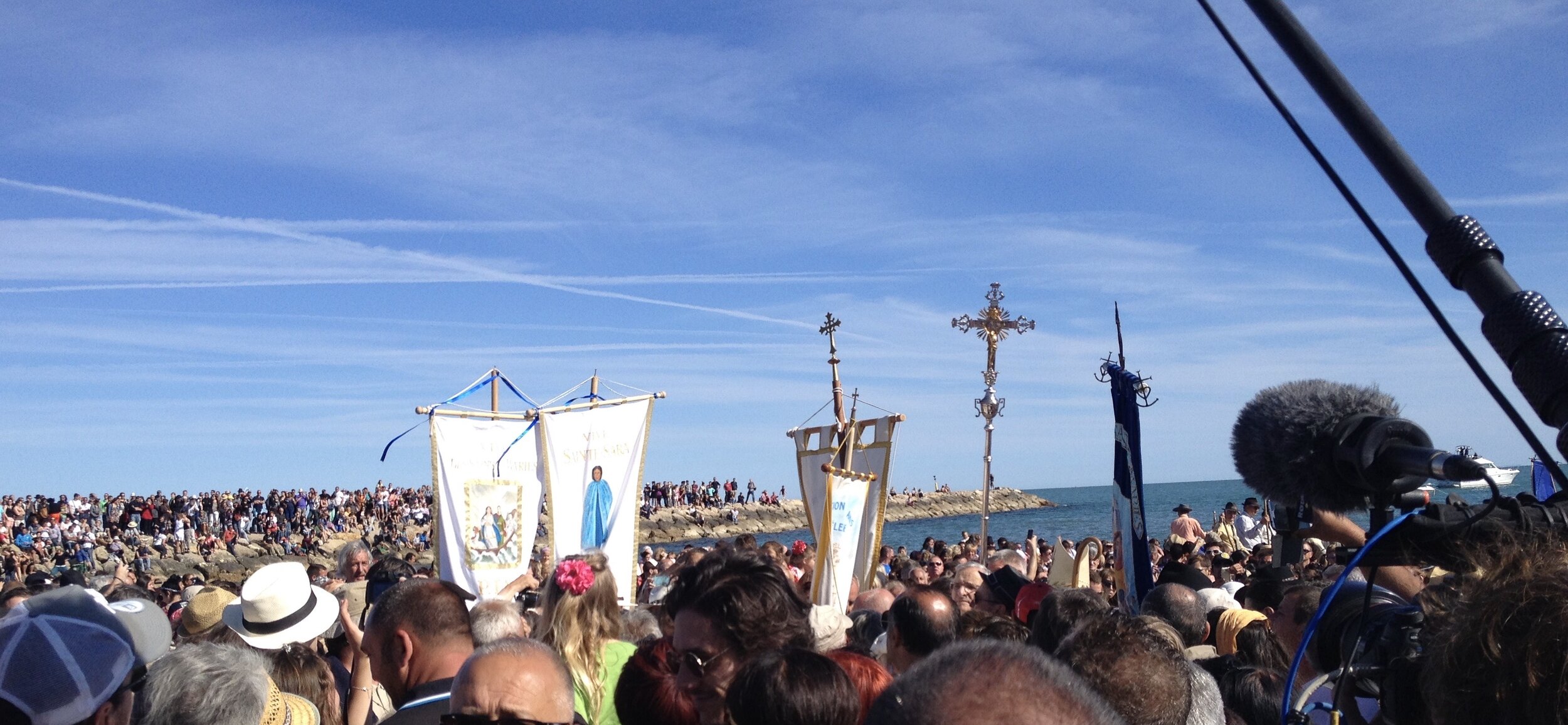
This time, we came face-to-face with the same head priest who had lead the procession the day before. As before, he was blessing the pilgrims along his processional route. He was followed by men riding atop beautiful white horses. The men on horses parted the crowds, allowing the statue of the Two Marys to pass through, toward the sea. I thought this curious that the third Mary, Our Lady Mary Magdalene, was not represented as well . . .





FINDING MARY MAGDALENE BLOG SERIES.
“Saintes-Maries-de-la-Mer, Part 3: Saint Sara’s Final Procession to the Sea”
Originally Published: June 9, 2014
Sunday I awoke feeling as if the day before had all been a dream. Celice and I had a LUXURIOUS breakfast complete with freshly baked croissant, creamy yogurt, fresh juice, and house-made cappuccino topped with whipped cream. The proprietor of our family-run hotel was more than willing to make our stay memorable. He even offered to drive us into town, saying for him, it is only a “promenade.”
Having experienced the grand procession the previous day, I walked into town feeling light, and free of expectation. As it turned out, Saint Sara granted us the privilege to re-witness the procession, from beginning to end.
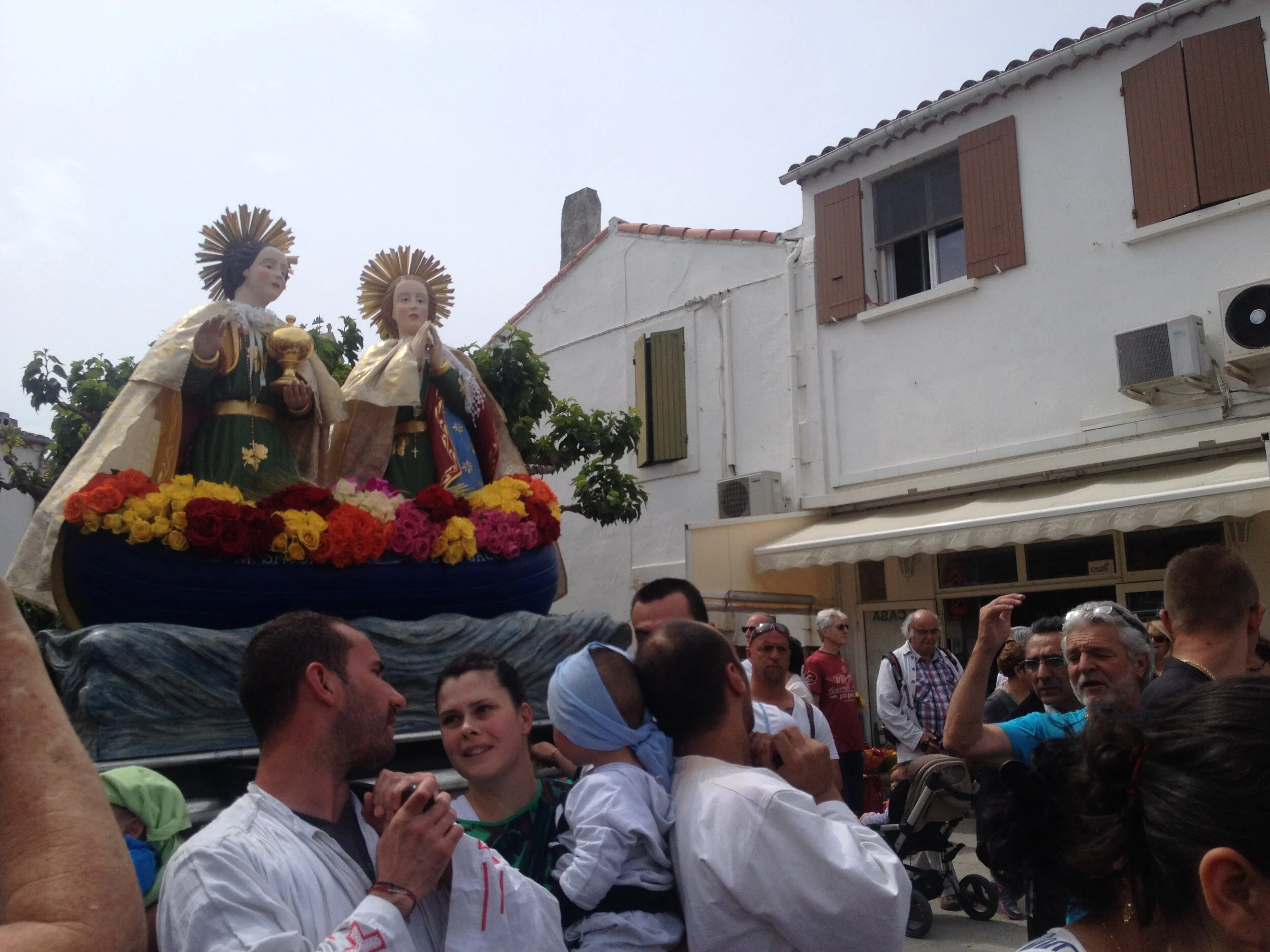
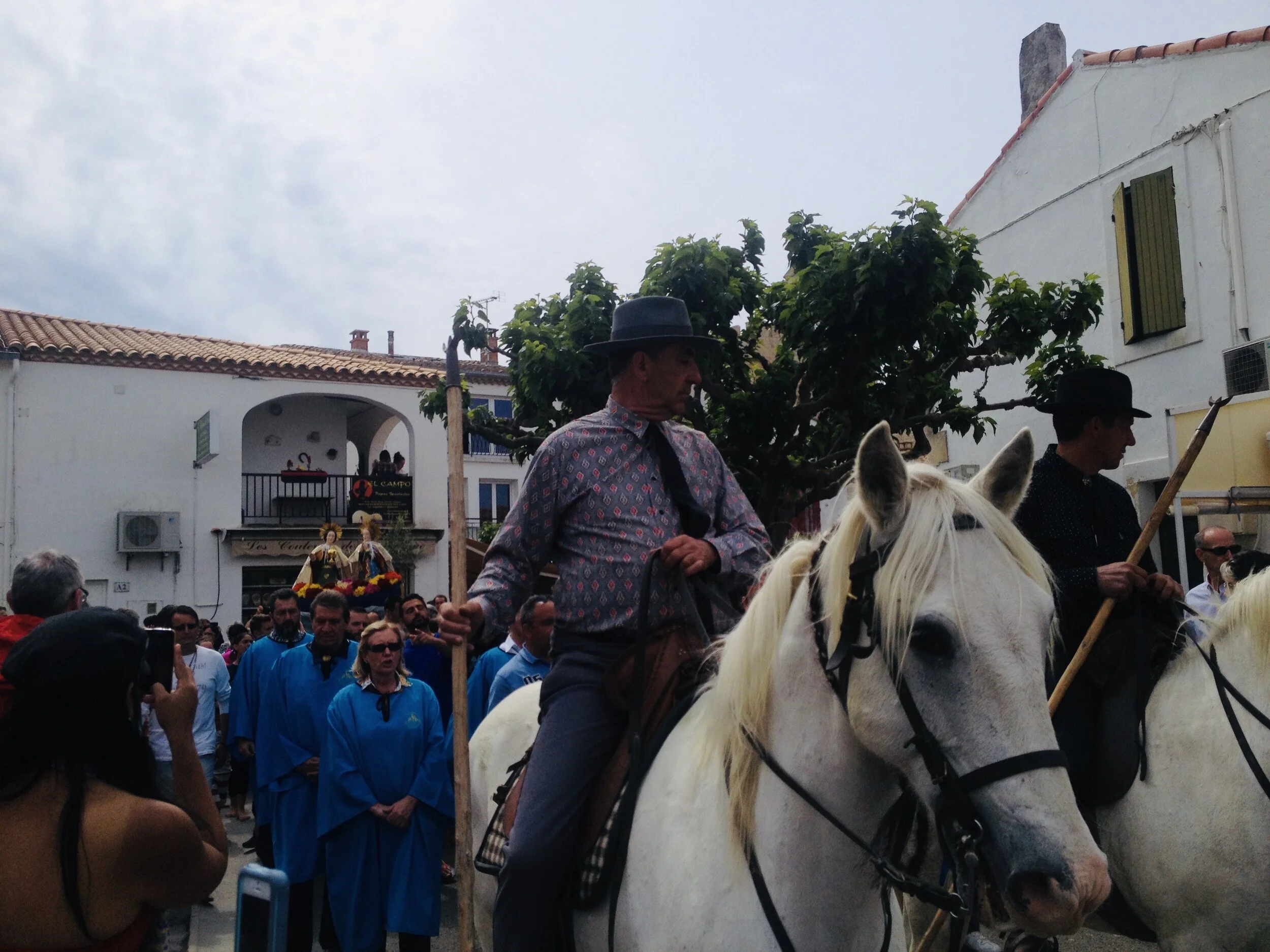
This time, we came face-to-face with the same head priest who had led the procession the previous day. As before, he was blessing the pilgrims along his processional route. Once again, he was followed by men riding atop those same beautiful white horses. The men on horseback parted the crowds, allowing the statue of the Two Marys to pass through, toward the sea. I thought this curious that the third Mary, Our Lady Mary Magdalene, was not represented as well.
Quickly, Celice and I ran ahead, cutting through town, in an attempt to beat the head of the procession to the sea. In a matter of moments, we made it to the shore to witness the sea-bound processional ceremony unfold before our eyes.
Along their route, the priests chanted over blow horns, “Long Live Les Saintes Maries!” and “Long Live Saint Sara!” The crowd soulfully repeated the chant.
Suddenly, a waive of an other-worldly spirit took over the crowd. Time and space seemed to expand, taking me and my fellow pilgrims back to the moment the Three Marys landed upon the shores of French Gaul, greeted by our lady of honor, Saint Sara.
Entranced, I watched as the pilgrims steadily processed the Two Marys, followed by Saint Sara, into the sea. Moments later, the procession turned face, and began its march back toward the town. I turned to see that Celice and I, just as the day before, were surrounded on all sides by the riders and white horses. To me, this double experience was a clear sign that the spirit of Saint Sara was taking special care of us.
The next moments passed like a blur: Saint Sara approached me, flanked on all sides by pilgrims willing to carry her load. My body filled with the chanting of her name and my heart ached to embrace her. Suddenly, I rushed toward her and reached out my hand. One of the young women carrying Saint Sara grabbed my outstretched hand and placed it upon Saint Sara’s dress. Tears flooded my eyes as I gently backed away, feeling into the immensity of the moment.
Time stood still as I watched the procession disappear into the streets of Saintes-Maries-de-la-Mer. In a moment of clarity, I took a tiny glass bottle, and dug it into the sand, collecting a bit of the earth that once welcomed “The Three Marys of the Sea.”
Trying to catch my breath, I turned to Celice with tears in my eyes. She pulled my hand, and off we went in the direction of the basilica.
Once there, I took myself down to the crypt. I wanted to see Saint Sara one last time. I quickly made my way to the front of the line and looked Her in the eye. She spoke words of love to my heart for having completed another piece of my soul’s journey.
Before leaving the church, I noticed numerous rose garlands descending from the ceiling. They seemed to point to a large wooden box, placed high upon the altar, delicately painted with the story of the Marys. Following the motions of others around me, I gently placed my hand upon the box, thanking the women one final time for their great love and courage.
Later, I learned the box is said to contain the remains of Mary Jacobe and Mary Salome. This led me to deduce that the reason Mary Magdalene was not “physically” included in the procession is because her journey did not end at Saintes-Maries-de-la-Mer. Rather, it is believed she was guided by angels to the cave of La Sainte-Baume, where she continued to pray and work in the name of Love.
Celice and I made our way to the Arles train station, the place in which we had met three days earlier. We hugged goodbye, knowing in our hearts that our time together had been a reconnection, rather than an introduction. She left for her final pilgrim site, Rennes-le-Chateau, while I remained in Arles, the city that would quickly steal my heart.
READ NEXT BLOG: The Fortified Medieval Castle of Carcassone