GODDESS BLOG

Diwali abundance from the Goddess Lakshmi! 🪔
As darkness begins to consume the Northern hemisphere of the world at this time, the veil between this world and the world of the spirits—including those of our ancestors—becomes ever thinner. But what is it that we are supposed to see, or unsee, or perhaps even to see-through, at this time?
Do these celebrations encourage us to live and experience life more deeply and profoundly?

Goddess Lakshmi
IN THIS NEWSLETTER:
Annalisa’s Monthly Letter
RECENT Journey to the Goddess TV Episodes
Goddess News
What I’m Reading
Feature: In Memoriam
Upcoming Interviews
DON’T FORGET . . .
Don’t forget! SUBSCRIBE to my YouTube channel. It’s Free!!
Become a Journey to the Goddess member on Patreon! Benefits include behind-the-scenes access, goddess gifts, and more!
Happy (belated) Diwali 🪔!
At its most basic, Diwali is the Hindu “festival of lights” that celebrates the triumph of the light over the dark. One of the stars of this festival is goddess Lakshmi. She is a goddess of beauty and maternal nurturance, and represents abundance, sustenance, and continued well-being in the material world. At this time of year, families beautify and purify their homes (as well as their bodies, hearts, and souls) in anticipation of Lakshmi’s arrival and the good fortune she brings with her.
(Want to learn more? Check out my interview, “Celebrating Lakshmi during Diwali” with Daniela Riva).
Diwali takes place after the summer harvest, around the new moon in late October (sometimes early November). To me, Diwali feels as though it is a beautiful precursor to similar cultural celebrations such as Samhain, Halloween, and Day of the Dead. The thread connecting these late fall celebrations is the dance of light and dark at the borderlands between the known and unknown, the seen and unseen.
As darkness begins to consume the Northern hemisphere of the world at this time, the veil between this world and the world of the spirits—including those of our ancestors—becomes ever thinner. But what is it that we are supposed to see, or unsee, or perhaps even to see-through, at this time?
Do these celebrations encourage us to live and experience life more deeply and profoundly?
~~ 🪔 ~~
For me, I am approaching this year’s festivities with a heart broken wide open by the sudden and recent loss of one of my most cherished friends, Justin Dixon. Justin and I met in graduate school and became instant friends. We literally spent thousands upon thousands of hours discussing mythology, Near Death Experiences (NDEs), the meaning of life and death, and how, in his words, “to be a part of the healing of this world.”
When I got the news of his sudden and fatal illness, all I could utter was, “my heart is broken.” When I wrote to inform Dr. Mahaffey—Justin’s beloved Hindu and Buddhist traditions teacher as well as the Chair of his dissertation committee—he shared with me that, “The Heart of Wisdom is a Broken Heart." And also that, “Prajnaparamita is the divine feminine in Mahayana Buddhism (her name means ‘perfection of wisdom’).”
As I shared in Justin’s eulogy, “this means to me that we can think of the divine feminine as the indwelling presence of God. She is the experience of God in the material world. In other words, is it through a broken heart that we can access Her Divine Wisdom, which then becomes a profound teaching to realize God, the Infinite, or the Great Mystery.
I am beginning to understand that in his passing—and my heartbreak—he is in a sense guiding me . . . into a deeper, more profound experience of what he called the Infinite, and more so to my true nature beyond my human form. This is probably the greatest gift one person can give to another. This is how he is continuing his work to be a part of the healing of this world from the other side of the veil.”
This deepening—a call to experience the profound heartbreak embedded in the human experience—is where I am currently swimming, here, in the liminal borderlands this Diwali season.
~~ 🪔 ~~
l will leave you with two questions:
Which in-sights, if any, are waiting to be discovered by you as we plunge into the liminal borderlands between life and death, light and dark, known and unknown, this Diwali season?
What blessings might Lakshmi, the goddess of well-being, have in store for you?
🪔 Annalisa, PhD

In sweet memory of my friend, Justin Dixon
Recent Episodes:
Join me in conversation with Dr. Megan Rose as we explore this deeply spiritual, personal, and not-so-uncommon experience of marriage to an otherworldly being. Join us as we “normalize the paranormal.”
• But what is Spirit Marriage?
• Can anyone marry a spirit?
• Why would a person even consider such a thing?
• What are the benefits?
Watch our fascinating conversation to learn more!
In this episode, Dr. Joanna Kujawa and I discuss her book, ‘The Other Goddess – Mary Magdalene and the Eros of Secret Knowledge’.
A self-proclaimed “spiritual detective,” Dr. Joanna Kujawa dives deep into the sacred feminine power hiding behind the surface of the Christian tradition in the figure of #marymagdalene
I’m also thrilled to note that we discuss how her personal experiences with sacred spiritual practices and philosophies—such as esoteric Hinduism (ie, tantra)—has shaped her quest to reimagine Mary Magdalene within a lineage of erotic goddesses and as a bearer of “Secret Knowledge.”
Watch our riveting conversation to learn more!
This video premiered in January 2021. It is a conversation I had with my late friend, Justin Dixon, about the power and meaning embedded in Near Death Experiences (NDEs). His wisdom and insights are timely and sorely needed in our troubled world.
Some key points from this video: Through his work with NDEs, and supported by Quantum Physics theories, Justin wanted to share with people what he said were “the key lessons in NDEs. Such as that they tell us how to make meaning in life for ourselves and how to frame our behaviors so that they are affirming of those lessons…The way we are in service to one another, the way we connect with one another, kindness and self-sacrifice and service are really the meaning in life. This is what we are here for.”
Justin also explained why a soul would want to be born into a physical body, “The physical body is a limiter—it’s insulation— so our minds are infinite [not the physical brain but mind as conscious awareness] and are part of an Infinite Mind which is the Universe itself. We embody in order to be isolated from that infinite connection that we all share. Acts of connection, empathy, love, acts of service, these are actually miracles that happen here in the world. Because physically we are all separate, we may seek connection with one another, we may experience connection with one another. We will never know or be known by someone completely.
We are having an experience of isolation from the Infinite. And that’s very important because you can’t grow spiritually without struggle. And if in this other place, you are constantly connected to the Infinite, there is no way to struggle, no way to grow, there is no way to practice empathy or to create love if it is always there and always embedded in everything you experience. So being here is a huge gift to each and every individual human being. Because we are given the opportunity to fight our sense of isolation, fight our sense of disconnect from one another and work to love, to be kind, to connect. That in itself is Glorifying the Universe itself.”
Watch the full interview to learn more.
Goddess News

BIG news!
I signed a publishing contract with Inner Traditions to transform my dissertation into a “real” book! That means (eventually) you’ll be able to read all about Inanna and Sacred Menstrual Power at a bookstore near you! Want to learn more about my work? Watch my presentation here!

Dr. Joanna Kujawa invited me to be a guest on her YouTube channel. I was able to share my doctoral work with Inanna and Sacred Female Power and so much more! We had a FABULOUS conversation. Watch it HERE!

Dr. Megan Rose has a new course coming out, too! Her course is called, “The Dark Goddess: Her Many Faces and Expressions.” Click here to learn more!
Dr. Joanna also has a brand new course on the Goddesses of Eros and Secret Knowledge, which will be released on Nov 11. Click here to learn more!

What I’m Reading
Women’s Power to Heal Through Inner Medicine

This book is a game changer. Maya Tiwari healed herself from terminal ovarian cancer at the age of 23. Recovering ancient Ayurvedic teachings about the female body that had nearly gone obsolete, Mother Maya teaches women how to heal our bodies by reconnecting us to our innate embodied feminine wisdom.
Feature: In Memoriam

Sacheen Littlefeather
was an actress and Indigenous civil rights activist, and author. (Photo Credit: UCLA Library Special Collections).
She accepted the academy award for “best performance by an actor” on behalf of Marlon Brando for his role in The Godfather. Her speech was moving, brave, and inspiring. Check out her acceptance speech here: Oscar Speech
Upcoming Interviews:
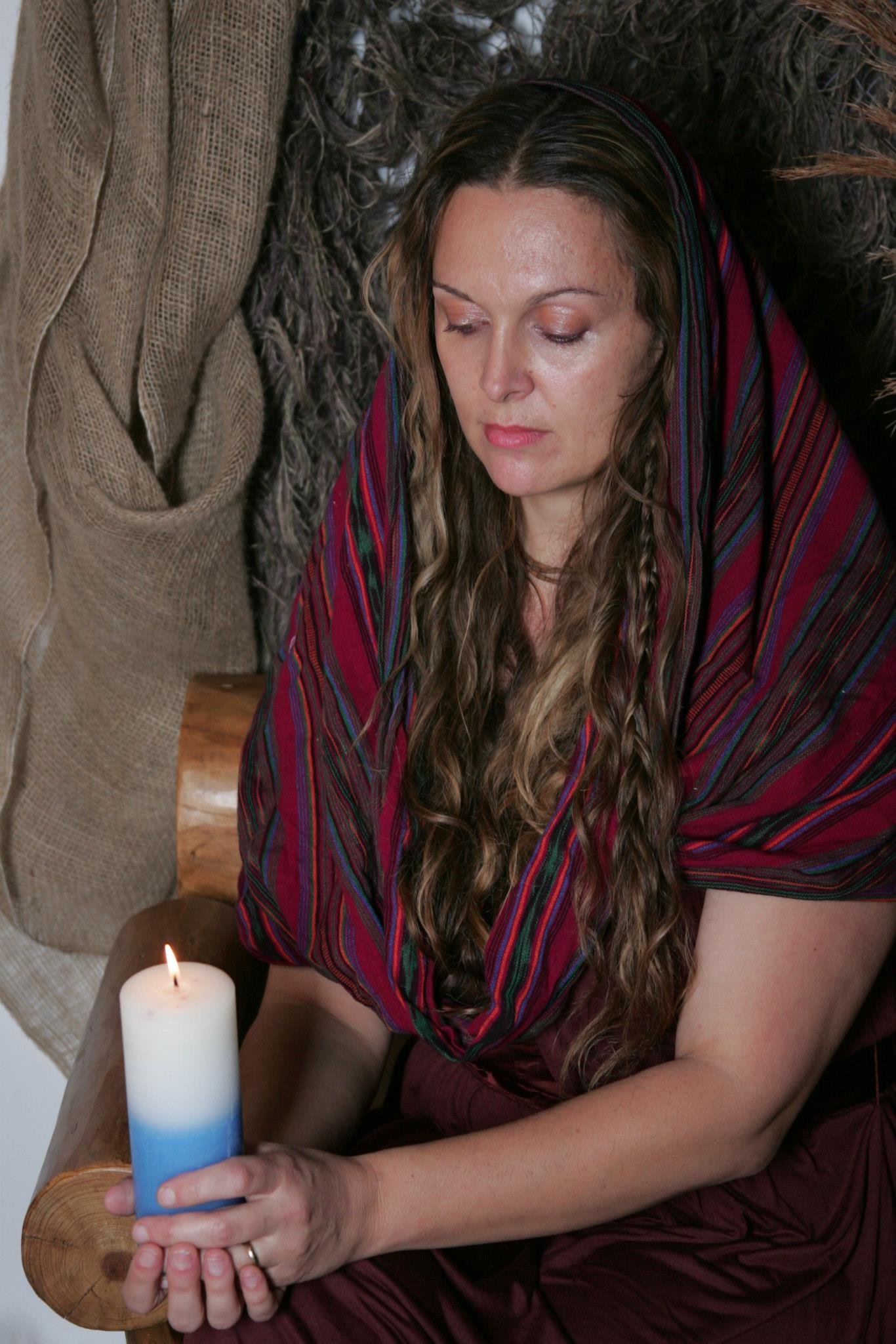
Krishna Rose
Oracle of the Grail. Prophetess. Priestess of the Magdalene.
Author of, “Woman in Red: Magdalene Speaks”
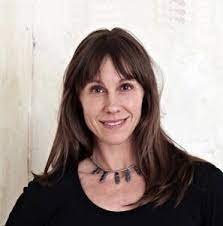
Seana Zelazo
Psychotherapist and spiritual counselor.
Author of, The Way of Inanna: A Heroine’s Guide to Living Unapologetically.
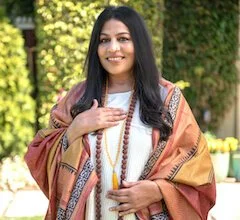
Acharya Shunya
Teacher. Podcaster. Lineage Holder.
Author of, “Roar Like a Goddess: Every Woman’s Guide to Becoming Unapologetically Powerful, Prosperous, & Peaceful.”

Dr. Yuria Celidwen
Speaker, Teacher, & Scholar and practitioner in Indigenous contemplative science.

What you seek is seeking you 🌺 April 2022
🌺 My Journey to the Goddess began as a young teenage girl, years before I ever knew who or what the Goddess is. She first appeared to me as a ritual agreement with Pele, the Hawaiian volcano goddess; an agreement which I fulfilled over twenty years later in graduate school.
She remained with me throughout my teenage years as a passion for the red hibiscus flower. In fact, the moment I turned 18, I felt the utmost urgency to get an image of the red hibiscus tattooed on my back. It wasn’t until many years later when I realized that the Goddess was speaking to me through my love for this flower. . .

“What You Seek is Seeking You”
My Journey to the Goddess began as a young teenage girl, years before I ever knew who or what the Goddess is. She first appeared to me as a ritual agreement with Pele, the Hawaiian volcano goddess; an agreement which I fulfilled over twenty years later in graduate school.
🌺
She remained with me throughout my teenage years as a passion for the red hibiscus flower. In fact, the moment I turned 18, I felt the utmost urgency to get an image of the red hibiscus tattooed on my back. It wasn’t until many years later when I realized that the Goddess was speaking to me through my love for this flower.
🌺
Reading “Awakening Shakti” by Sally Kempton nearly 15 years later, I learned that the red hibiscus flower is the symbol for the primordial Indic (Hindu) goddess, Shakti. I recognized then that, in a very real sense, my body had been marked by the Goddess. Though my Journey to the Goddess had begun a few years prior, She had actually been with me all along. Rumi’s famous words “What you seek is seeking you” couldn’t have been more true!
🌺
As I was searching my heart for the right words to say in this newsletter today, I couldn’t help but reflect back on my journey that began all those years ago. The past few weeks have brought me closer to my vision of what it means to be in service to the Goddess. For me, it is not a journey to claim some sort of elusive “feminine energy.” Though, this is a totally legitimate path for those who want it!
🌺
Instead, my Journey to the Goddess is actually a quest to discover what it means to be a woman, outside of any patriarchal fantasy, and to share this discovery with others who seek the same. Of course, the Goddess is leading the way. The fruits of the quest have led me to the profoundity of embodied feminine power. Thus, my path to female empowerment is crystalizing in my desire to Resacralize the Female Body.
🌺
But the simple truth is, all Life is sacred. So much of the world is currently dominated by staunch materialistic and anthropocentric paradigms. As a result, the sacrality of Life—and the beauty of our interconnectivity with plant, animal, mineral life, and one another—has increasingly become diminished and distorted for centuries, if not millennia. To truly recognize Life’s sacrality, it will take a reevaluation of many of our inherited beliefs.
🌺
One of which is our notion of power and how we wield it. I believe that the power humans need to cultivate is one that is in alignment with the cyclic powers of Life—think birth, growth, decay, death, and rebirth. And it is time for more women to remember that we embody this cyclic power, as it is so profoundly made manifest, throughout our lives, in our wombs.
🌺
It is a unique and primal power that is simultaneously biological, spiritual, and archetypal. And, I believe, this power—and ALL that it implies—is the feminine power that women, and the world, have been seeking.
🌺
Perhaps Rumi’s visionary words are the antidote for our time.
🌺Annalisa, PhD
IN THIS NEWSLETTER:
Current Journey to the Goddess TV Episodes
Goddess News
What I’m Reading
Feature: Women to Follow
Upcoming Interviews
————————————————————————-
DON’T FORGET . . .
SUBSCRIBE to my YouTube channel! It’s Free!!
LATEST EPISODES
🩸Why is is that Menstruation is still such a taboo topic around the world? What is it that makes this particular form of bleeding dangerous enough to largely remain hidden behind the cultural curtain? Why do so many women feel period shame
🩸Six years ago, I began to ask myself why I was so ashamed of my menstruation and menstruous body. This has led me down a deep and often dark path filled with anger, rage, and grief, but, ultimately, has given me the opportunity to heal my shame.
🩸This is an EXPANDED presentation of my doctoral work to resacralize menstruation--but with a twist! I asked two colleagues to join me for a post-presentation "Red Roundtable" discussion. In the Q&A section, we deep dive into our blood stories, internalized sexism, the sacred power of menses & so much more!
———————————————————————————-
Is menstruation 🩸 sacred or a curse? What would you think if I said menstruation is one of the most sacred of human acts? I believe that it IS sacred and I have created a Menstrual Art Performance series to honor the sacredness of menstrual blood.
This is a Period Performance called "A Ritual Puja for Menstruation" and is followed by my commentary on the inspiration for the piece, the bleeding goddess of Assam, Kamakhya.
———————————————————————————
After an extraordinary experience with a dying cat, I decided to bring on my dear friend, podcaster, and self realization expert, Maia Wilde to discuss how connecting with my feelings of grief actually healed my body.
This conversation is lively and dives deep into the intelligence of our bodies. Maia also gives several simple and effective techniques to anyone who would like to learn how to safely tap into and experience their feelings. She also shares how to use such techniques as a vehicle for creative expression and emotional healing.
GODDESS NEWS

New!
I am happy to share the publication of “Spirit Marriage” by Dr. Megan Rose! “Spirit Marriage” is an in-depth exploration of the practice, relevance, and purpose of spirit marriage around the world. You may remember Dr. Rose from her great talk on Sacred Sexuality and Mary Magdalene for Journey to the Goddess TV. Find her book, here on Amazon today!
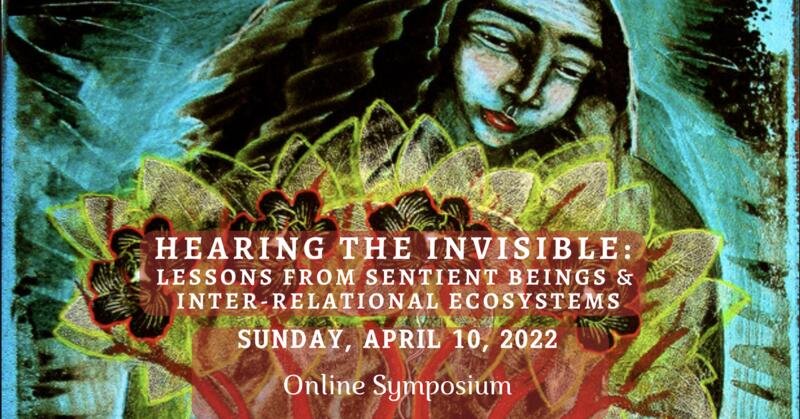
Sunday!
APRIL 10th! The Association for the Study of Women and Mythology will be holding their 2022 Symposium, “Hearing the Invisible: Lessons from the Sentient Beings & Inter-Relational Ecosystems.” For Registration, click here: ASWM SYMPOSIUM

Modern Matriarchy
“Portraits of Matriarchy: Where Grandmothers are Still in Charge.” A portrait series by KAROLIN KLÜPPEL. Featured in Yes! Magazine.
Enlightenments
Dr. Thomas Daffern (founder of the Mary Magdalene Studies Association) & Satyen Raja will be teaching: “A Course On Enlightenments, East And West:
Examples From The Past And Present, For The Future.” This course will consist of 12 online tutorials, in which they will take turns presenting role models of enlightenments. This will include sections featuring Mary Magdalene and the work of Marija Gimbutas. For more info, click here.
WHAT I’M (RE)-READING
“Awakening Shakti: The Transformative Power of the Goddesses of Yoga”
by Sally Kempton
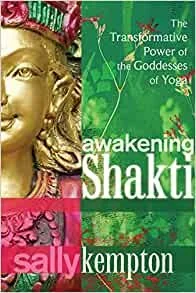
Shakti
If you’ve ever wondered what the Goddess is, then this is the book for you! Beginning with her personal narrative and an introduction to the meaning of the Goddess from the perspective of Shaiva Tantrism, Kempton takes us on a journey through the many facets of cosmic, deity, symbolic, and energetic feminine powers. Then, chapter by chapter, we learn about 11 goddesses, how to identify their archetypes, and practical how-to methods to access the goddesses’ power for our own empowerment. “Awakening Shakti” is truly one of the most thorough introductions to the
FEATURE: WOMEN TO FOLLOW

Ana Mendieta
was a Cuban-American painter, performance artist, and sculptor.
(Image: Women’n Art)
The more I learn about Ana Mendieta, the more I fall deeply in love with her unapologetic artistic vision and commitment to laying bare the profundity of embodied female power and its interwoven connection with the Earth and other spiritual elements.
Ana used her body as a vehicle of art and often in site-specific, natural settings. For example, in her Esculturas Rupestres series, including works such as Guacar or “Our Menstruation,” Ana carves locally worshipped goddesses into caves outside Havana. These carvings evoke symbolic and existential meanings about female power and embodiment.
In a way, I see myself and my own work with embodied menstrual rituals and retellings of goddess myths, within the artistic lineage so fully explored by Ana as well as other artists like Judy Chicago.
In 1985, Ana died in a tragic incident, that, some say, exemplifies the themes she so powerfully evoked in her art. Ana lives on through her art, which continues to inspire many artists and non-artists alike.
Learn more about Ana Mendieta here.
UPCOMING INTERVIEWS
April 2022
Co-founders of Fates and Graces Mythologium, Dr. Stephanie Zajchowski & Dr. Joanna Gardner, will join me for a special Earth Day discussion on the intersection of myth and ecological consciousness.

International Women's Day - March 2022
Years ago, I found myself sitting in a tiny, dark performance venue in NYCs Lower East Side. I was super excited to see the famed Living Theatre perform live! In the 1960s and 70s, the Living Theatre had become known for their experimental and avant-garde style and productions that were anti-war focused and critical of capitalist greed. They were, and remain, theatre for social change.
After their performance, they held a Q&A with the cast. I distinctly remember one of the younger cast-members who, through clenched teeth and shaking fists . . .
Happy International Women’s Day!
Years ago, I found myself sitting in a tiny, dark performance venue in NYCs Lower East Side. I was super excited to see the famed Living Theatre perform live! In the 1960s and 70s, the Living Theatre had become known for their experimental and avant-garde style and productions that were anti-war focused and critical of capitalist greed. They were, and remain, theatre for social change.
🌼
After their performance, they held a Q&A with the cast. I distinctly remember one of the younger cast-members who, through clenched teeth and shaking fists, seethed with anger he could hardly contain as he demanded peace and an end to war. Perplexed, I thought to myself, for a company that promotes non-violence, this is such a strange call for peace on behalf of one of their members.
🌼
It was then that I recalled a quote from Brian Browne Walker’s translation of the Hua Hu Ching, “If you want to awaken humanity, then awaken all of yourself. If you want to eliminate the suffering in the world, then eliminate all that is dark and negative in yourself.” I realized then that the world peace many of us seek can only be achieved when enough people commit to cultivating inner peace within themselves. The outer world is a collective reflection of each individual’s inner dramas and inability to face and come to terms with their own deepest fears and demons.
🌼
In a way, this is the essence behind Journey to the Goddess. When I embarked on my pilgrimage to Mary Magdalene’s sacred sites in France back in 2014, I was certain that I was going on this quest to find Her, the “real” Mary Magdalene. But by the end of my journey, I realized that my pilgrimage wasn’t really about Her at all. My outer journey to Mary Magdalen was, in actuality, an inner journey to know what it means to be a woman through the very act of seeking Her.
🌼
Thus, the Journey to the Goddess is a journey of inner awakening. And the Goddess (or god, divinity, or whatever your object of attention), is the vehicle that points the seeker in the direction of this awakening. I believe that such an awakening can cultivate an inner peace to live by, even in the midst of all the challenges the outer world presents.
🌼
It has been eight years since I first embarked on my life-long Journey to the Goddess. I still struggle with my own inner demons and my heart aches for the suffering in the world and also for our Earth Mother. And perhaps a cultivation of inner peace does not preclude compassion for one’s suffering and the suffering of others.
🌼
I fell hope for the future because of the great community of women (and men) around me who are bringing healing to the world, even if in a very (seemingly) small and simple way.
🌼
Over the past few weeks, Deva Premal and Miten have continued to chant the Gayatri mantra for peace; Lama Tsultrim Allione has invited her community to invoke the 13th Tārā, Yülle Gyaljema, “to help end war and the conditions of war”; CODEPINK, the women-led, non-violent movement for peace has continued their call for peace around the world; recognizing that women and children are disproportionately impacted by war and conflict, Women for Women International continues to bring resources and aid to women in these worldwide conflict situations; and finally, the Israel singer Yael Deckelbaum brings together women from warring communities (Israeli and Palestine, for example) to sing for peace. And these are but only a few of the women and women-led groups taking a stand for peace around the world.
🌼
Today, on International Women’s Day, I invite everyone to do one simple thing to get in touch with that peaceful place within.
🌼
This weekend, I’ll be speaking in more detail about my own Journey to the Goddess and how, to my surprise, graduate school has been central to my own spiritual blossoming. Details in the Goddess News section.
Goddess Blessings to all.
🌺 Annalisa, PhD
IN THIS NEWSLETTER:
Journey to the Goddess TV Episodes
Goddess News
What I’m Reading
Feature: Women to Follow
Upcoming Interviews
DON’T FORGET . . .
SUBSCRIBE to my YouTube channel! It’s Free!
Latest Episode:
Have you ever looked at your tarot cards and wondered if the tarot is sexist?
Dr. Lisa Skura did and decided to explore the origins of the images in one of the oldest known complete tarot decks, the Sola Busca, made in Italy in the 15th century.
Of the 5 (Lisa argues there are 6) female images in the tarot, Lisa uncovers the mythic and historical symbolism roots. She argues that the female images in the tarot go back to pre-patriarchal goddess worship and its usurpation by male-centered fool--hero myths!
The question remains: Even though the tarot as we have it today has sexist roots, can we reclaim it as empowering for women?
Find out in my most recent talk: "Exploring the Myths, Symbols, & Archetypes of the Feminine in the Sola Busca tarot" with Dr. Lisa Skura.
Vintage Episodes:
Back in January 2020, (Oh, those pre-pandemic days), I teamed up with Kris Oster, PhD to devote a 4-part series to "Sacred Pleasure and the Goddess."
In this series, Kris discusses her approach to life and business as she integrates and celebrates sacred pleasure vis-a-vis the divine feminine.
If you’re like me, you have a deep desire and passion for the work you do in the world, but struggle with workaholism, perfectionism, and “the struggle” to get it all done.
If so, then check out this conversation that's sure to give you a deeply connected and sensuously embodied approach to your work.
Goddess News
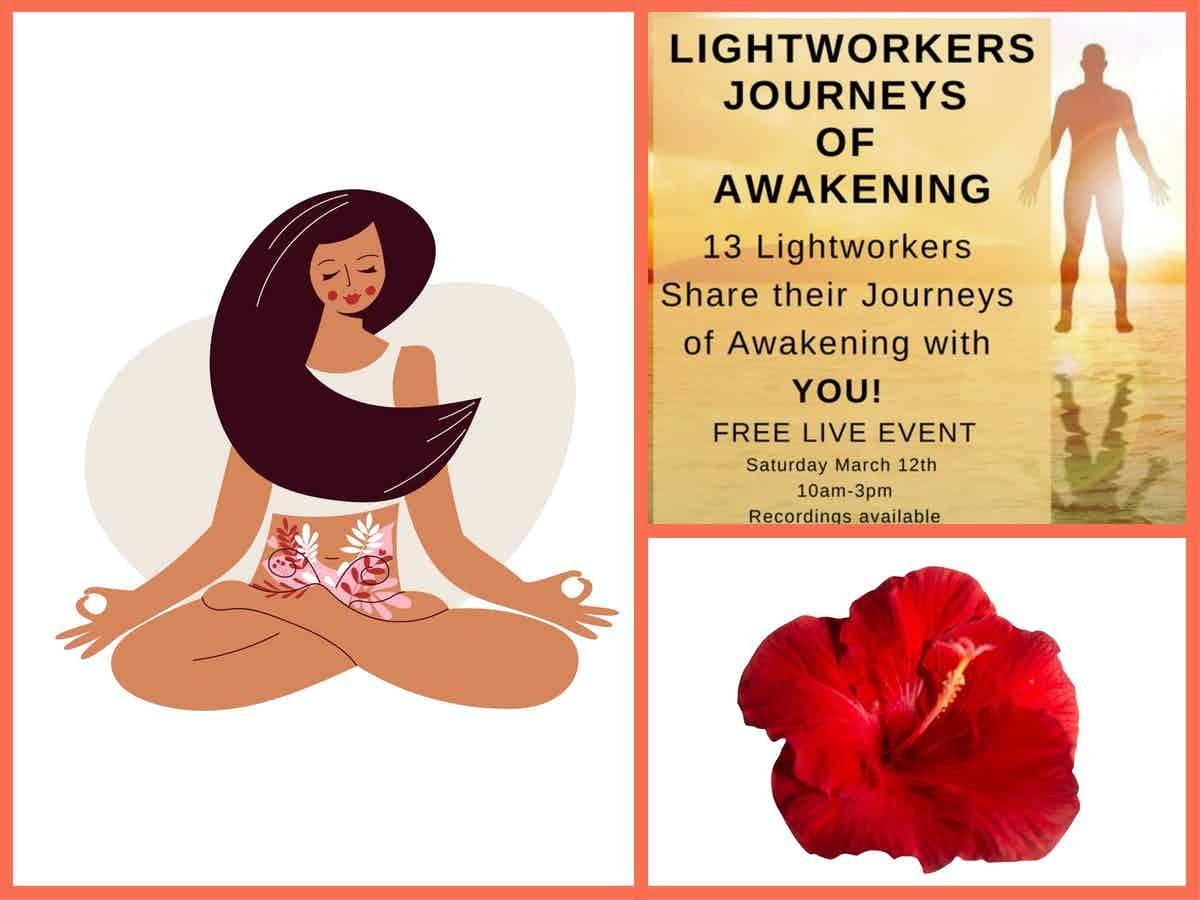
I’m thrilled to be sharing my Journey to the Goddess origin story with a new audience! Most of all, I look forward to sharing why womb healing is spiritual healing.
To join this free March 12th summit on Lightworkers Journeys of Awakening, register here: https://go.zarastarchild.com/optin-meoz08qv6d
The Association for the Study of Women and Mythology will be holding their 2022 Symposium on April 10th. For Registration, click here: ASWM SYMPOSIUM

“Goddess Embroideries of Ukraine as Prayers for Peace” by Laura Shannon. Originally published on Feminism and Religion.
What I’m Reading
Honestly, I’m in the middle of at least 5 books at the moment. It reminds me of that old adage: You can take the woman out of graduate school, but you can’t take graduate school out of the woman…

“The Making of the Magdalen: Preaching and Popular Devotion in the Later Middle Ages”
I can not say that this is a pleasurable book to read, but it is a meticulously detailed account of—you got it—the making of Mary Magdalene in the mythic imaginations of the Middle Ages. It is rich in source material and offers a nuanced discussion of the many ways that sexist ideas infiltrate the making of Mary Magdalene into both a sinner and a saint. If you’re like me and you have a burning desire to know the difference between the Biblical Mary Magdalene versus the Magdalene that has come down to us today, then this is your book.
Feature: Women to Follow

I remember the first time I encountered CODEPINK. I was rushing to get myself out of Times Square as quickly as possible. I remember stopping in my tracks at the sight of this group of mostly women, dressed in bright pink, protesting for peace and the removal of US troops from Iraq. That memory has stuck with me all these years. Moreover, their clarion call for peace is more and more prescient as endless warring seems to be bringing humanity to the edge of extinction.
Originally started by Jodie Evans, Medea Benjamin, and Gael Murphy, CODEPINK is a national organization with an international reach. Their mission is rooted in and sustained by non-violent principles with one central goal in mind: to support the lives and wellbeing of human and non-human life on earth through the a commitment to peace.
As their website states: “CODEPINK is a women-led grassroots organization working to end U.S. wars and militarism, support peace and human rights initiatives, and redirect our tax dollars into healthcare, education, green jobs and other life-affirming programs.”
Last weekend, CODEPINK protests for peace in Ukraine spread across the world.
Join their movement for peace at: CODEPINK
Upcoming Interviews:

MARCH 2022
Yours Truly!
I’ll be debuting two episodes that focus on my work to “resacralize menstruation.” First up, a presentation of my doctoral work followed by a panel discussion with some amazing women.

In the following episode, I will discuss the origin story and symbolic meanings encoded in my 2018 performance piece, “A Ritual Puja for Menstruation.”

Finding Mary Magdalene
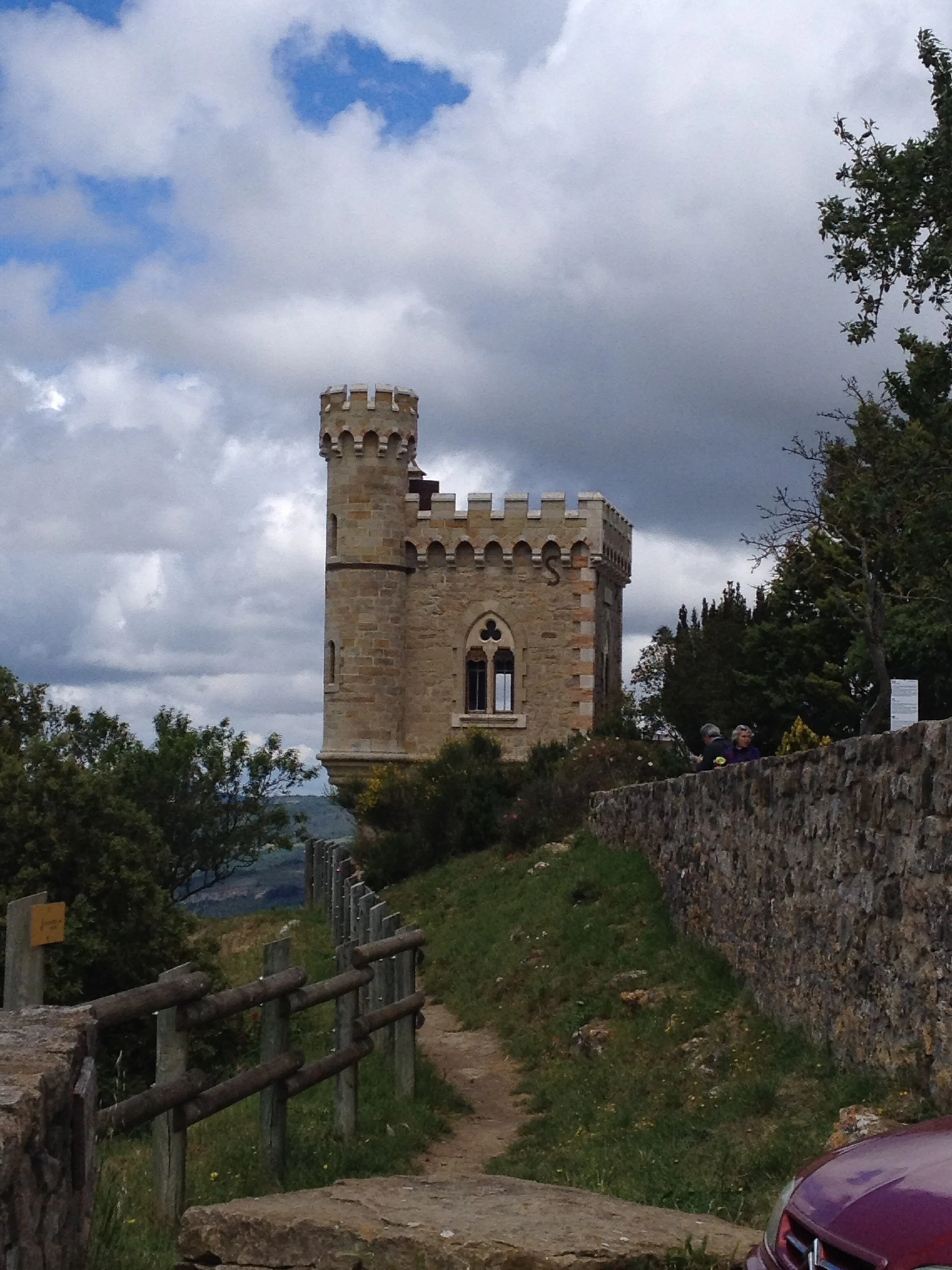
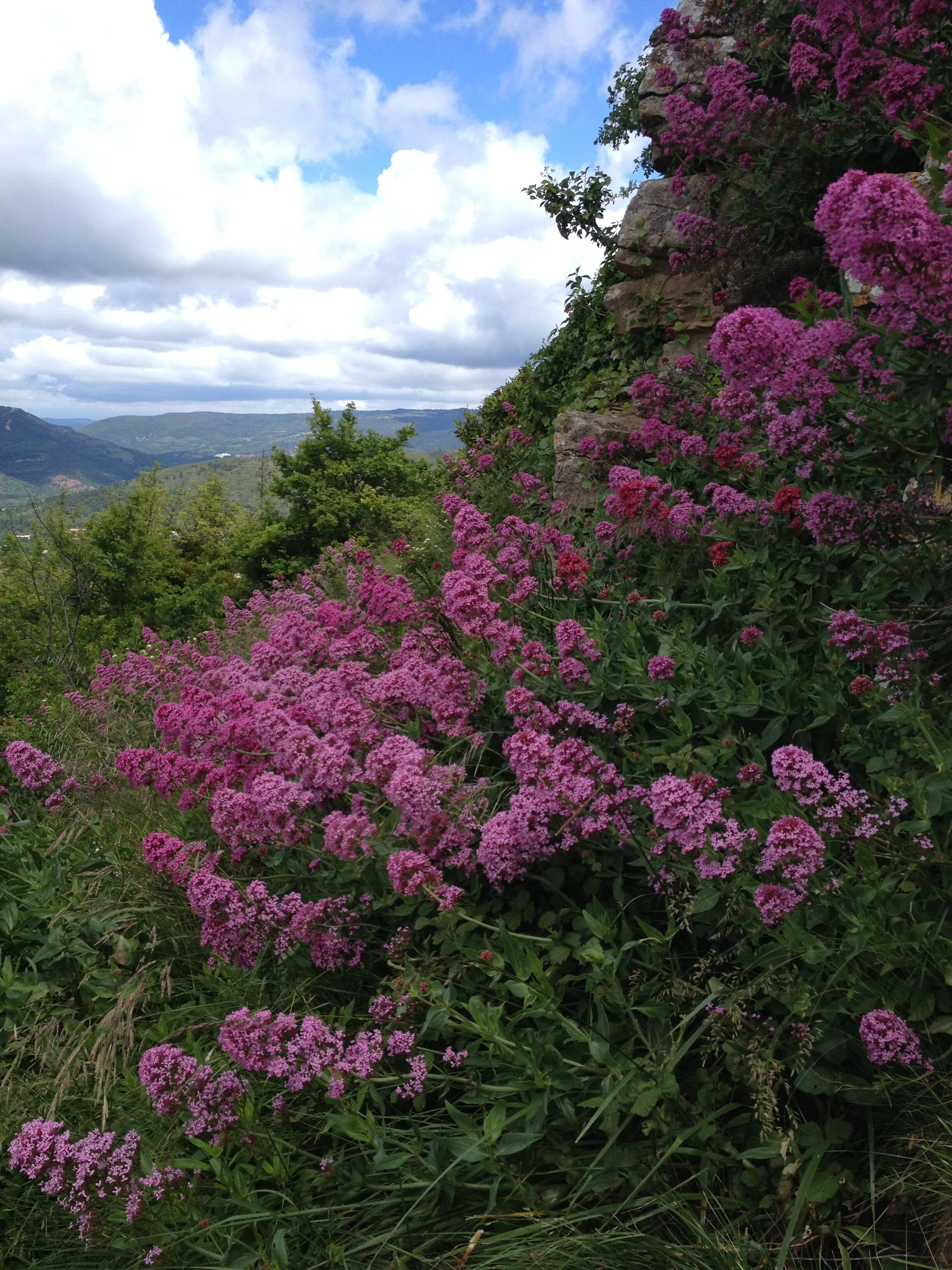
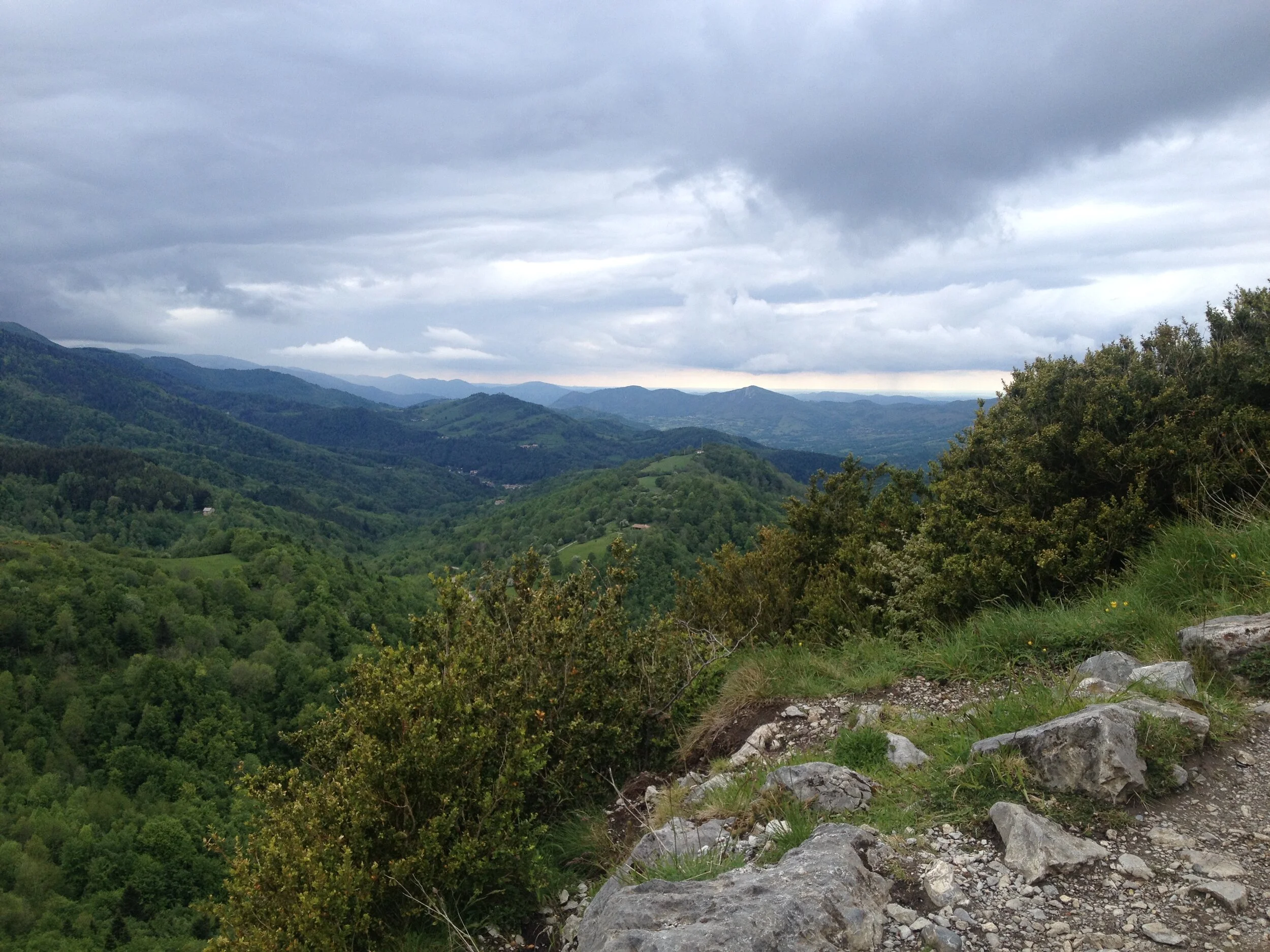
Seeing the fortress high above me, I parked my car and prepared myself for the ascent. The path was rocky and steep, but I felt encouraged by fellow pilgrims. Along the route I could hear the melodic ringing of cow bells, dangling from the necks of cows, far off in the distance. As I approached the summit I turned to look out among the sea of mountain peaks, and was rendered nearly speechless. “This must be what Heaven looks like,” I whispered. For as far as the eye could see, were voluptuous green mountain peaks, extending outward past Spain, and reaching what I imagined to be, the Atlantic Ocean . . .
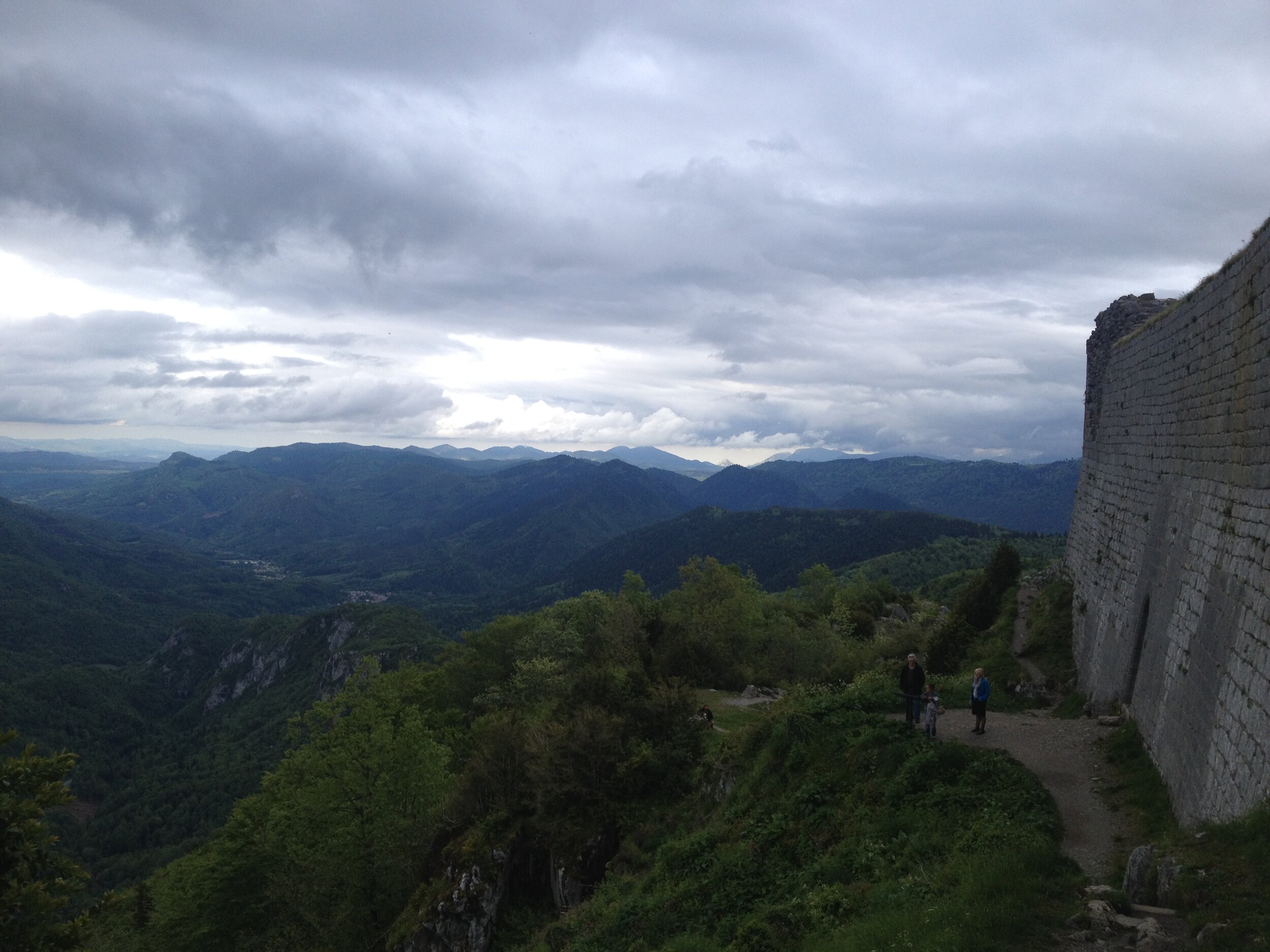
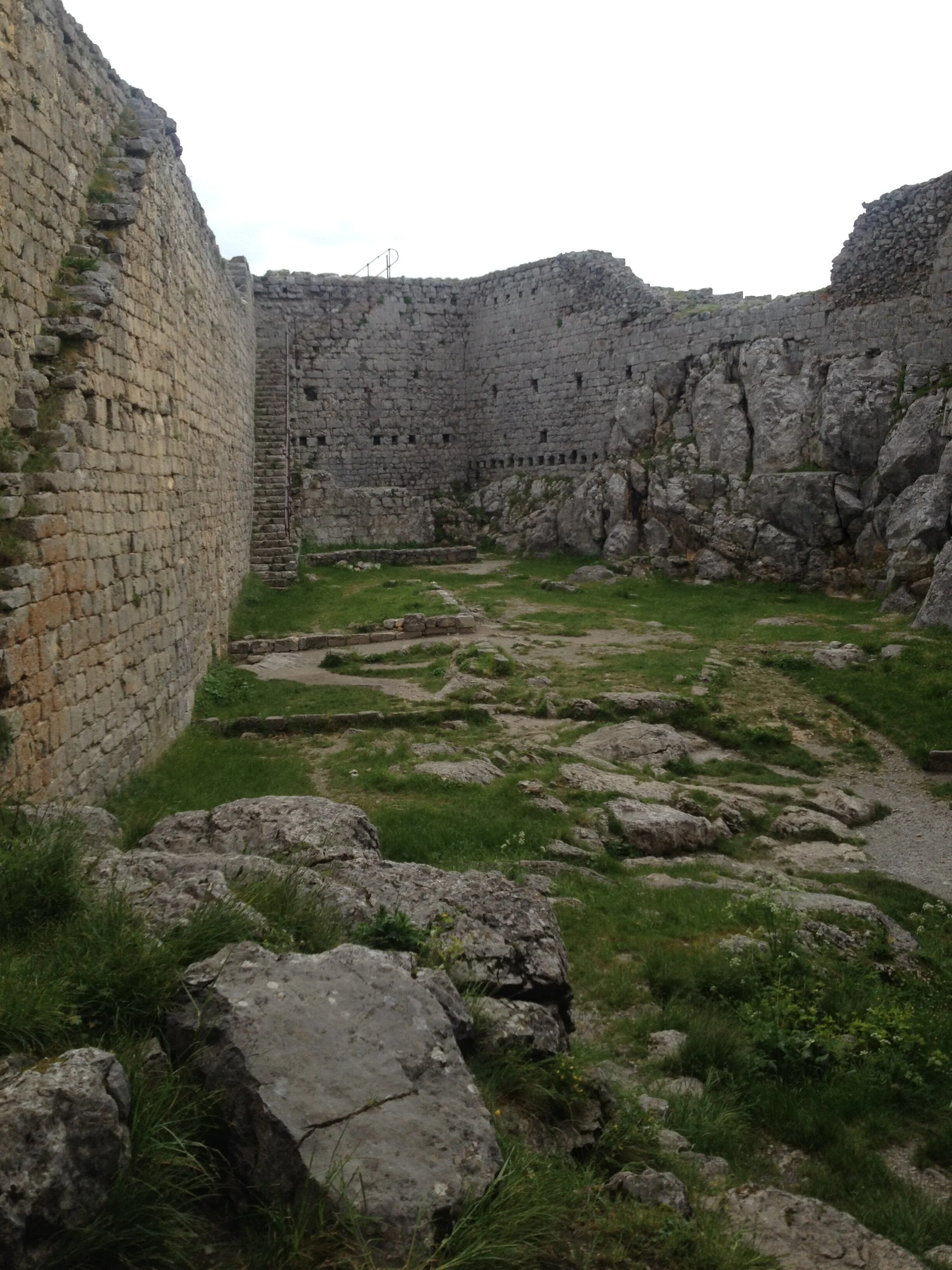
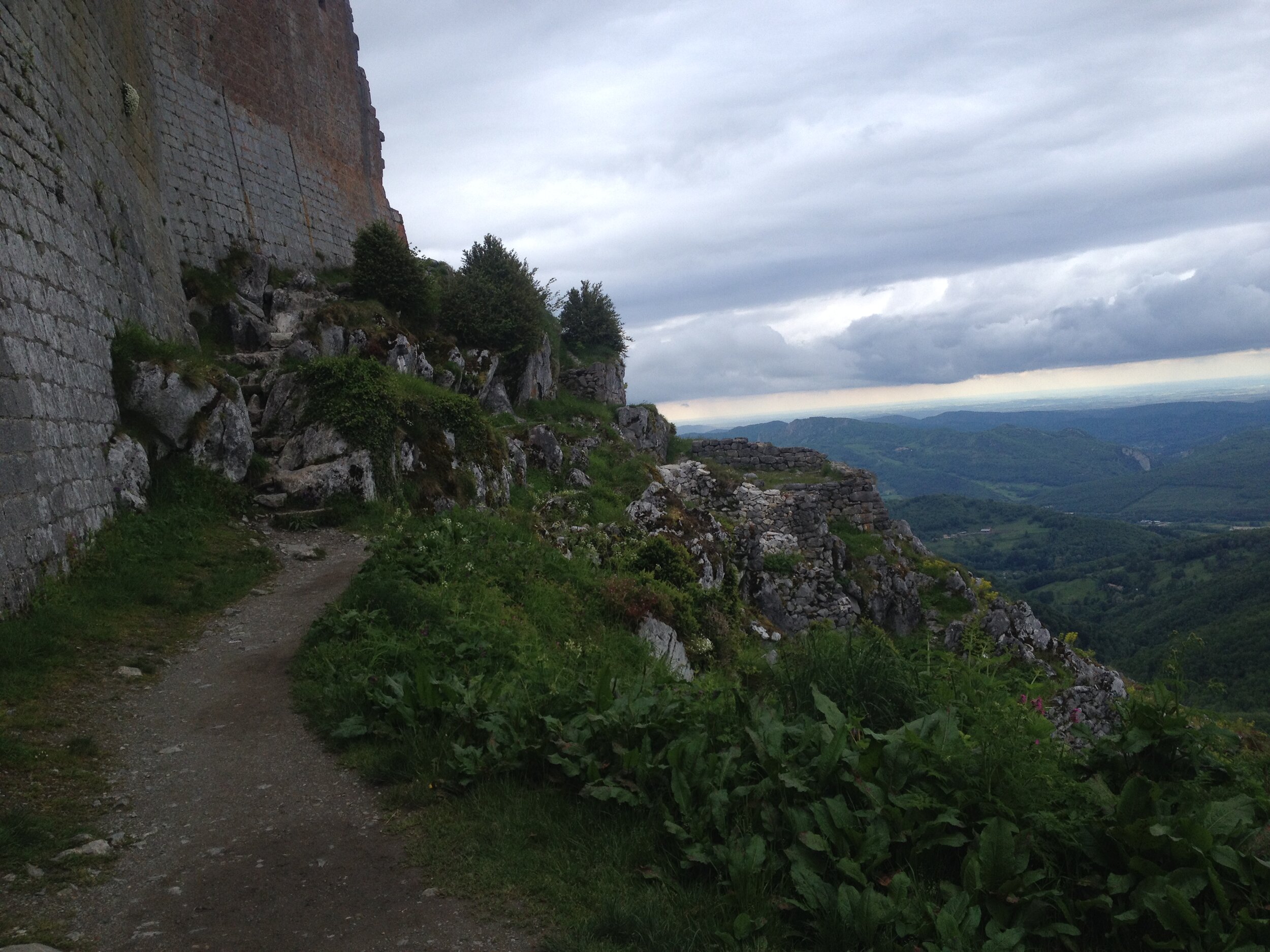
FINDING MARY MAGDALENE BLOG SERIES.
“Languedoc Part 3: Finding Mary Magdalene”
Originally Published: June 19th, 2014
Coming off my “angelic high” from the previous day’s journey to Alet-les-Bains, I awoke and prepared for another driving adventure in France. You may remember that I had previously mentioned the terror I experienced at the mere thought of driving in France. When the time finally came, the only “challenge” I had was finding a gas station among the bountiful vineyards. My second driving experience, however, was not as charming.
I took a shuttle bus to the Carcassonne airport only to discover the car rental place was not actually located at the airport; and to make matters worse, it required me take a taxi to the rental office. Crisis averted, I got the car, set my GPS in English mode, and took off for the nearest gas station. There was, however, a minor problem. The station had no gas attendant on duty to take my cash, and because my American credit cards lack a “chip,” the French card machine would not take them.
So, off I went in search of a mega gas station. Again, I encountered the same problem. I kindly asked another driver what was going on and he informed me that because it was a national holiday in France, the gas attendant would not be on duty.
Well! That would surely pose a problem with just a quarter tank of gas and several sites to visit.
I drove back to the agency and explained my dilemma, of which he could offer me no solution, but ensured me there would be a station along the way in Limoux.
Off I went. By the seventh try, I was desperate. I sat at the pump wondering what to do. Then, as if by divine intervention, an attractive man with shoulder length curly hair, pulled up in a vehicle I would certainly label a “hippie van.” He must have sensed I have a thing for the gypsy type! I realized this was my chance. As he was pumping gas, I casually got out of my car, and approached him. Turning on the charm, I smiled and asked if he spoke English. “No,” he said, fainning apology. “Okay, no problem,” I mumbled to myself, “I’ll try in French.” So off I went about my “grand problème,” and he got it! Not only did he get it, but he offered to put the gas on his credit card in exchange for my cash!
Emergency averted, I took off for the destination du jour, Rennes-le-Chateau. To my amazement, and slight embarrasment, the very next gas station I passed had an attendant on duty. Obviously, there was an important lesson I needed to learn regarding flirting and French men.
International fame hit Rennes-le-Chateau with Dan Brown’s Da Vinci Code. However, decades before, the tiny town had become notorious for the scandalous parish priest, François Bérenger Saunière. Supposedly, he had discovered a hidden treasure on its grounds. Some say it was actual golden treasure, while others believed it was the remains of Mary Magdalene. Further more, Saunière was said to hold secret information about Jesus and Mary Magdalene.
After several winding turns, I arrived at the little mountaintop village of Rennes-le-Chateau. I walked through the quiet streets toward the abbey, stopping at a gift shop along the route. Decked with books and jewelry and music - pretty much all things spiritual - I had the sneaking feeling that something quite unspiritual was brewing.
Somehow, I ended up buying a ticket for the museum, which was a conspiracy theorist’s dream. The museum gift shop even sold Rennes-le-Chateau wine, bearing Saunière’s face. Despite the lack of depth, I did find delight in the Magdal Tower, built on church grounds by Saunière.
According to Margaret Starbird, Magdal (from Magdala) means “The Tower” in Hebrew. She contends that the town of Magdala did not exist during the lifetime of Jesus and Mary, so it is more plausible that Magdala (Magdalene) was not Mary Magdalene’s given name. For Starbird, this suggests that Magdala was a name given to Mary Magdalene to denote her strength and wisdom within the community of Jesus and his followers, eventually earning her the title of “Apostle to the Apostles.”
The church of Rennes-le-Chateau was tiny and darkly lit. I knew in my heart that the spirit of Mary was not there; the energy had become more about the drama and intrigue of the Saunière story and less about her story. Mid-meditation, a camera crew entered the small church, filming a very important person, and his entourage. Images of Mary Magdalene were numerous, yet I found myself annoyed by the “scene” of Rennes-le-Chateau, and quickly left for solitude just outside the town walls. The surrounding grounds were beautiful and lush, and despite my overall misgivings, I feel there may lay a secret of Mary hidden within the hills of Rennes-le-Chateau.
I eagerly left Rennes-le-Chateau, but first, made time to enjoy a fabulous lavender creme brûlée.
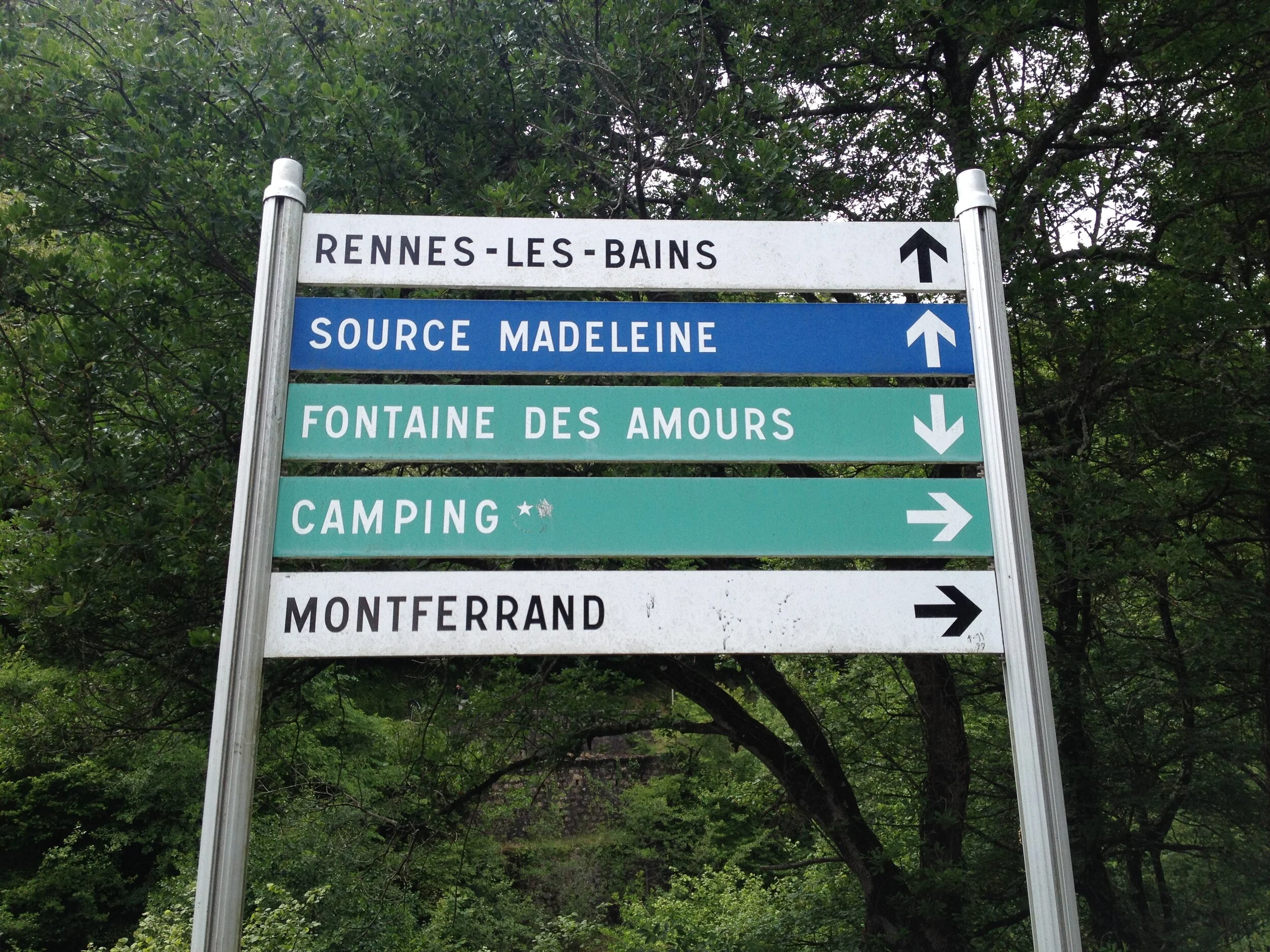
Next I drove to nearby spa town, Rennes-les-Bains. I was mesmerized by its beauty and vibrant energy. Hippies littered the streets. Inside I jumped for joy. Along the ancient pathways and the river of Rennes-les-Bains, one can find such glorious sites as the Seat of Isis, The Source Madeleine, and the Fountain of Lovers; where, legend has it, if you and your lover bathe naked in its waters, you’ll be lovers for all time.
Sadly, I was out of time. I left Rennes-les-Bains—promising to return soon—for Mt. Bugarach, a supposed former Essene community tucked away in the Pyrenees. I took a stroll through its empty ancient streets, admiring Mt. Bugarach, as it loomed over the city; a stoic protector of an ancient lineage forever in hiding from the ancient Roman Empire.
Severely behind schedule and over my allotted mileage, I decided to head to Montségur. To miss such a sight was not an option for me. Despite overwhelming car-sickness, I drove like the wind through the endlessly winding roads of the Pyrenees. After much anxiety and doubt that I would ever reach Montségur, my GPS informed me I was 5 kilometers from my destination. A heavy mist hung in the air, as I drove further into the heart of the Pyrenees and Cathar country.
I looked up and was overcome by the view of a fortress nestled high upon a mountain peak. “How stunning!” I exclaimed to myself. “How beautiful and majestic. But that CAN’T be Montségur. I only have 5 kilometers left…I’ll have to visit that site next time I’m in the region.” Ten minutes later, as I approached the town of Montségur, I realized that that fortress was indeed, Montségur.
Seeing the fortress high above me, I parked my car and prepared myself for the ascent. The path was rocky and steep, but I felt encouraged by fellow pilgrims. Along the route I could hear the melodic ringing of bells, dangling from the necks of cows, far off in the distance. As I approached the summit I turned to look out among the sea of mountain peaks, and was rendered nearly speechless. “This must be what Heaven looks like,” I whispered. For as far as the eye could see, were voluptuous green mountain peaks, extending outward past Spain, and reaching what I imagined to be, the Atlantic Ocean.
Face-to-face with the now abandoned majestic fortress of Montségur, I imagined life streaming in and out of it’s stone walls. I entered the fortress and a sudden stillness came over me, as if I were walking into someone’s intimate space. The inner walls of the fortress held the laughter of children. I could almost see them playing hide and seek. I realized there was a presence still lingering from the trauma of long ago.
Montségur gained notoriety for being the last stronghold of the Cathars in the face of the Crusades. History has mixed understanding of the Cathars, with the most commonly held belief that the Cathars were a serious acetic religion that believed the material world to be sinful, and therefore devoted all their attention and energy to the spiritual realm. In esoteric circles it is believed that the Cathars were actually the keepers of an original Gnostic Christianity. Their primary teacher, Mary Magdalene. And, depending on who you talk to, Jesus as well. The Cathar faith and belief held the knowledge of the Holy Grail, which was protected by the Knight Templar, and had connections to the activist medieval love poets, the Troubadours. To read Joseph Campbell’s exciting commentary on the Troubadours, click here:
https://journey-to-the-goddess.tumblr.com/post/86396881610/marriage-in-the-middle-agesas-in-most-of
The Church launched a full-out crusade against the Cathars and region of Languedoc. They slaughtered and burned them, until only those of Montségur were left. After a year siege, the water supply within the high fortress of Montségur failed, leaving the Cathars with no choice but to surrender. The Church, feeling “generous,” gave the Cathars the option to convert to Catholicism and be saved, or be burned at the stake. After a 15 days truce, it was over. All 200 Cathars - men, women, and children - calmly walked down the mountain and into the burning pyres. And that was, essentially, the end of the Cathars. Some believe a few escaped and kept the knowledge alive. Still others say those who escaped kept the royal bloodline of Mary and Jesus alive.
Upon my descent, I looked out at the endless horizon and wondered what it was like for the Cathars, in the face of certain death, to see this view for the last time. So I chose to honor the Cathars the only way I knew how: by infusing each step I took down the mountain with honor and dignity, for a people willing to die for their beliefs.
My drive home was full of emotion. The mystique of the Pyrenees faded into perfectly manicured rolling vineyards, and country houses made of stone.
I returned my car without problem and made my way back to Carcassonne. Suddenly, I realized my pilgrimage was officially over. I smiled as I reflected on the months of planning and hard work it took to prepare for this pilgrimage, that resulted in a life changing two week adventure. The icing on the cake? On the following day I would be turning 31 in my new favorite French city, Arles.
~~~~~~~~~~~~~~~~~~~~~~~~~~~~~~~~~~~~~~~~~~~~~~~~~~~~~~~
My heart bursting with love, I traveled from Arles to Nice and from Nice down into Italy. An open invitation awaited me in Ischia. Tears fell from my face as I crossed over the French border into Italy. For this self-proclaimed Italophile, something new was blooming inside, something unexpected: a yearning to return to the southern region of France, where Mary Magdalene is honored and revered as a woman of courage, devotion, and passionate love. Her name and reputation have been dirtied for nearly 2,000 years, as a way to manipulate and control people. One result, women have been placed secondary to men. This, as history is our witness, is a great disservice to women and men alike.
Although back in the states, my quest for Mary Magdalene has only just begun. Many others have come before me, and surely there will be plenty to follow. To France and back, my search for Mary Magdalene has led me back to me. My journey is her journey, and from this place of wisdom, I am truly finding myself.
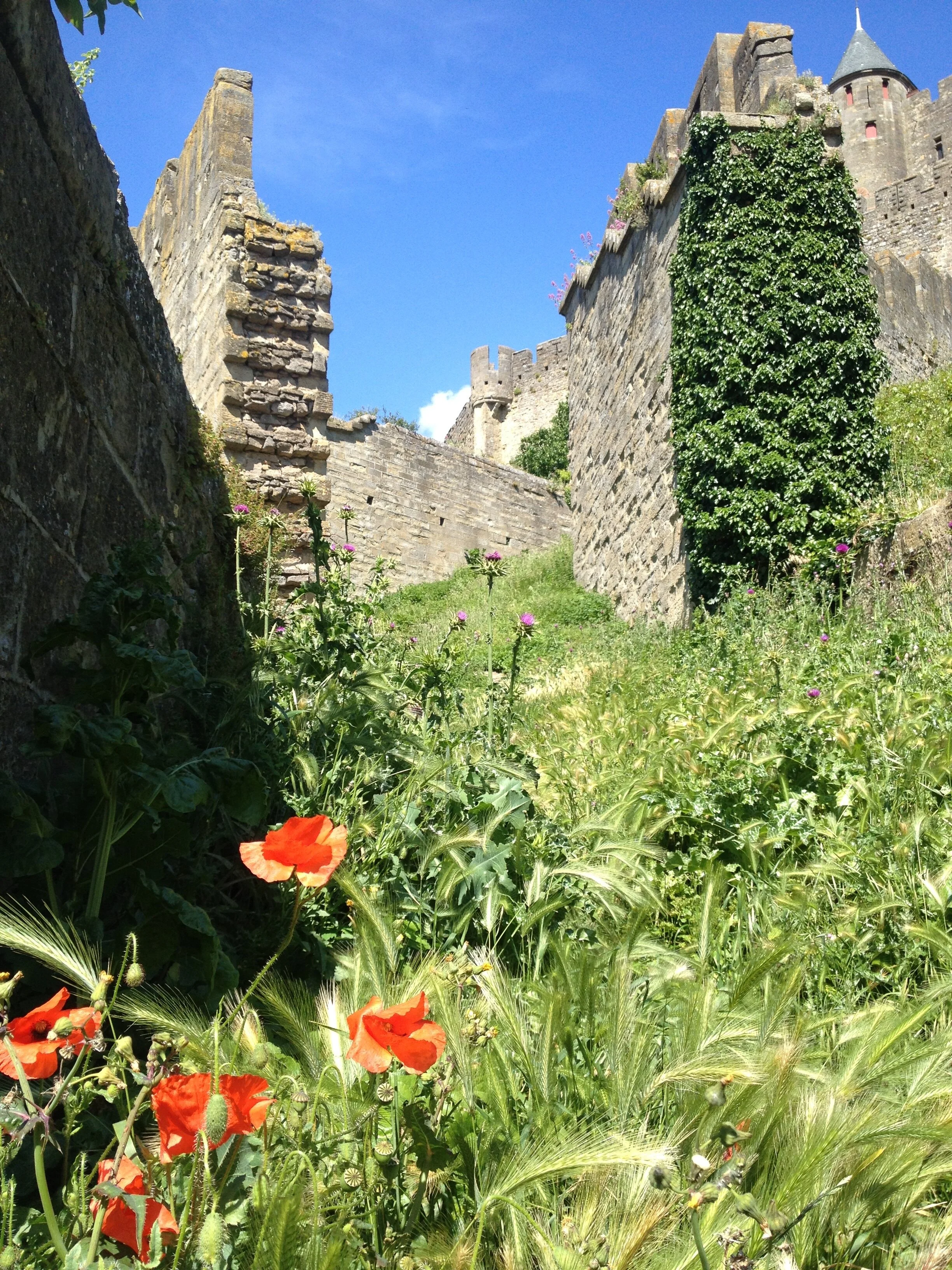
The Fortified Medieval Castle of Carcassonne
Continuing on, I toured the contours of the castle. I explored the Basilique of Sainte Nazaire, discovering a magnificent life-size marble engraving of a Knight Templar, supposed protectors of the Cathars. At the right of this knight, stood a statue of Saint Anna, my patron saint, sitting with her young daughter, the Virgin Mary. Stained glass windows seemed to contain the symbols, and messages, of a suppressed wisdom . . .




Finding Mary Magdalene Blog Series.
“Languedoc, Part 1: The Fortified Medieval Castle of Carcassonne”
Originally Published: June 12, 2014
Because of my hotel mishap in Les Maries, I had an extra day at my disposal. I decided to use that as an opportunity to spend a night in Arles.
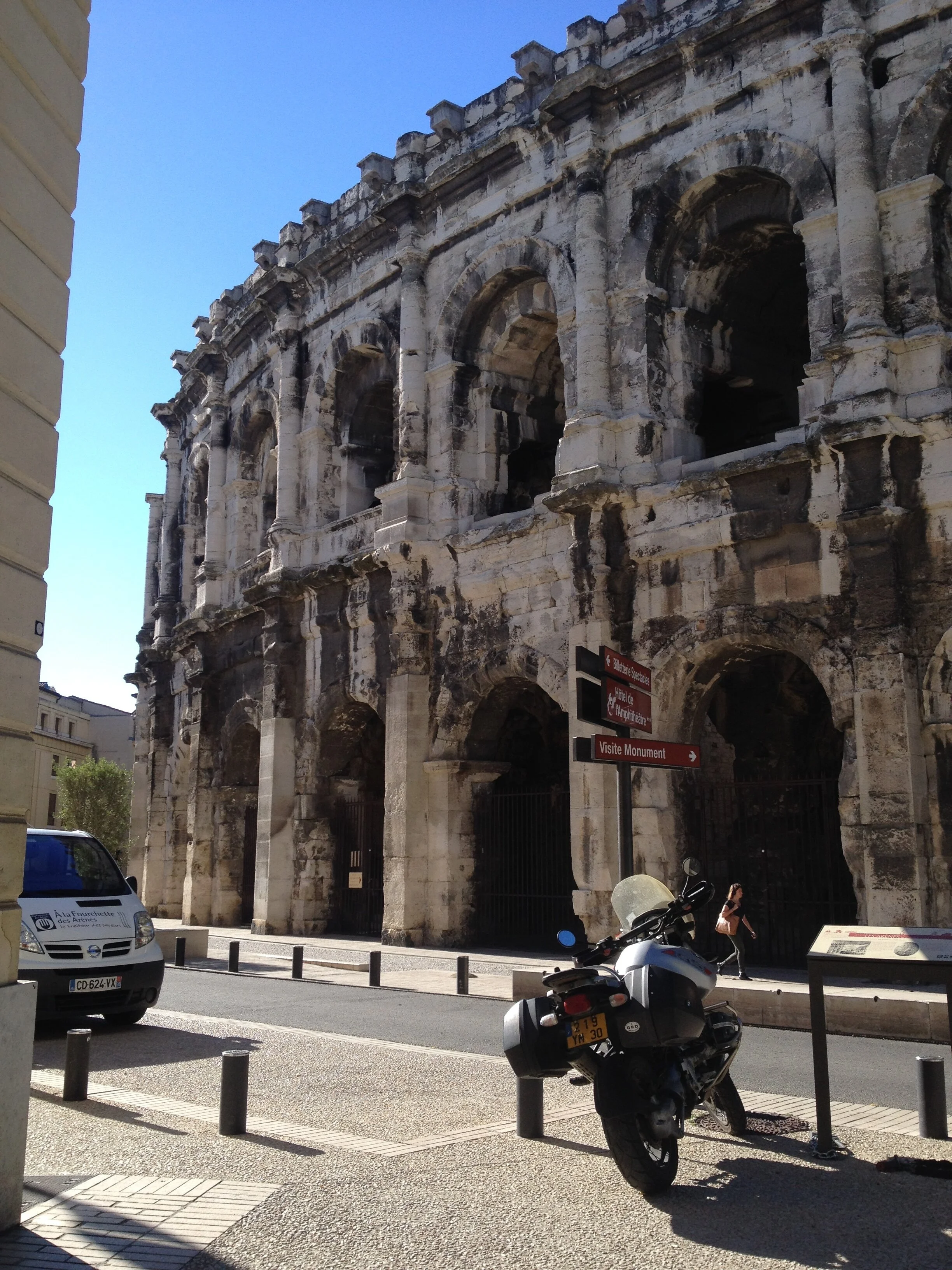
Arles has a reputation for being one of the most charming cities in southern France; and boy, does it live up to its reputation! Teeming with life and verve, Arles was the final home and inspiration for some of van Gogh’s most famous paintings. It sits along the Rhone and has been colonized by many peoples, most notably, the Romans. It at once feels very Italian–complete with a fully intact Roman amphitheater–yet oozes French charm.
Hôtel - Musée, my hotel for the night, provided me with the perfect backdrop to complete my French Country Dream. Chic, warm and cozy, my room smelled of lavender. Aged green shutters opened up to a glorious view of the quaint patio below that was adorned with jasmine, roses and climbing vines; terracotta tiles and cast iron patio furniture.
I spent the evening walking in a dream world. I found a neighborhood cafe and quickly made myself at home. A glass of wine and fondue, and viola, my life was complete.
I awoke the next morning with a sadness in my heart, and made my way to Nîmes.
Nîmes is also a former Roman colony, but has the underlying feeling of brute force, lacking the quaint charm of Arles. I stayed an uneventful night there, before heading to my final pilgrim site, Carcassonne.
Carcassonne cite is a fortified medieval city that embodies, among other historically important events and peoples, the wisdom of the Cathars and Templars.
After plopping my stuff in the hotel, I decided to spend the rest of the afternoon exploring the medieval castle at the heart of the city. I made my way over the ancient bridge that connected the ville basse with the cite. I explored the park on either side of the river, quietly listening for the hushed voices of the city’s guardians. Following their lead, I sat near the river, digging my hands into the moist earth, absorbing the centuries of history that had traversed this land.
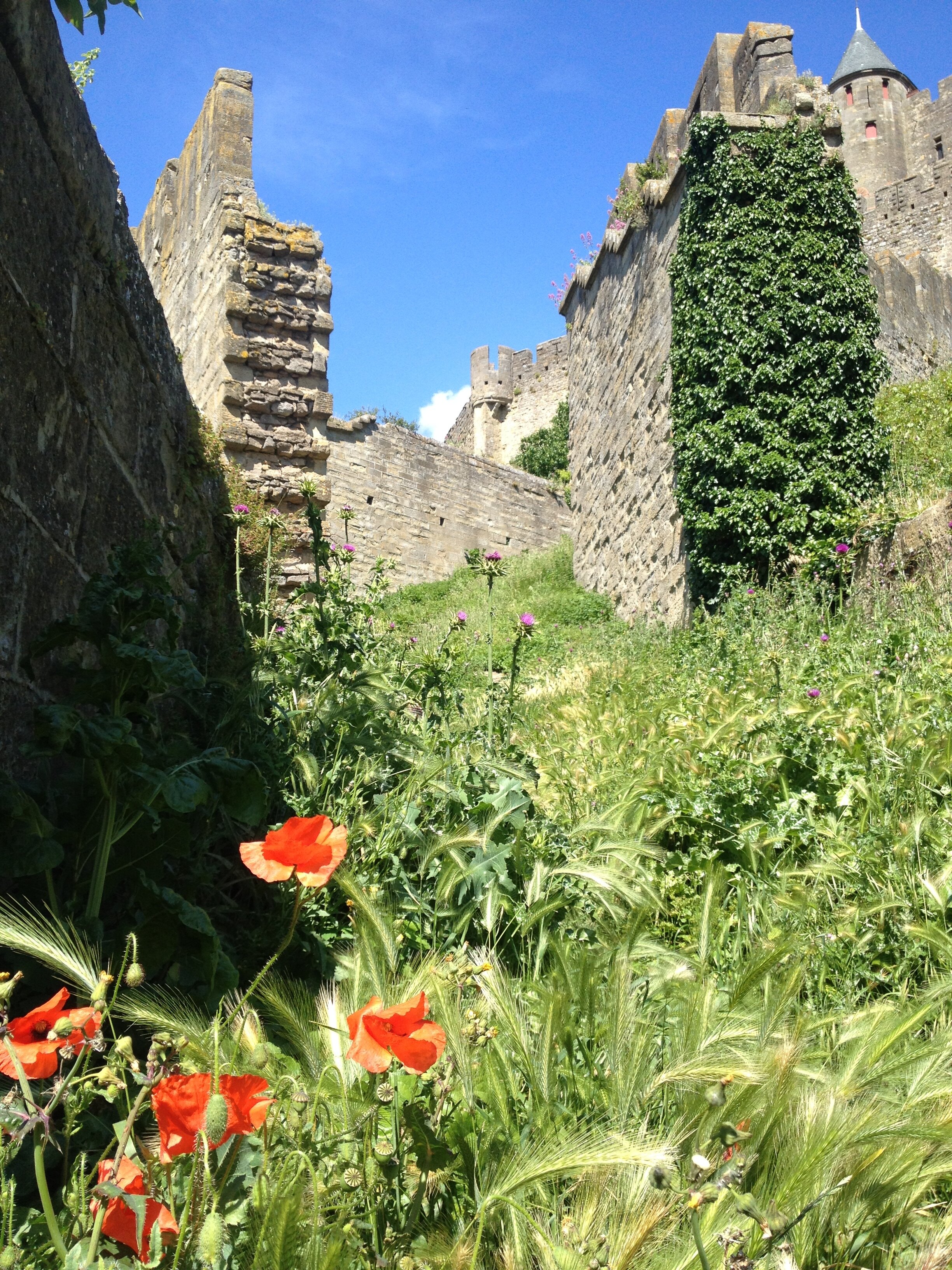
Feeling the “call of the castle,” I made my way to an ancient pathway, that I imagined once welcomed returning heroes along its route. Overgrown with weeds and wildflowers, remnants of the ancient stone way remain. I looked up and felt the brute strength it took to build these walls. I felt the sweat of the hundreds of men who spent their lives building this fortress, in service of the kingdom. And then I sensed him; a knight who had returned from battle, longing to be in the embrace of his secret lover. His presence so strong, I wondered: was that me in a past life?
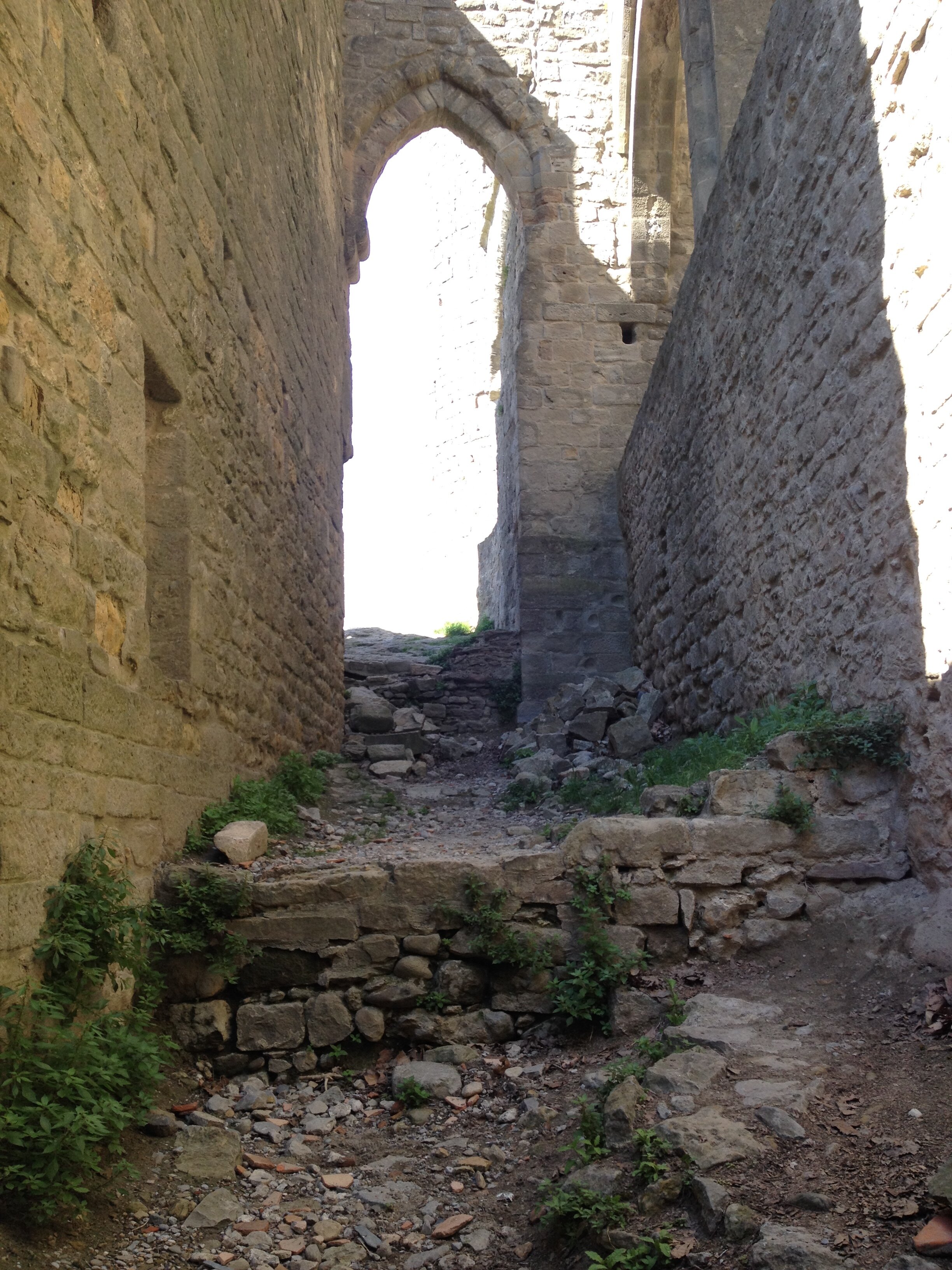
A force compelled me further along the path. No longer in everyday use, I wondered if I had discovered a secret portal to another realm. I climbed, and to my surprise, found myself at an entry point beyond the first layer of castle walls.
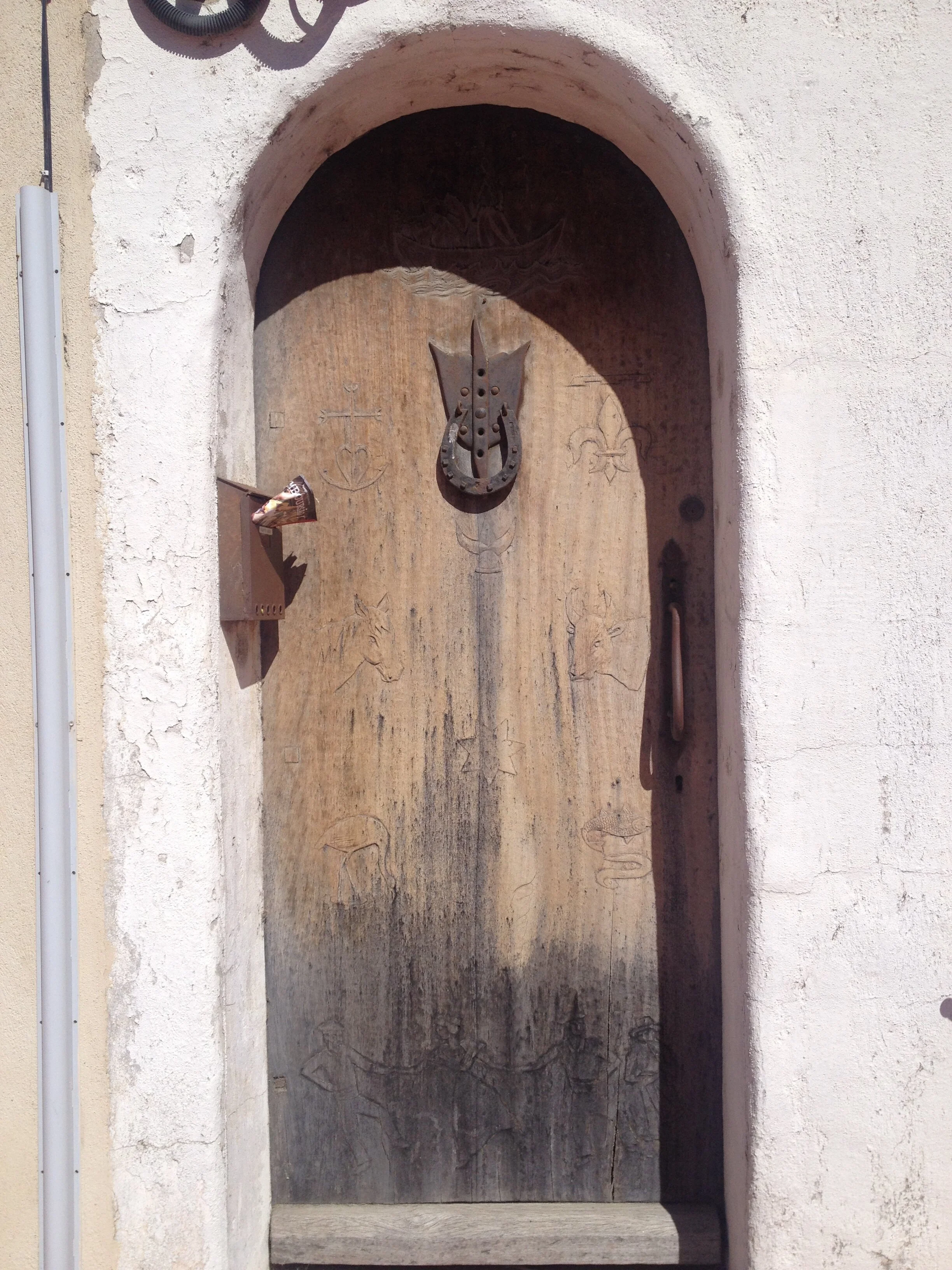
I was called to a large, non-descript wooden door. Reaching out to touch the door, I remembered. I remembered what it was like to be her, the princess or nobelwoman awaiting her knight, in secret. Their love affair, forbidden. In a flash, the entirety of their romance and tragic end came into my consciousness, as I felt her anticipation, and her pain. Every corner I turned, contained more memories of their romance: their hopes and dreams, and their love.
In my heart, I could hear her say, “I am sorry my love. Please forgive me. I am so sorry.” Tears flooded my eyes, and I felt immense pain for the hurt she had caused this man.
And so, with the encouragement of Mary, I prepared myself to do a ceremony in remembrance, and to release this past trauma. I didn’t know where or how, but I knew the answer would come to me in time.
Continuing on, I toured the contours of the castle. I explored the Basilique of Sainte Nazaire, discovering a magnificent life-size marble engraving of a Knight Templar, supposed protectors of the Cathars. At the right of this knight, stood a statue of Saint Anna, my patron saint, sitting with her young daughter, the Virgin Mary. Stained glass windows seemed to contain the symbols, and messages, of a suppressed wisdom.
For dinner, I splurged on a fabulous pork cassoulet, famous cuisine from the region.
As the sun began to set, I decided to head home. However, my path took me just along the outside of the castle walls. Heeding her call, Mary had found a place for me to perform a small ceremony, softly illuminated by the last remaining orange and pink rays of sun.
Not-so-elegantly, I waded through the tall grass, reaching out toward the castle wall for support. I pulled out my stones–some of which I had found earlier by the river–and looked out over the town below. Crying, I felt a burden lift from my spirit.
Upon my descent, I took the same route down, as I had up. Acknowledging that this was the last time I would ever need to walk these steps, I left a poppy in the wall–a gift she would have given him long ago–as a remembrance of the love shared between the star-crossed lovers.
As I approached the parking lot, the sun had nearly set, and I turned to have one more glance at the castle. In my mind’s eye, I could see the couple waiving me goodbye. Happy and liberated, they were free to live in their bliss for eternity, and I free to find my own.
That night, I slept well. With two more days left, and many sites still to visit, I felt at peace, and wondered what the next days would bring.
READ NEXT BLOG: The Angel Sanctuary of Alet-les-Bains

The Gypsy Festival of Les Maries
As Provençal legend has it, Mary Magdalene arrived on the shores of Gaul with Mary Salome and Mary Jacobe, and possibly Joseph of Armithea. The mystery and intrigue of this legend involves a woman named Saint Sara. Some claim she was a native of Gaul who greeted the party fleeing the Roman Empire. Others say she arrived on the boat with the Marys, either an Egyptian handmaiden to Mary Magdalene, or better yet, the secret daughter of Jesus and Mary. Either way, Saint Sara has become the patron saint of the Romani people the world round, and I was headed there for the annual festival in honor of Saint Sara . . .



Finding Mary Magdalene Blog Series.
Saintes-Maries-de-la-Mer, Part 1: The Gypsy Festival of Les Maries
Originally Published: June 2, 2014
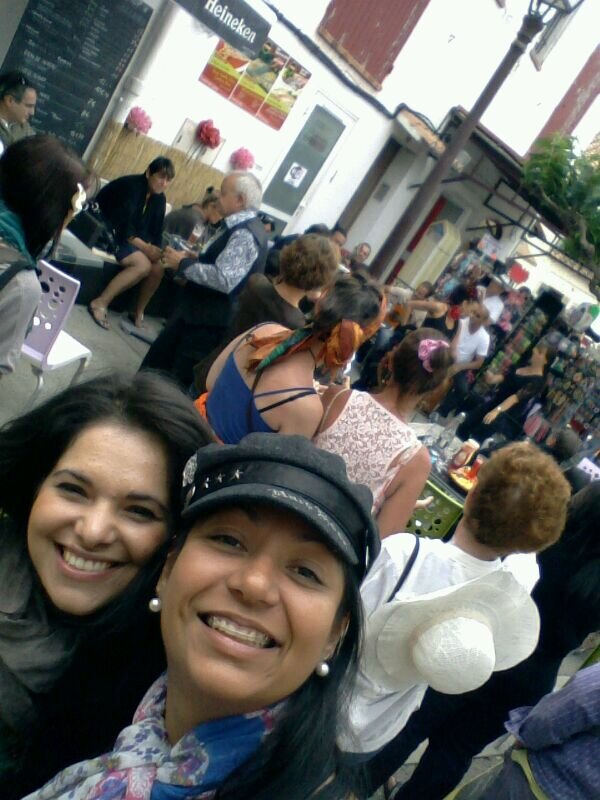
As Provençal legend has it, Mary Magdalene arrived on the shores of Gaul with Mary Salome and Mary Jacobe, and possibly Joseph of Arimathea. The mystery and intrigue of this legend involves a woman named Saint Sara. Some claim she was a native of Gaul who greeted the party fleeing the Roman Empire. Others say she arrived on the boat with the Marys, either an Egyptian handmaiden to Mary Magdalene, or better yet, the secret daughter of Jesus and Mary. Either way, Saint Sara has become the patron saint of the Romani people the world round, and I was headed there for the annual festival in honor of Saint Sara.
Saintes-Maries-de-la-Mer is a tiny beach town in the Camargue region of France. It is surrounded by a national park that is filled with long green grass and canals, all of which accommodate migratory birds from Africa. The feel is somewhere between American west and Spanish Conquistador.
But before I found myself in Les Maries, I first had to find a way to get there from Arles–an exquisitely BEAUTIFUL town in France. So, I made my way to the tourist office and started a conversion with another woman looking to get to the festival. As it turns out, Celice, a Venezuelan national, was also on a pilgrimage. Hers revolved around the Camino de Santiago in Spain, but overlapped with the western French sites associated with my Mary Magdalene pilgrimage. Celice and I became fast friends. In fact, we were inseparable for those few days at the festival.
Celice and I found the bus, (super easy and way cheap), to Les Maries. We chatted the whole time about our pilgrimage experiences thus far, and also about all we hoped would happen at the festival.
As the bus approached our destination, it turned out that our hotels were right next to one another. (Kind of strange for a small town with several hotels). I laughed at the synchroncity. She told me she stopped seeing our similarities and meeting in Arles as coincidences, but as something more predestined. I walked her to her hotel first, and made a plan to meet her in two hours, but she insisted on walking me to my hotel for check-in, as well.
The moments that followed were very telling of what would come: My hotel had never received my reservation and down payment from the third party site I had originally booked through. And to top it off, they were completely booked for the festival. In her fashion, Celice said, “No problem, she’s staying with me.” In disbelief, I gladly accepted her offer.
My ex-hotel invited us to their private dinner/flamenco show that night. We gleefully arrived amongst the colorful guests, and were seduced by the home-cooked food and soulful Spanish gypsy music. Gypsies from the crowd, including a family from Brazil, danced and sang, as we shared wine and a love for the beautiful music.
Exhausted, yet in anticipation for the following day’s culminating fesitval event,The Procession of Saint Sara, Celice and I returned to the hotel, hardly able to sleep a wink. For my part, I thanked my guardian angels for the new friend, and angel, they sent my way.
READ NEXT BLOG: The Procession of Saint Sara
The Pilgrimage Begins
The Legend of Mary Magdalene post crucifixion is sort of a “choose your own adventure” story. However, what is commonly held as truth, in the South of France at least, is that Mary Magdalene, along with Mary Salome and Mary Jacobe were set assail in a boat belonging to Joseph of Armithea. They were in exile, fleeing the Roman Empire, and . . .
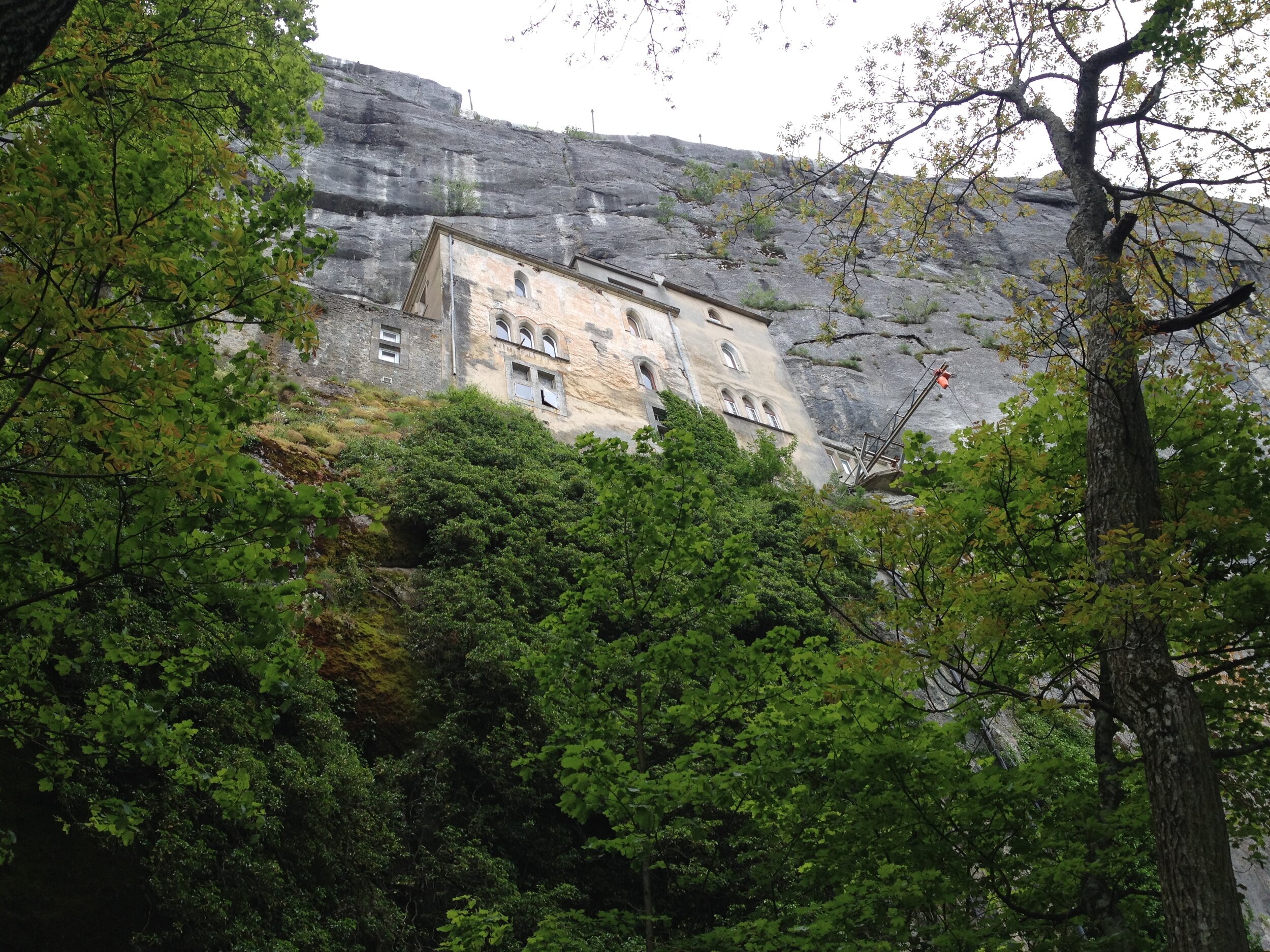
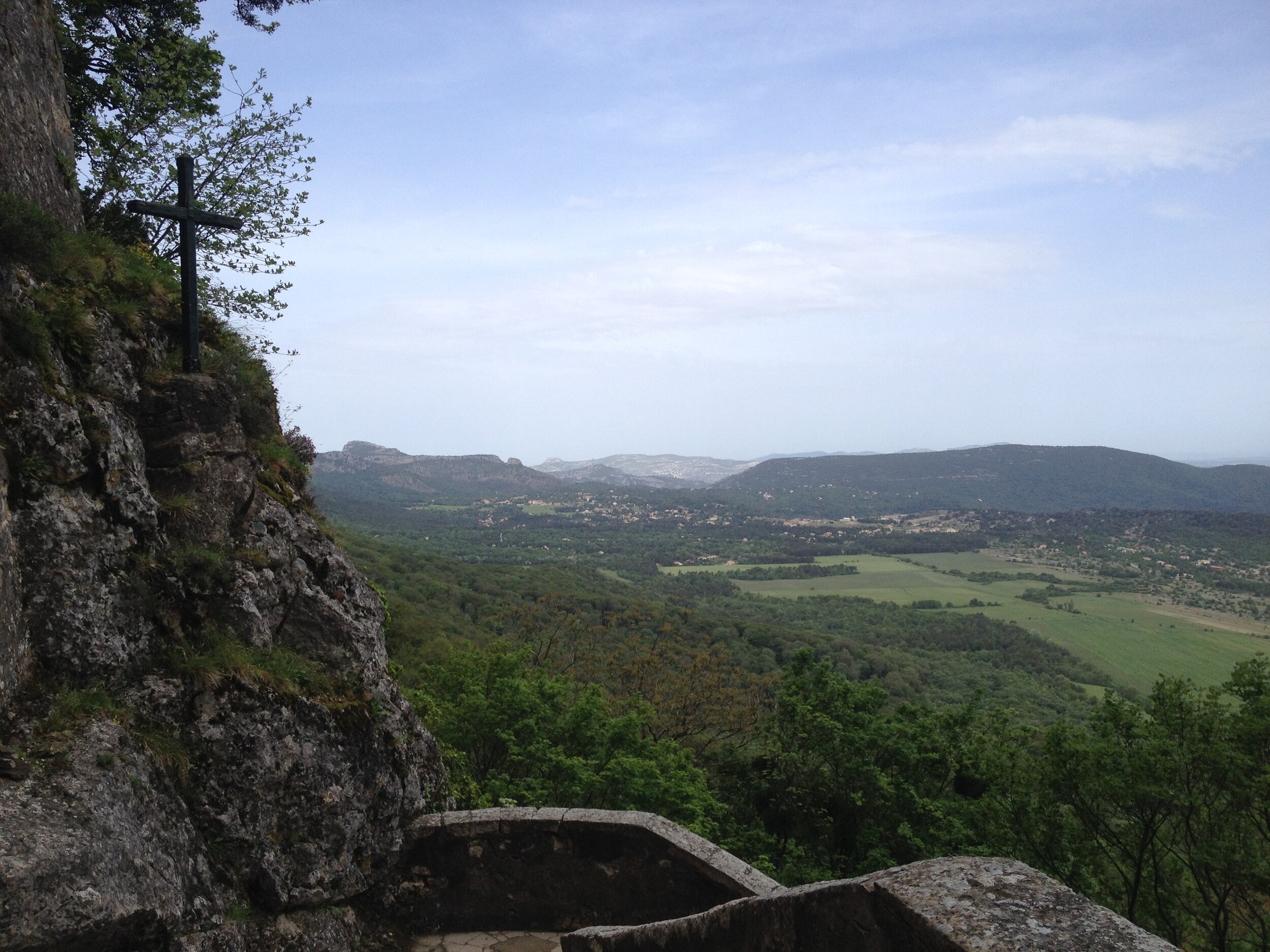
Finding Mary Magdalene Blog Series.
“The Grotto of La Sainte-Baume, Part 1: The Pilgrimage Begins”
Originally Published: May 27, 2014
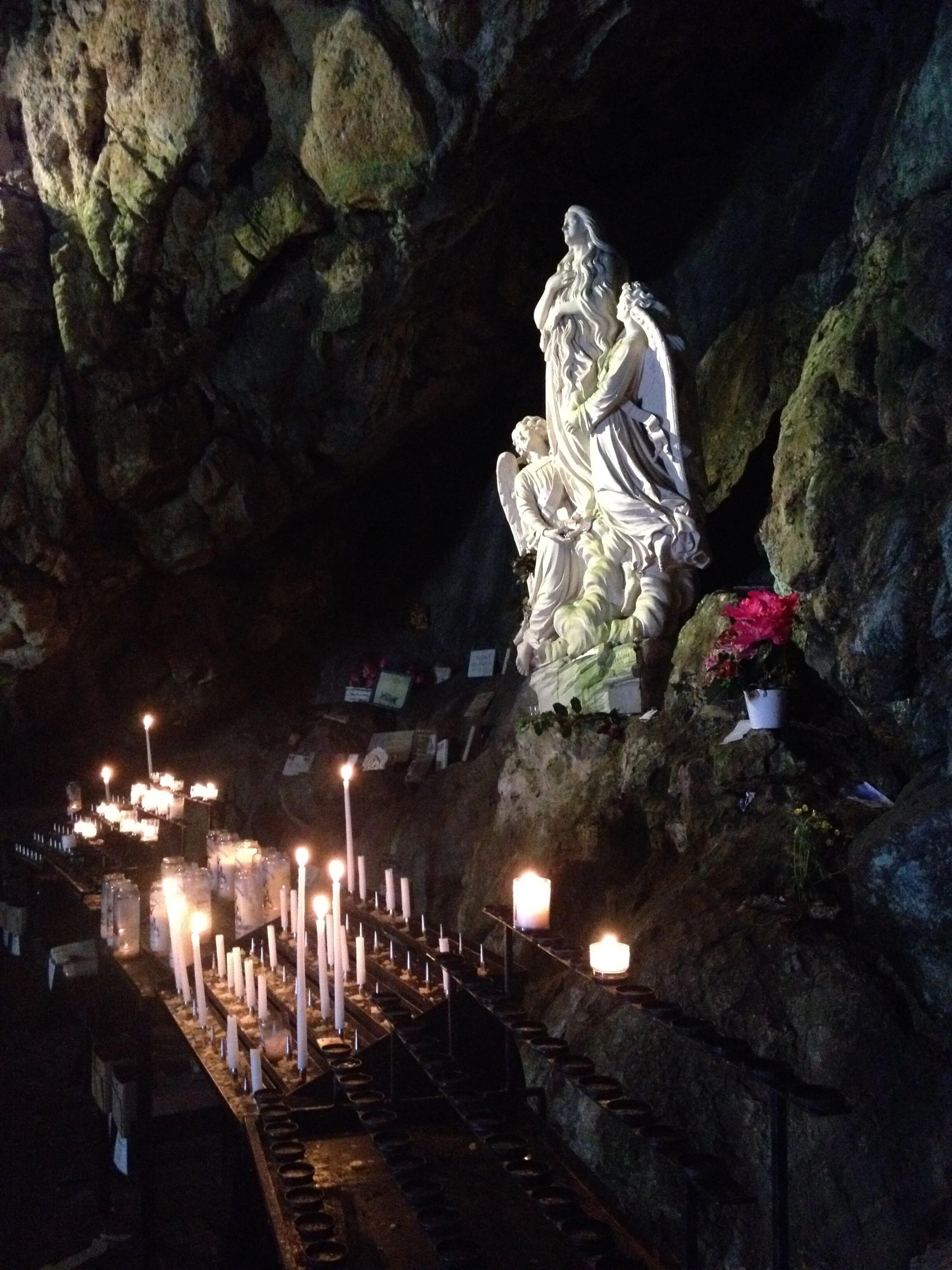
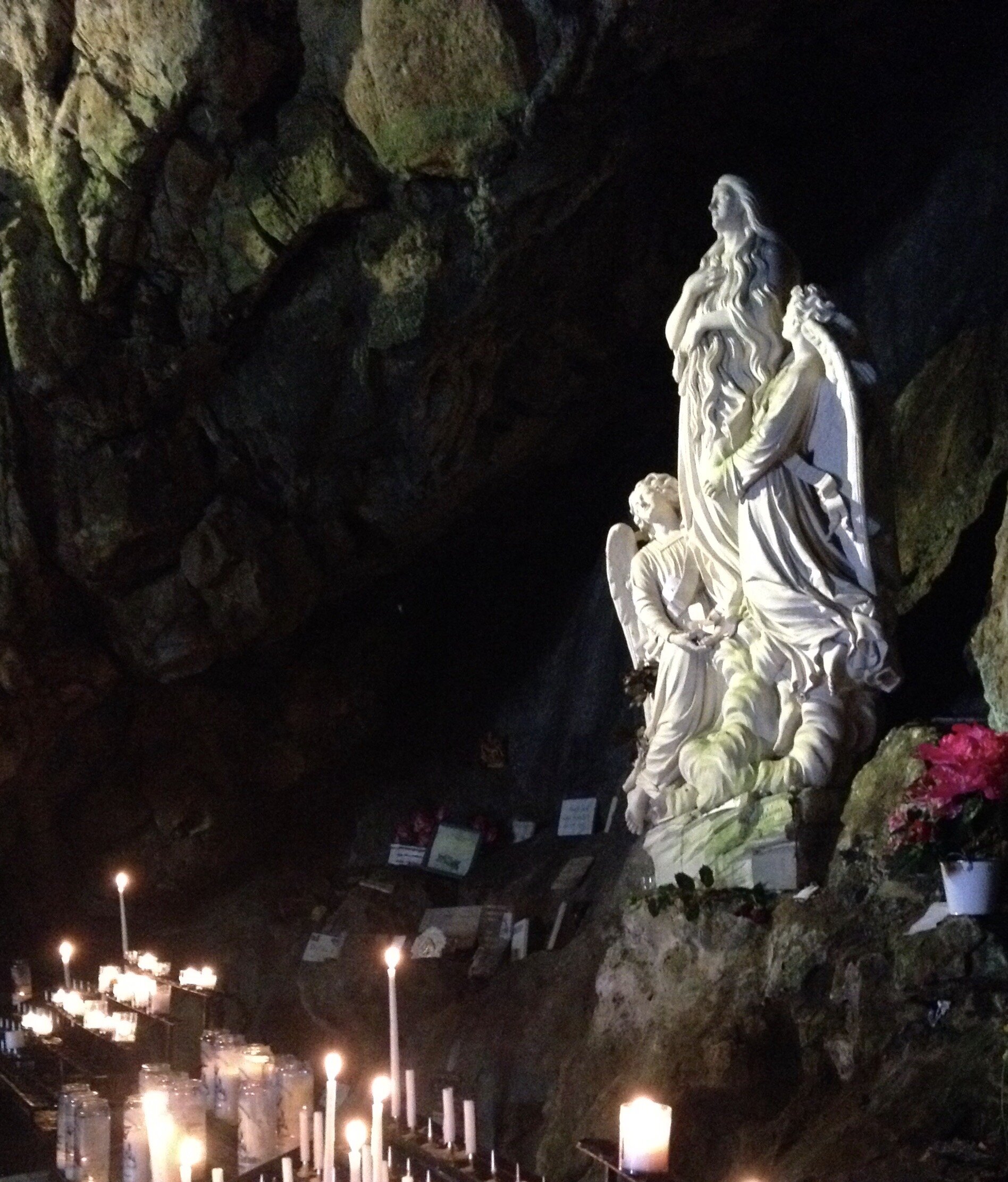
The Legend of Mary Magdalene post crucifixion is sort of a “choose your own adventure” story. However, what is commonly held as truth, in the South of France at least, is that Mary Magdalene, along with Mary Salome and Mary Jacobe were set assail in a boat belonging to Joseph of Arimathea. They were in exile, fleeing the Roman Empire, and determined to spread the message of The Way, as expressed by Jesus. Their ship landed upon the shores of what was once known as Gaul, but today is known as the Camargue region of France, in a little sea-town called Saintes-Maries-de-la-Mer.
Although there are many variations on the Mary Magdalene legend throughout the region, the dominant version is that, after preaching the gospel to the inhabitants of Provence, Magdalene eventually made her way to the cave, La Sainte-Baume. There she spent thirty years in prayer and meditation, taken to the heavens by angels every hour of the day for material and spiritual sustenance. And this is where my story begins:
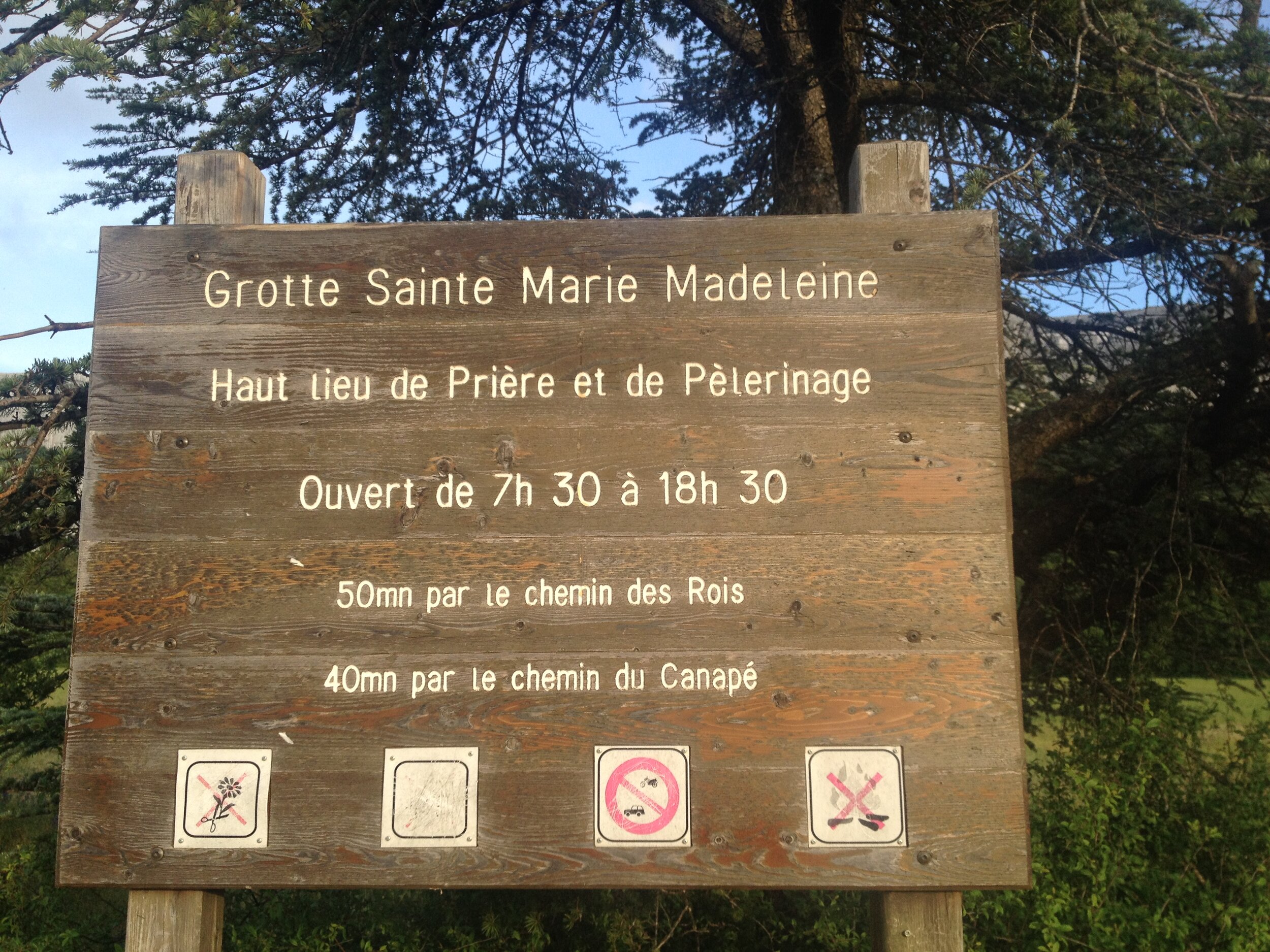
La Sainte-Baume is a pilgrim site at the base of Le Plan d’Aups. One must rent a car to get there, which, admittedly scared the crap out of me. For months I had been worrying about driving in France. Well, long story short, I finally made it to the Aix-en-Provence train station to pick up my car: a compact citroen diesal engine - tiny, lightweight, and non-descript. After several deep breaths, as if preparing myself for child-birth, I began my engine and took off for La Sainte-Baume.
Wanting to ease into my European driving experience, I chose to avoid the highways and instead took the back route from Aix to Saint-Maximin and then onto La Sainte-Baume. After about ten minutes, the English-accented GPS guide and I had a running joke about his constant command to “Cross the round-about.”
The drive to Le Plan d’Aups was stunning. I drove through vineyards and unpaved countryside roads. After climbing from Nans-les-Pins to the base of Le Plan d’Aups, on what was practically a single-lane road, I came upon it: La Hostellerie de La Sainte Baume. The Hostellerie is a functioning monastery run by the Dominican order. They hold daily mass in the Hostellerie as well as in the cave of Sainte-Baume.
After depositing my baggage, I took a walk outside. The cave-turned-monastery lay just above the tree tops, awaiting my arrival the following day. I walked through the ancient untamed grass strewn with poppies and crickets. I felt the wind upon my face–which I was later told was coming eastward from Greece…ahhh, only a French man could make such a statement sound so romantic! I imagined Mary Magdalene walking upon this land 2,000 years ago. I slept well, knowing I was in the care of Mary.
The following day at the communal breakfast–which included a morning prayer and Sunday School songs–I met 17-year-old Marie, her mother Jean and grandmother Marie-Therese. This encounter put my French language skills to the test, as these ladies spoke almost no English. So, I braced myself, and allowed our mutual passion for Mary Magdalene guide the way.
Jean asked me why I had come all this way, by myself, to La Sainte-Baume. I told her, “For Mary Magdalene. Why? Because I love her.” Jean looked me with piercing intensity, and said, “It is because she had so much love for Jesus.” Taken aback by the simple, yet deeply resonate statement, I could do nothing but nod in sincere agreement. It was then I understood the real impact Mary Magdalene has had on her beloved followers for millennia.
I looked around the room and suddenly realized that it was full of people with a deep love and reverence for one of the most important women in Jesus’s life. Many of us had different interpretations of this love, but it was the pureness of Mary’s love–not a religious pureness, but the pure potential of unconditional love–that brought us together. And it wasn’t just me. Hundreds of people come to La Sainte-Baume every day to hike to the cave and honor her.
Marie and I climbed to the top, so deep in our conversation, alla Franglais, that I didn’t notice the challenge of the steep climb. As we reached the base of the monastery, a stillness came over us.
The potency of the Sacred Feminine was in the statues of women surrounding and grieving at the foot of the cross. A life-sized scuplture of Mother Mary holding the lifeless Jesus with Mary Magdalene weeping at his feet sits across from the entrance to the cave.
As Marie and I entered the cave, a cool dampness embraced us. I could hear the dripping of water. The haunting glow of the candles allowed the presence of Mary to become very real.
I felt drawn to the furthest most corner of the cave down at the base of the staircase. Walking in silence, I turned the corner, and saw the statue of Mary Magdalene, cross in hand, in agony over her loss. After investigating the rest of the cave, I soon returned to this corner, feeling Mary’s presence strongest there. There I remained, in prayer and gratitude, for such a woman; a woman who has been misinterpreted and debased for too long.
The four of us stayed on for 11 AM Mass. The chanting of the priests rang like bells in the cavernous space….At the end of the day, France is a Catholic country, and the Dominicans are a Catholic order. And for many of them, Mary is important because of the profound love and devotion she had for Christ. Officially, she showed this love and devotion through her act of penance, as well as for her role as the “Disciple of the Disciples,” who spread the message of Jesus throughout the region. SHE brought the message of The Light and The Way–which was synonymous with her profound love and devotion–to France.
Marie eventually asked me my beliefs concerning Christ and Mary, to which I gently explained that, for me, Jesus and Mary represent the masculine and feminine faces of God. She told me she believes that Jesus is the one and true God and that Mary was his devoted disciple. I smiled and told her that I respect all points of view and at the end of the day, it is Mary’s profound love, devotion, and strength that connects us all.
After parting ways with my companions, I had lunch, but did not feel at ease. I heard the call in my heart and knew I needed to return to Mary, in that cave, and in that moment. I practically ran up the mountain. Reaching the top, out of breath, I entered the cave and was embraced by her love. I went directly for my hidden corner and prayed and asked for guidance. As I sat in meditation, she responded, “Just listen.” I laughed to myself at this simple and often repeated advice. Then and there, I stopped asking questions and surrendered to the way she would have me go and be.
Some time later, I discovered I had missed a statue of Mary behind the Priest’s altar. Here Mary appeared to recline in a somewhat erotic manner. Many notes and flowers were left, along with engravings–the oldest of which from 1863–bearing her gratitude.
And then, suddenly, I heard it. I listened, and she spoke. She asked me to give her a ceremony the following day upon my return to the cave.
Suddenly all was well. I knew the mission I had before me. I descended the mountain light-filled with joy.
That evening was filled with laughter as I met several new pilgrims; all forcing me to express my adoration for Mary in simple, yet direct ways, allowing our shared passion to do the talking.
READ NEXT POST: “The Anointed”