INANNA AND THE LION: Exploring Sacred Symbolism
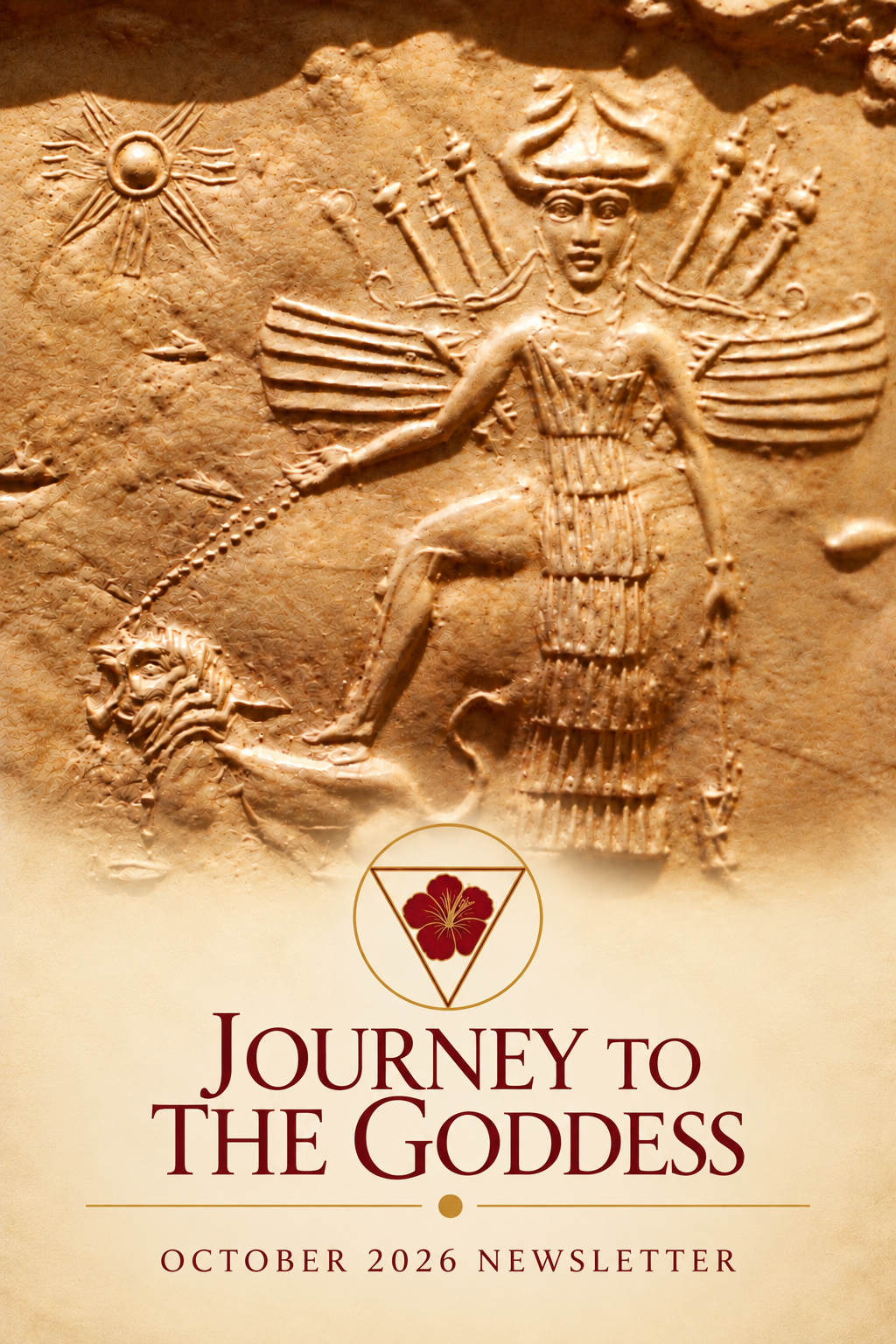
The goddess Inanna has a handful of recurring symbols that appear in myth, poetry, and imagery. One of them is the lion, or more likely, the lioness. Honestly, I’ve struggled with this symbolic motif of Inanna and the lion because of its strong association with her warrior aspect—a persona that I believe was largely developed to affirm Inanna’s role in patriarchal power dynamics of conquest and domination. At the same time, I’m also fascinated by the feline companion because of its common occurrence with goddesses throughout the ancient world.
And perhaps most revealing is that the relationship between Inanna and her lion may offer us insights into a much larger cultural transformation: the gradual development of patriarchy and the changing role and function of goddesses like Inanna within it.
So what exactly is the significance of the lion in relation to Inanna and her cultic worship?
The Lion-Goddess pairing is a Cross-Cultural Phenomenon:
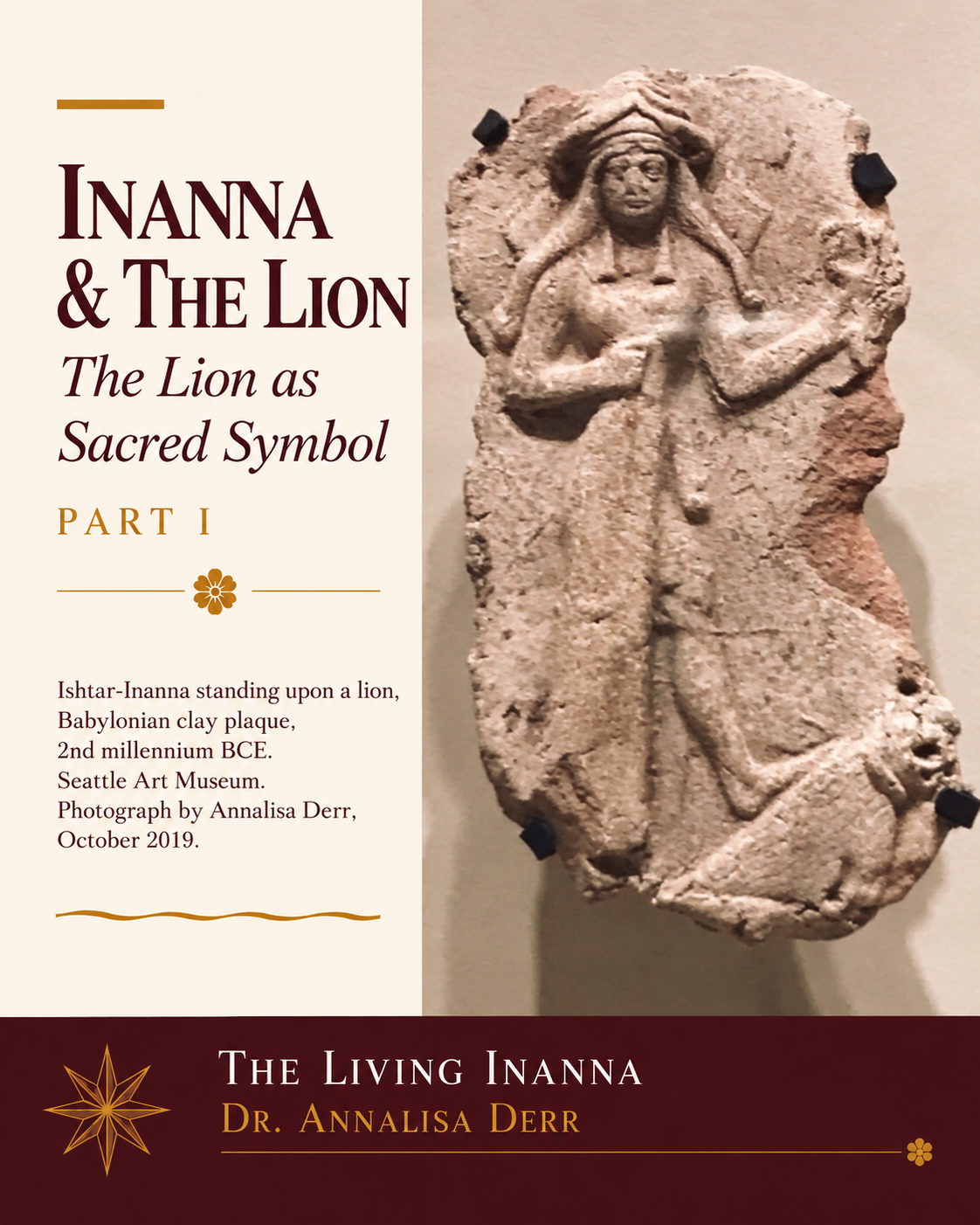
On the one hand, it makes complete sense to me that the lion would be one of Inanna’s totems or companions. Plenty of powerful goddesses in the ancient world appear alongside lions. The Hindu Durga gracefully rides into battle on her lion. The pre-Islamic Iranian goddess Anahita is also depicted with a lion. The Anatolian mother Goddess Cybele is depicted with lions, as is the even older Neolithic female figure, known as The Seated Woman of Çatalhöyük. Inanna—along with her Akkadian counterpart Ištar—are in good company amongst these other powerful goddesses. The real question here is actually why are lions a common symbol of these powerful goddesses? I have my theories, but those will have to be divulged at a later time.
The Esoteric Dimensions:
The esoteric dimensions of Inanna’s cult are far from conclusive—though I lay out my theories in my forthcoming book. Because the historical evidence cannot answer what the lion may have symbolized spiritually in relationship to Inanna, a cross-cultural approach invites us to consider other possibilities. One of my teachers, Raja Choudhury, explains that within the tantric tradition there is a Goddess of the Golden Dawn, who represents the direction of the East while seated on her lion, an association he has made with Inanna. What particularly interests me about this comparison is Inanna’s own association with Venus as the Morning Star. This aspect of the Golden Dawn Goddess can be associated with qualities such as creativity and inner light and fire. Could the lion also speak to inner psychological transformation and spiritual self-realization?
Psychologizing the Lion:
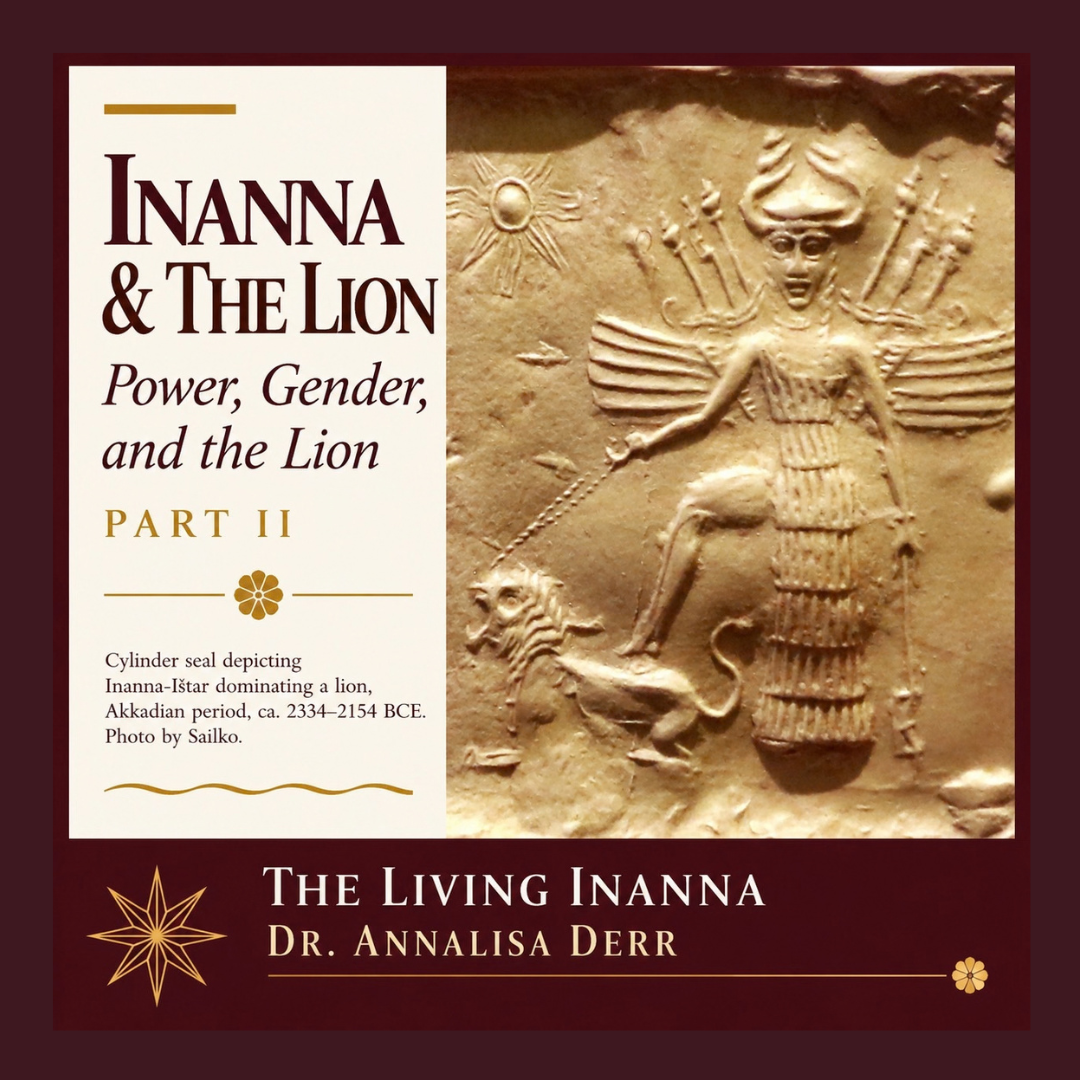
One of the most accessible ways for us to examine the lion’s role in relation to Inanna is psychologically. In one famous cylinder seal (pictured here) we see the warrioress Inanna-Ištar in full war regalia with one foot squarely placed on the lion’s back while holding the animal on a leash as she would a dog.
Are we to understand that she embodies the raw power of the lioness in a way that might frighten her enemies? Does the lion symbolize the ferocious, death-wielding and destructive power that was already native to Inanna’s essential divinity, perhaps even as an echo from her pre-patriarchal, early historic iteration? If the lion can be understood as an aspect of Inanna herself, perhaps her relationship to the lion offers us a model for reclaiming our own inner authority and enacting our agency. Or is it something even more mystical? Perhaps she is possessed by the spirit of the lion.
Political Dynamics & the Lion
In Sophus Helle’s translation of “The Exaltation of Inanna,” a famous hymn attributed to the world’s first named author, the high-priestess Enheduanna tells us that Inanna is “the Queen who rides astride a lion.” Are we to understand the lion is a symbol of royal authority, prestige, and economic power?
These visual and textual clues lead us into several potential political meanings. Is she getting ready to unleash her lion (or embodied lion power) on her enemies? Is she conquering the lion as a way to show her enemies that she dominates nature’s prime apex predator? Whether the lion represents a primal force she controls, embodies, possesses, or wields, its coupling with Inanna-Ištar presents her as a formidable Mistress of Dominion.
Gender Dynamics & the Lion
The gender dynamics here are vast. From one angle, Inanna’s lion affiliation in conjunction with her warrior persona already shows us how Inanna defies typical Mesopotamian gender roles. Rather than embody the ideal domesticated social roles and behaviors of the typical Mesopotamian woman, Inanna arguably represented the opposite: what Tikva Frymer-Kensky calls “the undomesticated woman.” Inanna was free to pursue the object of her attention, aggressively punish her enemies with force and conviction, and change the rules as she saw fit.
Conquest of the Lion:
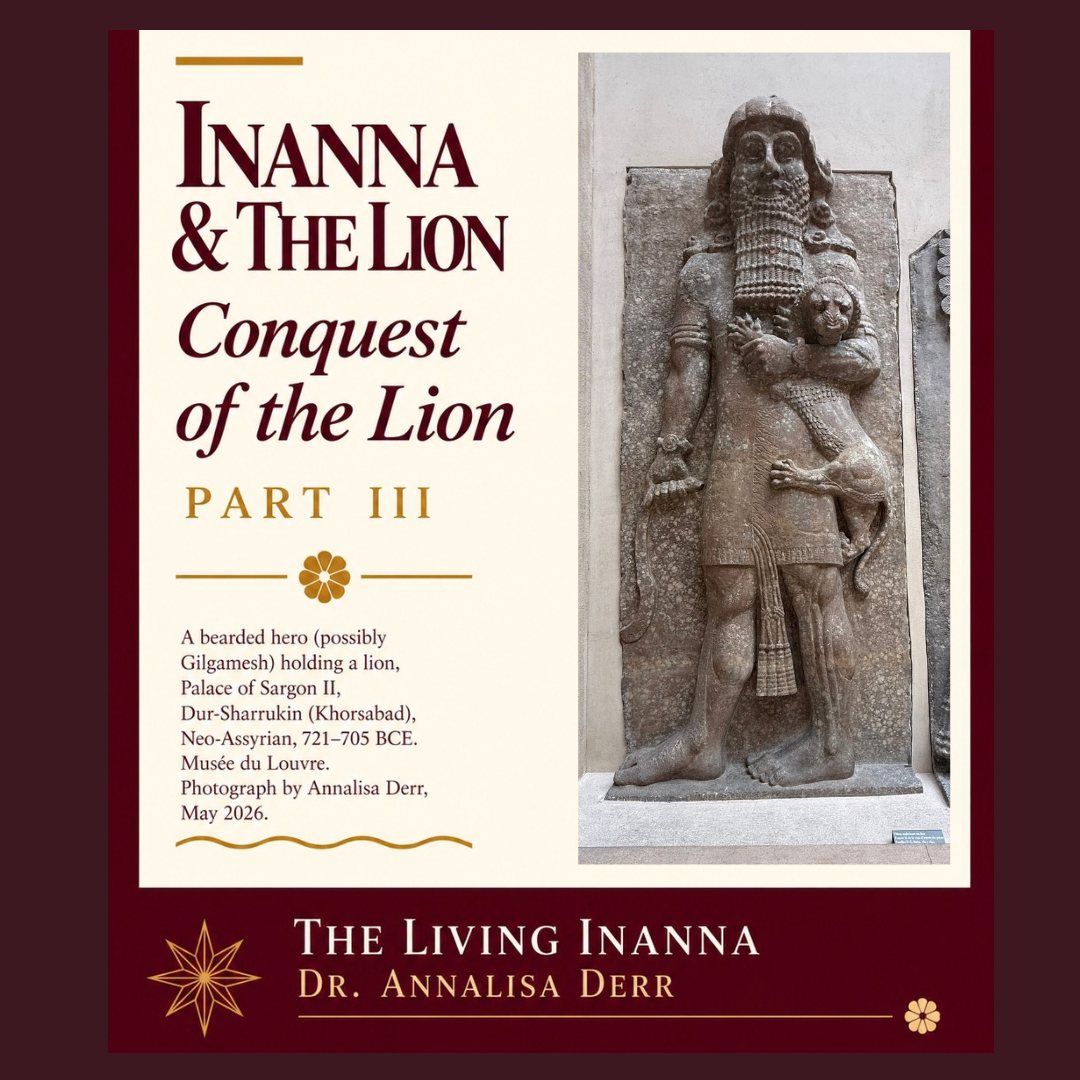
Something interesting happens in later myths and imagery that forebodes a change in the way Mesopotamians understood Inanna’s lion. For example, we see a large, looming relief of a warrior-king (possibly Gilgameš) conquering a lion. Because the lion is an ancient symbol associated with goddess worship that extends beyond Inanna, I read this imagery in relation to a much larger transitional moment in history, one laid out by several Goddess Studies scholars who came before me: the gradual conquest of Great Goddess worship and the rise of patriarchal male-god dominion.
In this instance, Great Goddess worship in Mesopotamia, once potentially associated with Inanna, was gradually displaced as Mesopotamian society became increasingly patriarchal in its social, political, and religious structures. In other words, I read the image of a gigantic hero (Gilgameš) subduing a ferocious lion as potentially symbolically representing the subjugation of Inanna and the sacred feminine power the lion once embodied.
🦁A Reflection Question:
What might Inanna’s changing relationship with the lion reveal about changing ideas of gender, power, and the sacred feminine?
I’ll also be diving more deeply into Inanna’s changing identity in my upcoming four-part course, The Living Inanna, offered through ISM.
📚Further Reading:
Choudhury, Raja, “Siddha Lakshmi” course on “A Thousand Suns Academy.”
De Shong Meador, Betty, “Inanna, Lady of the Largest Heart.”
Dexter, Miriam Robbins, “Ancient Felines and the Great-Goddess in Anatolia: Kubaba and Cybele.”
Frymer-Kensky, Tikva, “In the Wake of the Goddesses: Women, Culture, and the Biblical Transformation of Pagan Myth”
Gimbutas, Marija, “The Living Goddess.”
Helle, Sophus, “Enheduana: The Complete Poems of the World’s First Author.”
Shunya, Acharya, “Roar Like a Goddess: Every Woman’s Guide to Becoming Unapologetically Powerful, Prosperous, and Peaceful.”
Stuckey, Joanna “‘Inanna and the Huluppu Tree’: One Way of Demoting a Great Goddess.”
MY BOOK: Derr, Annalisa “Sovereign Menstrual Power: Embodying Cyclical Regeneration with the Goddess Inanna.”