
My Origin Story
I reached out to place my hand on the statue of Mary Magdalene one last time. As my hand made contact with her knee, a drop of water fell from the cave ceiling and landed on my third eye.
For a moment I froze. I could hardly believe that Mary Magdalene had communicated with me in such a direct yet profound way.
“I’ve been anointed,” I exclaimed quietly inside my head.
I looked around to see if anyone else had witnessed what had just happened. No one had. In that moment I realized it was a private exchange shared only between Mary and me inside her hidden cave sanctuary in the hills of Provence.
Two years prior to my journey to this Mary Magdalene cave, I experienced goddess worship for the first time while traveling through India. It was overwhelming. The goddess was worshipped not simply as a theological concept, but as an indwelling presence within people (especially women), animals, plants, and the earth.
In a moment of clarity—or perhaps divine grace—I saw the difference between this goddess-centric tradition and the goddess-phobic tradition I had grown up within. This moment of insight ignited in me the quest to find the missing goddess within the Christian tradition. Soon afterward, Mary Magdalene became my guide and companion on this journey.
My research over the next two years revealed that there was much more to her than the traditional stories (for example, she was not a harlot), which maligned and misrepresented her in ways that undermined women’s authority, humanity, and sacred roles within Christianity. I also wondered what this emergent version of Mary Magdalene might teach us about the missing goddess within Christianity. My next step became immediately clear: the only way to find the real Mary Magdalene was to travel to the places in France said to hold the stories of her life there. In that moment, my pilgrimage had begun.
The seed of anticipation is planted the moment a pilgrim answers the call to pilgrimage. Excitement and fear occupy her mind, painting endless fantasies of what might be—what she longs for and what she secretly dreads.
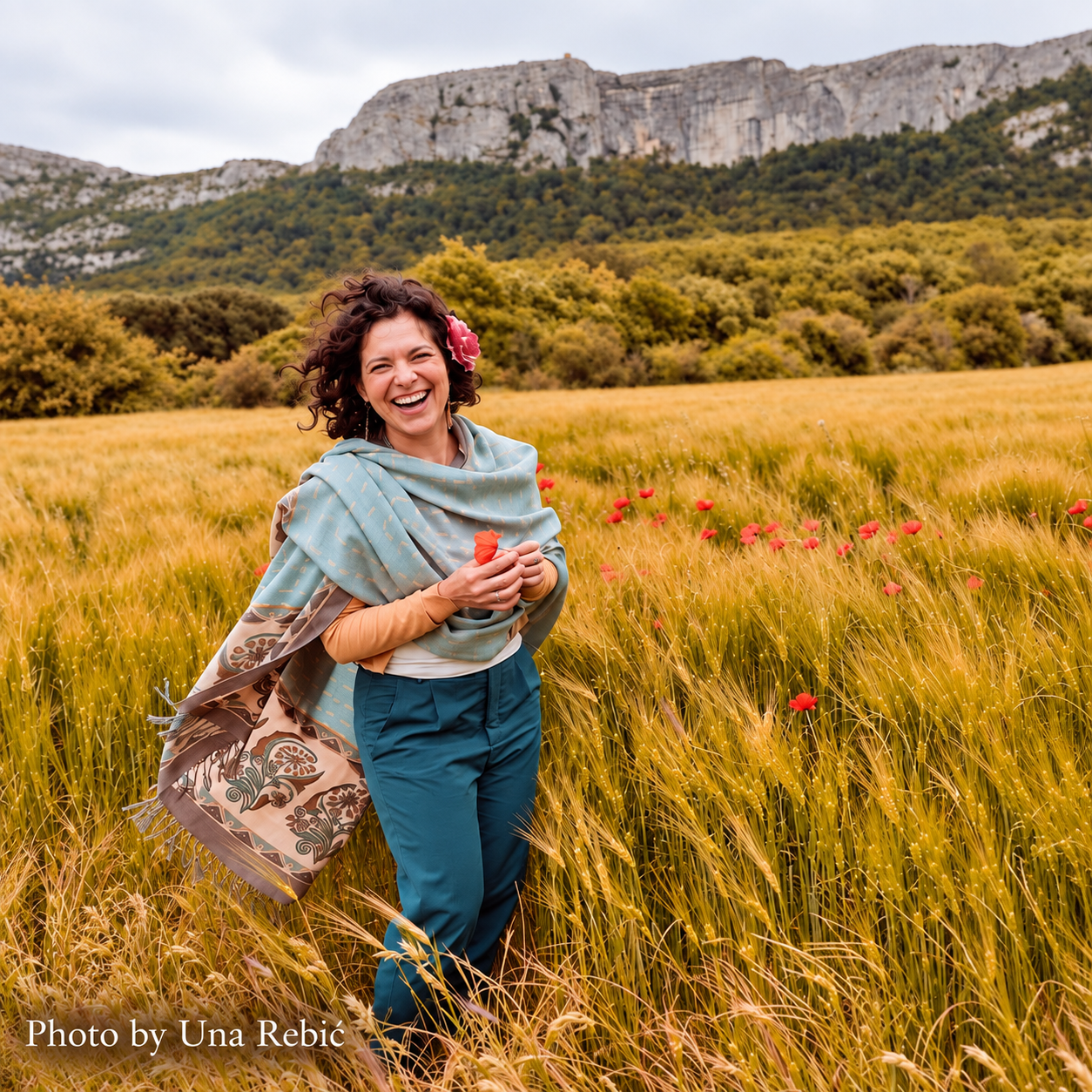
I arrived in France anticipating that I would find answers about Mary Magdalene that I could not find in the books I was reading. Yet, like any worthwhile journey, Magdalene gave me what I needed—not necessarily what I wanted.On the morning of my first visit, I set out on the hike with “the triple goddess Marie,” a daughter–mother–grandmother trio I had met at the communal breakfast hosted by the Dominican monastery that tends Magdalene’s cave. I gleefully spoke in Franglais as we traversed the rock-strewn path through the dense, ancient forest. As we approached the entrance to the cave, my heart raced. I eagerly awaited my encounter with Mary Magdalene.
The second and third visits were strikingly more challenging. My legs were sore from the first climb, and I had to stop frequently to catch my breath. Anticipation turned to impatience as I fought my bodily limitations. My sole desire was to be inside the cave, sitting before my favorite statue of Mary Magdalene.
Legend has it that Mary Magdalene spent the last thirty years of her life in deep prayer inside the cave in France.
When I arrived, the cave was dim, moist, and surprisingly spacious. Though she was no longer physically there, she made her presence gently known. Candles illuminated the statues of Mary Magdalene and the single relic above the reliquary, which seemed to glow with an otherworldly presence. The constant flow of pilgrims was evident. Dedicated plaques dating back to the 1800s—petitioning Mary Magdalene for aid—decorated the wall near the entrance. Red roses and small handwritten notes were tucked into the corners of her statues. I felt immensely honored to be one of the thousands of pilgrims who had made the trek to her sacred abode over the centuries.
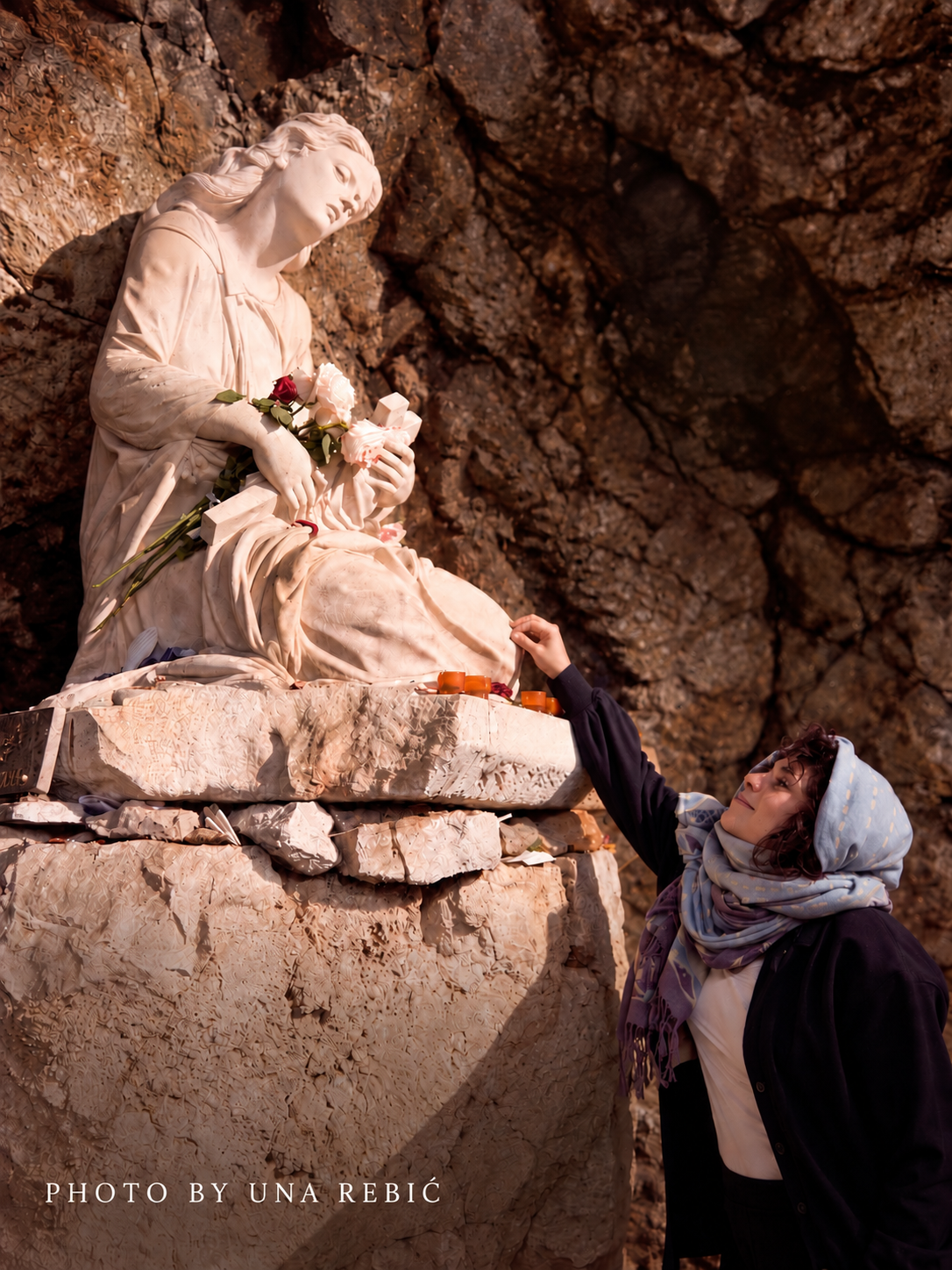
I took the stairs down to the lower level of the cave and walked toward my favorite Mary Magdalene statue to say goodbye. Her downward gaze met mine. I could almost feel her anguish as she gripped the cross in her hands, imploring pilgrims to bear witness to her heartbreak. I placed a handwritten message and a single red poppy in the crevice between her knee and the base of the statue.
I reached up to touch her statue one last time to thank her for guiding me there. And then it happened—my anointing.
That was my third and final visit to the cave in two days, and it was only the beginning of my pilgrimage. That morning I would leave to visit another site along the pilgrimage route: the church of Saint-Maximin, which houses the infamous golden-encased skull of Mary Magdalene. Despite my desire to remain within the warm embrace of Magdalene in that cave, I knew it was time to move on. The anointing moment in the cave felt like an initiation into the path of the Sacred Feminine. It was as if my unwavering devotion to finding the real Mary Magdalene—the most misunderstood woman at the heart of Christianity—had been witnessed and affirmed.
It became clear that my departure from my New York life had not been misguided. I had saved every dollar, worked double shifts as an actress moonlighting as a barista, and had given up my NYC apartment to make this journey possible. In that moment with Mary in her cave, I knew I had found my path.
At the end of my journey, I realized that my pilgrimage to find the “real” Mary Magdalene behind the biblical narrative was actually about me, not her. It taught me that pilgrimage is not simply a physical journey to sacred places. It is an inner journey of self-discovery.
Mary Magdalene was not my end result, but rather my guide on a journey to discover what it means to be a woman through the eyes of the world’s goddesses and their human heroine counterparts. Since then, I have approached my life as if I am on one continuous pilgrimage.
The invitation? To let pilgrimage become a way of life rather than a final destination.